

NHS Covid-19 app in England and Wales tweaked to notify fewer contacts
The app will look for contacts two days prior, rather than five, when someone without symptoms tests positive.
Health Secretary Sajid Javid said it would reduce disruption but still protect those at risk.
The government is urging the public to continue using the app.
It comes as the UK recorded another 21,952 new coronavirus cases in the last 24 hours, compared to 24,950 cases last Monday.
Another 24 deaths within 28 days of a positive test were reported, higher than the 14 recorded on the same day last week.
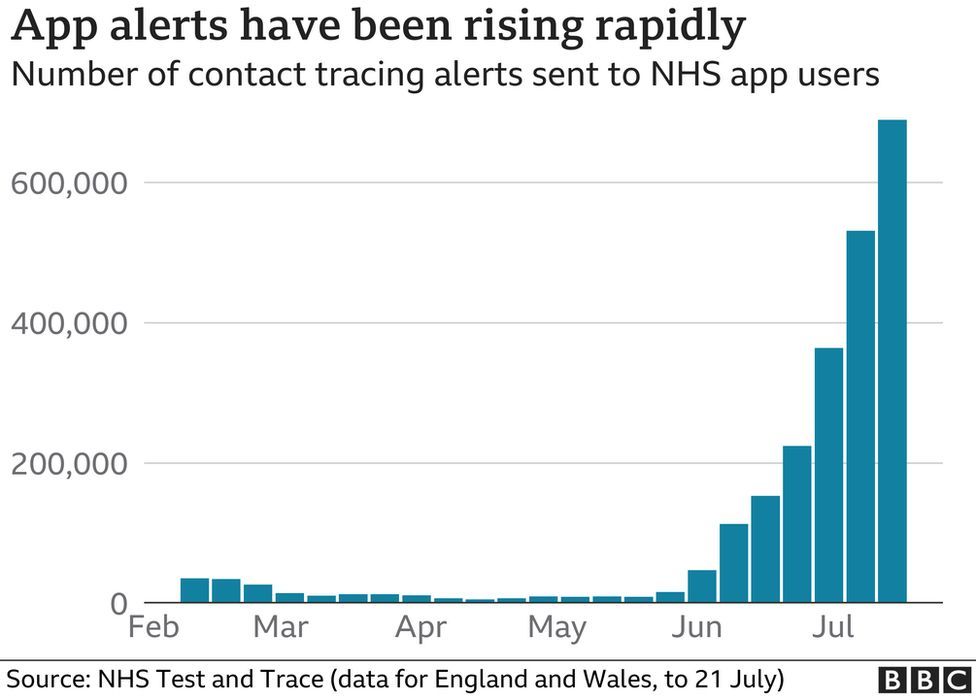
Almost 700,000 alerts were sent by the app to users in England and Wales for the week to July 21, a record since it was launched, which has caused staffing issues in many industries.
It led to the government allowing some key workers - such as those working in food distribution - to be exempt from having to self-isolate if pinged. Instead they have to take daily tests.
There had been speculation that the app could be made less sensitive to the distance between users and the length of time spent in close proximity - currently 2m or less and more than 15 minutes.
But the DHSC said the update "does not impact the sensitivity of the app, or change the risk threshold".
Trust still essential

There was speculation when Sajid Javid became the new health secretary just as the word "pingdemic" was entering the language that he would order changes to make the app less sensitive.
That was ruled out - but it seems Mr Javid asked what else could be done and was advised that the option unveiled on Monday would be wiser.
Cutting the period the app hunts back through the close contacts of an asymptomatic person before a positive test from five days to two could mean a substantial fall in the numbers sent into isolation.
There has been huge pressure for change from businesses which have seen their operations disrupted by thousands of pings - but at the same time the team behind the app believes it now has strong evidence that it is working.
The government will hope it has found a middle way, reducing the burden on businesses and making it less likely that people will delete the app while still alerting those in most danger of becoming infected with the virus and passing it on.
But, as with so much about this project, this is an experiment in human behaviour because for the app to work, people have to trust it.
Announcing the change, Mr Javid said: "We want to reduce the disruption that self-isolation can cause for people and businesses, while ensuring we're protecting those most at risk from this virus.
"This update to the app will help ensure that we are striking the right balance."
Dr Jenny Harries, of the UK Health Security Agency, said the app was "the simplest, easiest and fastest way to find out whether you have been exposed to the virus," and it had saved thousands of lives.
She said she would "strongly encourage everyone, even those fully vaccinated, to continue using the app".
It is unclear how many people will be affected by the tweak.
Scientists have estimated the app prevented up to 2,000 cases per day in the three weeks to 21 July when the number of self-isolation alerts - known as "pings" - rose by over 70,000 to a new record of 689,313.
And their analysis, which assumed 60% compliance with instructions to self-isolate, suggested another 50,000 Covid cases were prevented by including chains of transmission.
This was estimated to have prevented 1,600 hospitalisations, the Department of Health and Social Care (DHSC) said.
Around 40% of the eligible population regularly use the app and around 50% of all reported tests are being inputted, it said, saying usage remains "high".
Labour's shadow health minister Liz Kendall accused the government of "leaving hundreds of thousands of people forced to self-isolate every day" and quietly changing the app, rather than driving infections down.
Trade union Unite said the change did not go far enough and repeated a call from the automotive and steel sectors for workers to be exempt from self-isolation rules.
But the move has been welcomed by the British Beer and Pub Association, which said its research found up to 1,000 pubs had been forced to close temporarily due to staff being pinged by the app.
Its chief executive Emma McClarkin said: "On average, each pub forced to temporarily close due to staff being pinged costs £9,500 in lost trade per week and our larger venues much, much more at a critical time in their recovery."
From 16 August, fully vaccinated contacts in England will be exempt from isolation and instead will be advised to take a PCR test.
Those who are not fully vaccinated will still be required to isolate, and it will remain a legal obligation to isolate if you test positive.
On 7 August, Wales will become the first UK nation to stop asking fully vaccinated adults to self-isolate after close contact with a positive Covid case.
Meanwhile, a further 118,184 people received their second dose of a Covid-19 vaccine on Sunday, meaning nearly 38.5 million people - or 72.7% of the UK population - are now fully vaccinated.
But just 21,266 people received first doses, as the numbers coming forward for vaccination continued to slow down. A total of almost 46.9 million people, or 88.6% of adults, have had at least one jab.