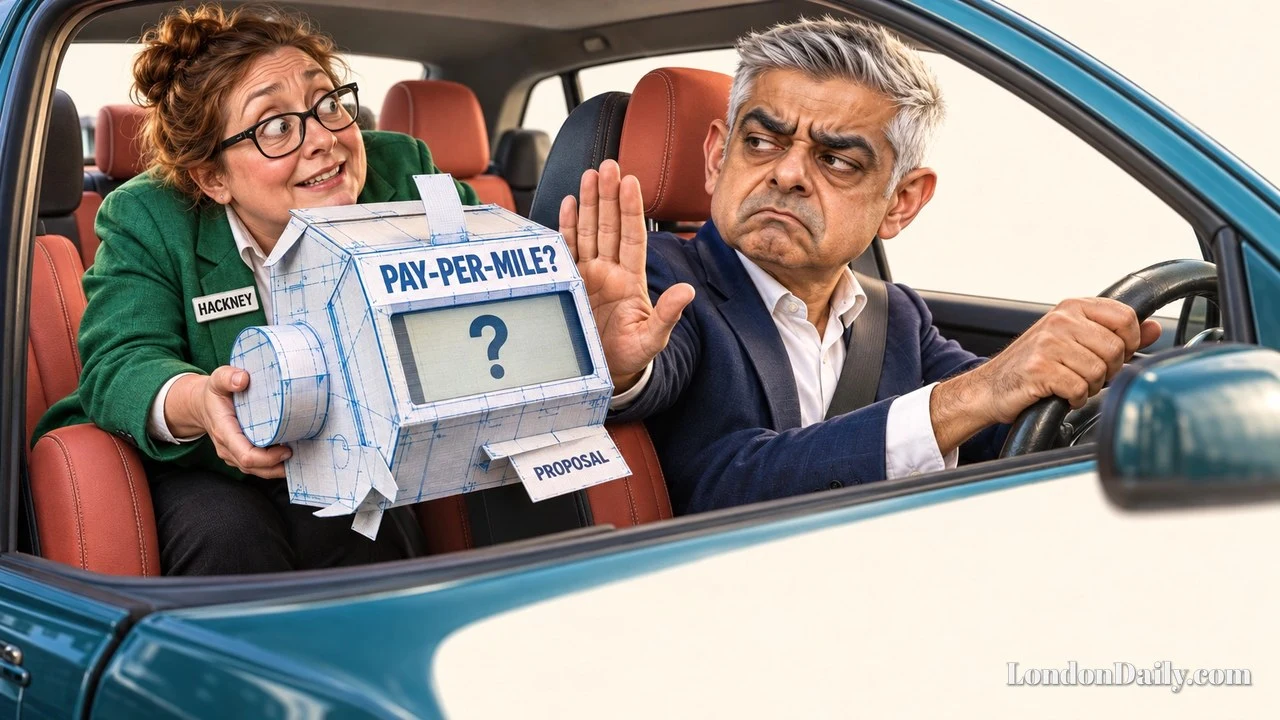
Hackney Council is considering lobbying for a London pay-per-mile road-charging pilot, despite Sadiq Khan’s pledge to rule out such a scheme while he remains mayor.
The Green-led borough’s proposal comes as Britain prepares to introduce a separate mileage-based tax on electric and hybrid vehicles in 18 months. The distinction matters: the national tax is already planned, while Hackney’s position is to consider pressing for smart road pricing, either through a London trial or nationally. It does not amount to an approved pilot.
The council said it would continue to engage in the road-user charging debate and consider lobbying for systems such as pay-per-mile. Khan, however, is understood to have no plans for City Hall to introduce it. “As long as I am Mayor, we are not going to have pay-per-mile,” he has said.
Shadow transport secretary Richard Holden accused the Greens of wanting to work with Labour to make London a testing ground. “These are the politics of the bonkers war on motorists, dreamed up by people who seem to think driving is a luxury,” he said.
The national Electric Vehicle Excise Duty, or eVED, was announced in last year’s Budget. It is intended to compensate for electric motorists not paying fuel duty, while their vehicles still contribute to congestion and road wear.
Fully electric and hydrogen-powered vehicles will attract a charge of 3p per mile; hybrids will pay 1.5p. Rates will rise annually with inflation, and the charge will sit on top of existing Vehicle Excise Duty.
The tax will apply to 2.3 million fully electric vehicles and more than 2.7 million hybrids across the UK, including more than 190,000 and over 300,000 respectively in London. Treasury receipts are expected to reach £1 billion in 2028/29, rising to £2.3 billion within three years.
Motorists will declare estimated annual mileage and current readings when renewing their vehicle tax. They can pay upfront or in instalments, with year-end readings used to reconcile the bill.
For many electric-car buyers, the counterargument is financial: they paid higher purchase prices expecting substantially lower running costs. Warnings of a “poll tax on wheels” invoke the backlash against the council tax predecessor that contributed to Margaret Thatcher’s downfall in 1990.
Existing charges remain significant. Standard annual VED is £200 for petrol, diesel and hybrid cars registered from 1 April 2017. Cars originally listed above £40,000, or £50,000 for electric models, may also attract a £440 Expensive Car Supplement. The planned mileage charge adds another cost; whether London should separately trial wider road pricing remains unresolved.








Join the conversation