

UK students want tuition fees refunded as they face third year online
Students are facing a third successive year of online learning, after an Observer analysis suggested that most universities are planning to offer a mix of in-person seminars and online lectures when term begins again this autumn.
It prompted fresh calls for students to be refunded at least part of the fees they are charged each year if they are mostly taught online. The exact blend of teaching will depend on social distancing rules and whether young people are double-vaccinated in time.
“It’s just not fair to charge £9,250 a year for YouTube tutorials,” said Rhian Shillabeer, a second-year politics student who wrote an open letter to her university, Kent, signed by hundreds of students. Shillabeer, who was angered that all three years of her degree would be disrupted by the pandemic, called for universities to prioritise in-person learning.
Most universities are planning to offer students a mix of in-person seminars and online lectures this autumn. The exact blend will depend on social distancing rules and whether young people are double vaccinated in time.
University bosses are understood to be frustrated at how slow the government has been to confirm plans for September, with guidance on campus social distancing still not published. The delay, combined with pressure from the regulator, the Office for Students, to be more transparent, means students have been left confused by communications from universities outlining possible scenarios for the autumn, ranging from near normal to mostly online depending on the progress of the vaccination drive, the emergence of new variants and social distancing rules.
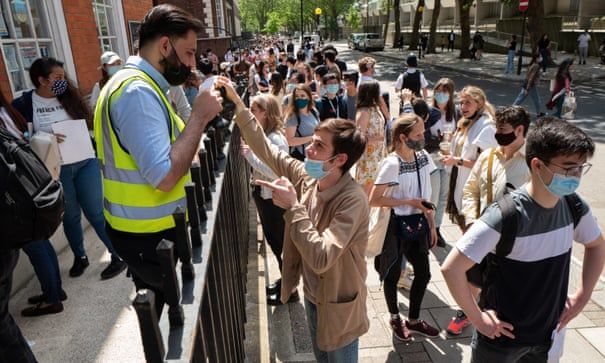 Thousands of UCL students turn up for their Covid jab in Bloomsbury this month.
Vice-chancellors from the Russell Group of research-intensive universities have urged the government to support the rollout of pop-up vaccination centres on campuses at the start of the autumn term.
This would help prevent a repeat of the Covid outbreaks which last year left thousands of students feeling angry and isolated as they were forced to lock down in small rooms in halls of residence.
Charlie Jeffrey, the vice-chancellor of York University, said: “The biggest thing is vaccination. That’s a precondition for universities operating as close to normal as we would wish them to. I’d like the government to see that as a priority, given the disruption university students have had to face. We’ve too often been an afterthought for the government, and students have felt that and are not happy about it.”
Jeffrey said although York was considering which buildings could be repurposed for classes in the event of one-metre social distancing, delivering all teaching in-person would not be possible. “We can’t build buildings in that short a space of time,” he said.
The survey of 17 universities by the Observer showed that many are planning for two main scenarios: one in which social distancing rules have been ended, meaning campuses return to close to normal, and the other in which one-metre distances must be observed, which would cut capacity in university buildings – potentially by a quarter – and force more teaching online.
Some universities are clear about their plans, such as Cardiff, which said all classes over 60 people will be online, while others are more vague, including Durham, which said the mix of online and in-person would depend on the course and year of study, and UCL, which said some modules would be completely online while others will be taught using a blend of online and in-person.
David Gordon, the general secretary of London School of Economics’ student union, who has been leading student efforts to negotiate a discount on tuition fees, predicted that another year of disruption would result in renewed calls for refunds.
“I think students will put up with a bit of online learning,” he said. “But if students are barred from campuses, not getting in-person teaching or building connections with each other or faculty you could see an increase in calls for compensation.”
Gordon added that students have appreciated efforts from universities to be more transparent with their students. “But I know there are a lot of discontented students at universities where they haven’t done such a good job,” he said.
“Universities which have been hit by the pandemic more harshly, which are struggling with their finances and ability to provide teaching, that’s where communications have been more disparate, and students feel angry and forgotten.”
The Department for Education was asked for comment, but did not respond.