London Daily

Focus on the big picture.
Thursday, Jul 23, 2026

UK economy shrank more than previously thought

UK economy shrank more than previously thought

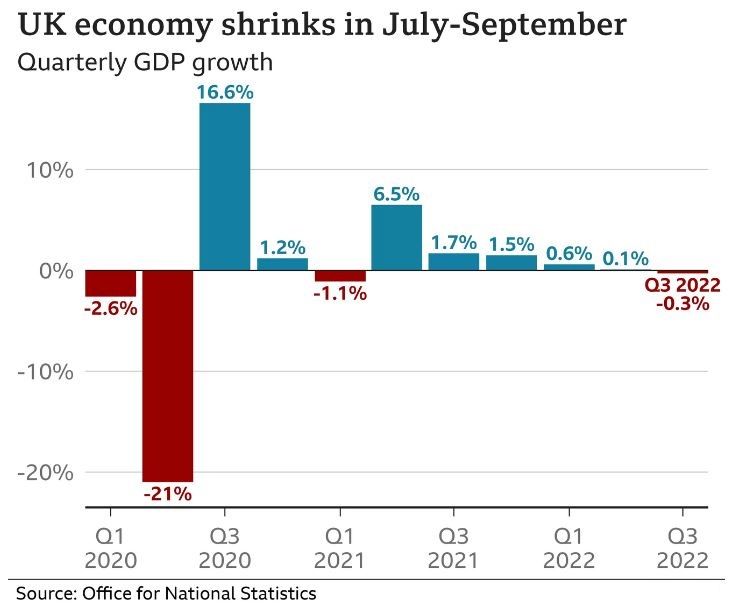
The UK economy shrank by more than first thought in the three months to September, revised figures show.

The economy contracted by 0.3%, compared with a previous estimate of 0.2%, as business investment performed worse than first thought, the Office for National Statistics (ONS) said.

Growth figures for the first half of 2022 have also been revised down.

The UK is forecast to fall into recession in the final three months of the year as soaring prices hit growth.

A country is considered to be in recession when its economy shrinks for two three-month periods - or quarters - in a row. Typically companies make less money, pay falls and unemployment rises, leaving the government with less money in tax to use on public services.

Darren Morgan, director of economic statistics at the ONS, said: "Our revised figures show the economy performed slightly less well over the last year than we previously estimated", with manufacturing "notably weaker".

He added that household incomes, when accounting for rising prices, continued to fall, and household spending "fell for the first time since the final Covid-19 lockdown in the spring of 2021".

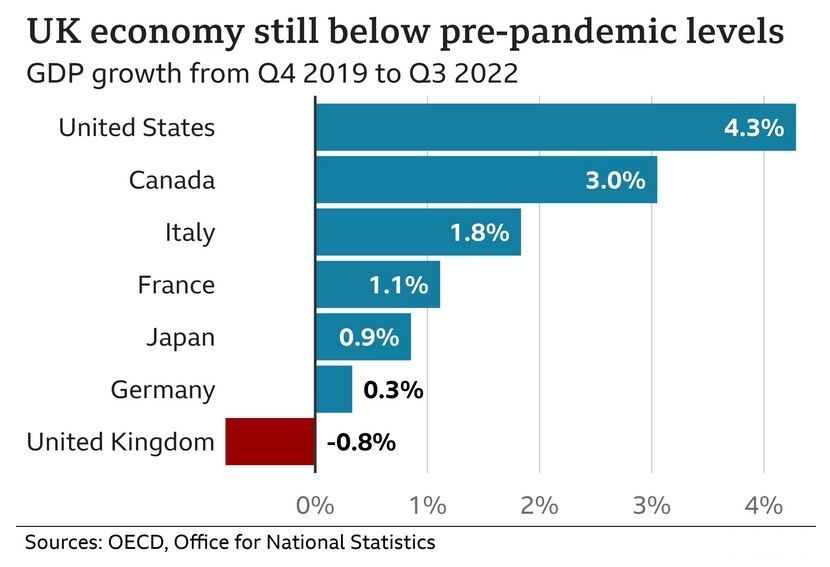
The ONS said that gross domestic product (GDP) - the measure of the size of the economy - was now estimated to be 0.8% below where it was before the pandemic struck, downwardly revised from the previous estimate of 0.4% below.

The economy has been hit as surging energy and food prices push inflation - the rate at which prices rise - to its highest level in 40 years.

It means that consumers are spending less and businesses are cutting investment.

Along with its revision for the July-to-September period, the ONS said the economy also grew less than first estimated in the first half of the year - expanding by 0.6% in the first quarter and 0.1% in the second quarter.

The ONS has previously said growth stood at 0.7% and 0.2% in those quarters respectively.

It is not unusual for the ONS to revise its growth estimates. It produces a first estimate of GDP about 40 days after the quarter in question, at which point only about 60% of the data is available, so the figure is revised later as more information comes in.

Last week, figures from the ONS indicated that the economy shrank by 0.3% over the August-to-October period.

The government's independent forecaster, the Office for Budget Responsibility (OBR), has warned that the UK will fall into a recession "lasting just over a year".

The OBR has predicted that the economy will shrink by 1.4% in 2023 before growth gradually picks up again.

As a result it expects the unemployment rate to rise and house prices to fall sharply as the Bank of England puts up interest rates to control soaring prices.

Last week, the Bank raised its key rate to 3.5%, the highest level for 14 years, which is pushing up repayment costs for people with mortgages and loans.

The UK is not the only country seeing its economy slow down, with the US and eurozone also expected to fall into recession next year.

However, Gabriella Dickens from Pantheon Macroeconomics said she expected the UK to "suffer the deepest recession among major advanced economies in 2023".

Chancellor Jeremy Hunt blamed Vladimir Putin's invasion of Ukraine for the economic difficulties.

"High inflation driven by Putin's invasion of Ukraine is slowing economic growth across the world. No country is immune, least of all Britain," he said.

But responding to the latest ONS figures, Labour's shadow chancellor Rachel Reeves accused the government of losing control over the economy.

"GDP data has been revised down, leaving the UK with the worst growth in the G7 in the last quarter," she tweeted.

"The Tories have lost control of the economy and are leaving millions of working people paying the price."

Newsletter

Related Articles

0:00
0:00
Close
UK Government Reviews Long-Term Balance Between Cost Relief, Industry Support, and Public Investment Priorities
BBC Could Receive Permanent Royal Charter Under Government Proposal
Northern Ireland Proposes End to Severe Weather Exemptions for Electricity Compensation Rules
Andy Burnham Holds Talks With UK Devolved Leaders on Regional Cooperation and Devolution
House of Lords Launches Inquiry Into Risks Facing UK Democratic Institutions
ScottishPower Renewables Plans Major Rebuild of Whitelee Wind Farm With Fewer Larger Turbines
UK and Italy Leaders Discuss Global Combat Air Programme and Future European Cooperation
UK Government Announces Six Hundred Million Pound Aerospace Investment Package at Farnborough Airshow
European Union Approves UK Participation in Ninety Billion Euro Ukraine Support Loan Framework
Rolls-Royce Warns UK Government Over Jet Engine Funding Decision and Future Manufacturing Plans
UK Inflation Falls to Two Point Six Percent in June as Fuel and Food Prices Ease
Andy Burnham Begins Premiership With Two Pound England Bus Fare Cap and Electricity Tax Cut Plan
YouGov Poll Shows Tight Competition Among UK Political Parties
Space Technology Investment Expands Through UK-US Cooperation at Farnborough Airshow
UK Opens Final India Young Professionals Scheme Ballot for Three Thousand Applicants
United Kingdom Approved for Ukraine Financial Support Initiative With EU Partners
UK and Ireland Leaders Discuss Security, Energy and Regional Cooperation
British Heart Foundation Identifies Ten UK Areas With Severe Shortages of Defibrillators
Former Southern Water Executives Charged Over Alleged Water Test Manipulation Scheme
IMF Warns UK Economic Growth Will Slow to One Percent in 2026
UK Inflation Falls to Two Point Six Percent in June as Food and Energy Costs Ease
United Kingdom Joins European Union Loan Mechanism to Support Ukraine’s Defense Needs
Prime Minister Andy Burnham Introduces Two-Pound Bus Fare Cap and Energy Tax Relief Measures Across England
Northern Ireland Secures Additional Infrastructure Funding From UK Treasury
Wales Approves Port Investment Plans to Support Green Energy Supply Chains
UK Financial Regulator Simplifies Stock Market Rules to Attract More Listings
UK Reports Decline in Small Boat Crossings Across the English Channel
UK Government Creates Emergency Support Fund for Financially Pressured Universities
Scottish Government Launches Economic Strategy Focused on Innovation and Renewable Industries
UK Expands Sustainable Farming Incentives to Support Environmental Measures
UK Government Introduces New Neighbourhood Policing Standards Across England and Wales
UK Competition Regulator Opens Review of Artificial Intelligence Foundation Models
UK Deepens Indo-Pacific Security Cooperation After Talks With Singapore and Japan
UK Announces Rail Modernisation Plan for Northern England With New Infrastructure Funding
UK Government Updates Housing Planning Rules to Accelerate Residential Construction
UK Approves Major North Sea Offshore Wind Project to Support Clean Power Goals
UK Health Service Begins Major Digital Upgrade to Cut Hospital Waiting Times
Bank of England Holds Interest Rates Steady as UK Inflation Pressures Remain Persistent
UK Universities and Industry Expand Space and Defense Research Partnerships
House of Lords Approves Social Housing Bill Amendments on Shared Ownership Rights
House of Lords Advances Civil Aviation Bill With New Passenger Protection Measures
UK Government Suspends Tariffs on Fertilizer and Food Imports to Reduce Costs
Russell Group Universities Support New UK Business Department Focused on Innovation
UK Parliament Opens Inquiry Into Transport Barriers Facing Young Jobseekers
Home Builders Federation Calls for Lower Costs as New UK Government Sets Housing Priorities
Andy Burnham Meets UK Devolved Leaders to Strengthen Regional Cooperation
Andy Burnham Holds First International Calls With Trump, Macron, and Zelenskyy
Andy Burnham Reshuffles Cabinet With John Healey Appointed Chancellor of the Exchequer
Andy Burnham Government Removes VAT From Electricity Bills to Cut Household Costs
Andy Burnham Becomes United Kingdom Prime Minister After Sir Keir Starmer Resigns
×