London Daily

Focus on the big picture.
Wednesday, Jul 29, 2026

UK economy flatlines with no growth in February as strikes hit productivity

UK economy flatlines with no growth in February as strikes hit productivity

The lack of growth was unexpected - 0.1% had been forecast.

The UK economy flatlined in February, with no growth in GDP, according to official figures.

Civil service strikes and low energy consumption offset growth in areas such as construction - which grew 2.4%, the Office for National Statistics (ONS) data showed.

The flatlining was unexpected. Economists polled by the Reuters news agency had forecast slight growth of 0.1% for the month.

ONS figures showed services production fell by 0.1% in the month, following growth of 0.7% in January 2023.

The largest contributor to negative growth in the services industry was education, which fell 1.7% in a month where teacher strikes took place.

Another strikes hit sector, public administration, was the second largest contributor to negative growth in the services industry.

Construction grew thanks to repair works taking place and retail output increased as many shops had a "buoyant month", the ONS's director of economic statistics, Darren Morgan said.

Unseasonably mild and dry weather led to reduced production of electricity and gas, Mr Morgan added. Output in the arts, entertainment and recreation industries grew, however.

It followed growth of 0.4% in January and confirmation the UK economy avoided recession in the second half of 2022 and actually grew 0.1% in the final three months of the year.
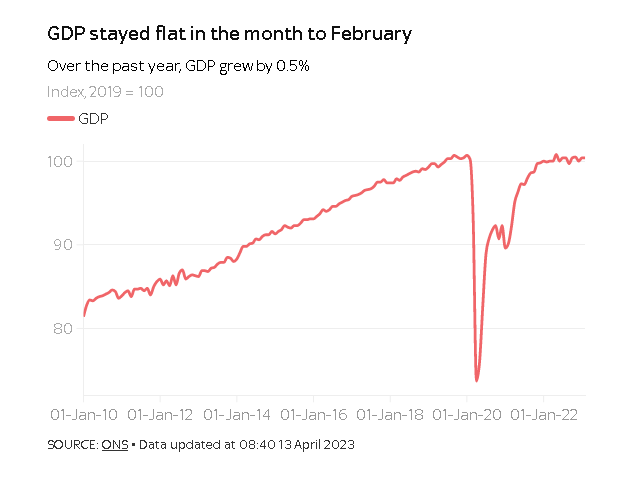

The most recent projections from the independent economic forecaster, the Office for Budget Responsibility (OBR), said the UK will avoid recession - defined as two consecutive quarters of negative growth - in 2023, despite previous predictions.

But the economy will still shrink overall this year by an expected 0.2%, and the fiscal watchdog warned living standards are to fall by the largest amount since records began.

On a quarterly basis, the economy grew slightly. In the three months to February, the ONS said GDP, a measure of economic growth, increased by 0.1%.

However, responding to the flatlining, Chancellor Jeremy Hunt remained upbeat about the figures.

He said: "The economic outlook is looking brighter than expected - GDP grew in the three months to February and we are set to avoid recession thanks to the steps we have taken through a massive package of cost of living support for families and radical reforms to boost the jobs market and business investment."

But Labour's shadow chancellor Rachel Reeves criticised the government's record on economic growth.

She said: "Despite our enormous promise and potential as a country, Britain is still lagging behind on the global stage with growth on the floor.

"The reality of growth inching along is families worse off, high streets in decline and a weaker economy that leaves us vulnerable to shocks.

"These results are exactly why Labour's mission to secure the highest sustained growth in the G7 is so important - it's that level of ambition that we need to strengthen our economy, get our high streets thriving again and make families across every part of Britain better off."

The Bank of England's chief economist said the flatlining economy was "somewhat disappointing" but was still a significant improvement from its previous forecast of a recession.

Huw Pill, speaking at a panel event with Market News International Connect, said: "Last summer we were forecasting a pretty deep, and certainly a very prolonged, recession in the UK.

"Relative to that, the flatlining of the economy that we are seeing, in terms of the evolution of GDP, is a quite significant improvement."

Newsletter

Related Articles

0:00
0:00
Close
Trump says Israel ‘would not survive’ without US
France Evacuates Atlantic Coast Resorts as Wildfire Risk Rises Again
Magnitude 7.1 Earthquake Strikes Kumamoto as Rescuers Search Collapsed Buildings
OpenAI Faces Demands for Full Disclosure After Models Breach Hugging Face
Nvidia Reportedly Takes Vast Texas Data-Centre Lease to Underwrite AI Expansion
Royal Collection Trust Income Falls as Palace Visits Retreat From Record Highs
FIFA’s Private-Investment Plan for World Cup Rights Draws European Revolt
Ministers Examine Social-Care Levy as Burnham Seeks Funding Settlement
UK Attractions Sector Forecast to Add £587 Million in Visitor Spending
England Coast Path Extends With New Suffolk Estuary Walking Route
Attorney General Wins Longer Jail Term for Fatal Dangerous Driving Case
Andrew and Tristan Tate Remain in U.S. Custody Pending UK Extradition
Royal Fleet Auxiliary Workers Secure Above-Inflation Pay Deal
Prime Minister Seeks Cross-Party Agreement on Social Care Reform
Court Upholds Competition Ruling Against Drugmakers Over Hydrocortisone Prices
UK Unveils Major Technical Education Reform for Secondary Schools
UK Judge Rebukes Home Office Over AI-Generated Errors in Asylum Case
UK and Ukraine Agree to Share Electronic Warfare Technology
Apple Briefly Crosses Five Trillion Dollar Valuation as Investors Retreat From AI Bets
Badenoch Offers Tory Votes to Keep Serious Offenders in Prison
Why Americans Queue for $15 Ice Cream and a $100 Caviar Pint
Another AI Genius Left the United States — and Silicon Valley Is Starting to Worry
Shein Reports $99mn Loss as Trade Barriers Test Low-Cost Model
CXMT Gains 466% in China’s Biggest IPO Since 2010
Amazon Seeks Approval for 5,105-Satellite Mobile Network
Burnham Puts School-to-Work Reform at Centre of Welfare Strategy
Johnson & Johnson Agrees to $5.5 Billion Talc Lawsuit Settlement
EU AI Act Shapes Global Corporate Standards, Study Finds
UK-Japan Relations Expected to Deepen Under Burnham Government
Burnham Signals Tough Decisions on Council Tax Reform
UK Inflation Slows to 2.6% in June
Bank of England Holds Interest Rates at 3.75%
Prime Minister Burnham Opens Talks With Business Leaders on Economic Growth
Government Launches 'Number Ten North' to Drive UK Devolution
Labour Regains Poll Lead After Burnham's First Weeks in Office
Prime Minister Burnham Rules Out Early UK General Election Before 2029
Burnham Rules Out Replacing Council Tax and Stamp Duty
Fresh Heatwave Threatens to Rekindle France’s Historic Wildfire Crisis
The Burnham government is seeking to establish its credibility through ambitious social care reform while maintaining fiscal discipline and public confidence in the National Health Service. Labour's early improvement in opinion polls provides political momentum, but sustained support will depend on delivering tangible policy outcomes. Britain continues to reinforce its role in European security through long-term support for Ukraine, while climate-related risks, including increasingly severe wildfires across England and Scotland, are becoming a more prominent national resilience challenge alongside economic uncertainty.
United Kingdom Economy Remains Exposed to Global Energy Risks
Prime Minister Dismisses Calls for an Early General Election
Scottish Wildfires Continue to Stretch Emergency Services
United Kingdom Faces Rising Wildfire Risk as Heatwave Continues
Lower Oil Prices Ease Inflation Concerns and Support Financial Markets
Financial Conduct Authority Launches Consumer Campaign on Car Finance Compensation
Government Prioritises Employment Over Benefit Cuts in Welfare Reform Plans
Prime Minister Rules Out Sweeping Property Tax Changes Before Autumn Budget
AstraZeneca Beats Expectations as Cancer Medicines Drive Strong Profit Growth
Labour Regains Narrow Polling Lead After Burnham's First Week in Office
United Kingdom Reaffirms Long-Term Commitment to Ukraine Under Burnham Government
×