London Daily

Focus on the big picture.
Thursday, Jul 23, 2026

Thailand legalises cannabis trade but still bans recreational use

Thailand legalises cannabis trade but still bans recreational use

People in Thailand can now grow cannabis plants at home and sell the crop after the nation removed marijuana from its banned narcotics list.

It's now legal to grow cannabis plants and buy marijuana-infused dishes in Thailand

The nation is the first to advance such a move in South-East Asia, a region known for its stringent drug laws.

But recreational use is still banned, even though advocates say the easing effectively decriminalises marijuana.

The government is hoping that developing a local cannabis trade will boost agriculture and tourism.

It's even giving away one million cannabis seedlings to citizens to encourage pick-up.

"It is an opportunity for people and the state to earn income from marijuana and hemp," said Anutin Charnvirakul, deputy prime minister and health minister, on his social media accounts last month.

He shared a photo on Facebook of a chicken dish cooked with cannabis, adding that anyone could sell the dish if they followed the rules - the main one being that products must contain less than 0.2% of tetrahydrocannabinol (THC), the compound that gives users that "high" feeling.

From Thursday, households will be able to cultivate up to six cannabis pot plants at home if they register with authorities, and companies can also farm the plant with a permit.

Diners will also be able to order cannabis-infused dishes and drinks at restaurants.
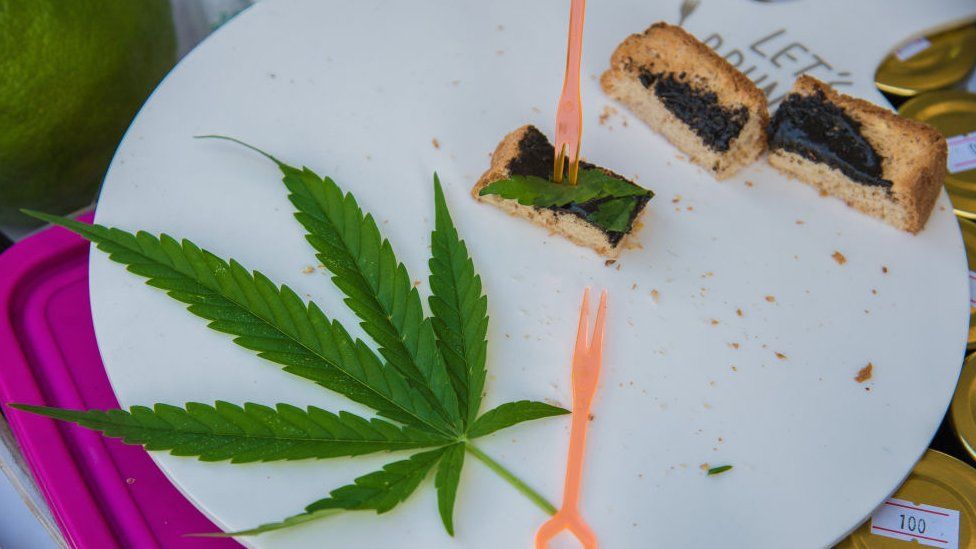
Restaurants will able to freely offer cannabis-infused menus


Clinics across the country can also more freely offer cannabis as a treatment. Thailand was the first in Asia to legalise medicinal cannabis use in 2018.

However, using the drug for personal use is still illegal. Officials have warned people against smoking in public, saying it's considered a public nuisance and offenders risked arrest.

Under the plan the government says it also aims to release about 4,000 prisoners convicted of cannabis-related offences.

Thailand, with its year-round tropical climate, has long had a history with cannabis which many locals commonly used in traditional medicines.

A wider draft law on cannabis control is currently being considered in Thai parliament. Advocates believe that coming years could see a gradual relaxing on the rules governing use.


So is it legal or isn't it? As Thailand's tourist economy recovers from its long Covid slumber, many visitors will be wondering whether the new liberal regime governing cannabis means they can light up a joint wherever and whenever they please.

The answer from the government is no, you cannot smoke marijuana in public, and it is still illegal to sell or supply any products containing more than 0.2% of the main hallucinogenic compound THC.

The official goal is for Thailand to get a head start on its neighbours in winning a large slice of the lucrative market for health treatments using cannabis derivatives, in particular the milder compound CBD. But there is another motive; to reducing overcrowding in some of the world's most overcrowded jails.

Which means, in theory, with cultivation of the plant in any quantities now completely legalised, that the police are now unlikely to arrest people just for possession of marijuana.

Already there are hundreds of businesses in Thailand, operating even before the new law, offering a whole range of marijuana products, like restaurants putting the leaves in Thai curries. It is hard to see how the authorities can regulate how much THC they contain.

The government insists they are permitting production and consumption solely for medical, not recreational purposes, but in practice that line is already blurred.

Newsletter

Related Articles

0:00
0:00
Close
UK Government Reviews Long-Term Balance Between Cost Relief, Industry Support, and Public Investment Priorities
BBC Could Receive Permanent Royal Charter Under Government Proposal
Northern Ireland Proposes End to Severe Weather Exemptions for Electricity Compensation Rules
Andy Burnham Holds Talks With UK Devolved Leaders on Regional Cooperation and Devolution
House of Lords Launches Inquiry Into Risks Facing UK Democratic Institutions
ScottishPower Renewables Plans Major Rebuild of Whitelee Wind Farm With Fewer Larger Turbines
UK and Italy Leaders Discuss Global Combat Air Programme and Future European Cooperation
UK Government Announces Six Hundred Million Pound Aerospace Investment Package at Farnborough Airshow
European Union Approves UK Participation in Ninety Billion Euro Ukraine Support Loan Framework
Rolls-Royce Warns UK Government Over Jet Engine Funding Decision and Future Manufacturing Plans
UK Inflation Falls to Two Point Six Percent in June as Fuel and Food Prices Ease
Andy Burnham Begins Premiership With Two Pound England Bus Fare Cap and Electricity Tax Cut Plan
YouGov Poll Shows Tight Competition Among UK Political Parties
Space Technology Investment Expands Through UK-US Cooperation at Farnborough Airshow
UK Opens Final India Young Professionals Scheme Ballot for Three Thousand Applicants
United Kingdom Approved for Ukraine Financial Support Initiative With EU Partners
UK and Ireland Leaders Discuss Security, Energy and Regional Cooperation
British Heart Foundation Identifies Ten UK Areas With Severe Shortages of Defibrillators
Former Southern Water Executives Charged Over Alleged Water Test Manipulation Scheme
IMF Warns UK Economic Growth Will Slow to One Percent in 2026
UK Inflation Falls to Two Point Six Percent in June as Food and Energy Costs Ease
United Kingdom Joins European Union Loan Mechanism to Support Ukraine’s Defense Needs
Prime Minister Andy Burnham Introduces Two-Pound Bus Fare Cap and Energy Tax Relief Measures Across England
Northern Ireland Secures Additional Infrastructure Funding From UK Treasury
Wales Approves Port Investment Plans to Support Green Energy Supply Chains
UK Financial Regulator Simplifies Stock Market Rules to Attract More Listings
UK Reports Decline in Small Boat Crossings Across the English Channel
UK Government Creates Emergency Support Fund for Financially Pressured Universities
Scottish Government Launches Economic Strategy Focused on Innovation and Renewable Industries
UK Expands Sustainable Farming Incentives to Support Environmental Measures
UK Government Introduces New Neighbourhood Policing Standards Across England and Wales
UK Competition Regulator Opens Review of Artificial Intelligence Foundation Models
UK Deepens Indo-Pacific Security Cooperation After Talks With Singapore and Japan
UK Announces Rail Modernisation Plan for Northern England With New Infrastructure Funding
UK Government Updates Housing Planning Rules to Accelerate Residential Construction
UK Approves Major North Sea Offshore Wind Project to Support Clean Power Goals
UK Health Service Begins Major Digital Upgrade to Cut Hospital Waiting Times
Bank of England Holds Interest Rates Steady as UK Inflation Pressures Remain Persistent
UK Universities and Industry Expand Space and Defense Research Partnerships
House of Lords Approves Social Housing Bill Amendments on Shared Ownership Rights
House of Lords Advances Civil Aviation Bill With New Passenger Protection Measures
UK Government Suspends Tariffs on Fertilizer and Food Imports to Reduce Costs
Russell Group Universities Support New UK Business Department Focused on Innovation
UK Parliament Opens Inquiry Into Transport Barriers Facing Young Jobseekers
Home Builders Federation Calls for Lower Costs as New UK Government Sets Housing Priorities
Andy Burnham Meets UK Devolved Leaders to Strengthen Regional Cooperation
Andy Burnham Holds First International Calls With Trump, Macron, and Zelenskyy
Andy Burnham Reshuffles Cabinet With John Healey Appointed Chancellor of the Exchequer
Andy Burnham Government Removes VAT From Electricity Bills to Cut Household Costs
Andy Burnham Becomes United Kingdom Prime Minister After Sir Keir Starmer Resigns
×