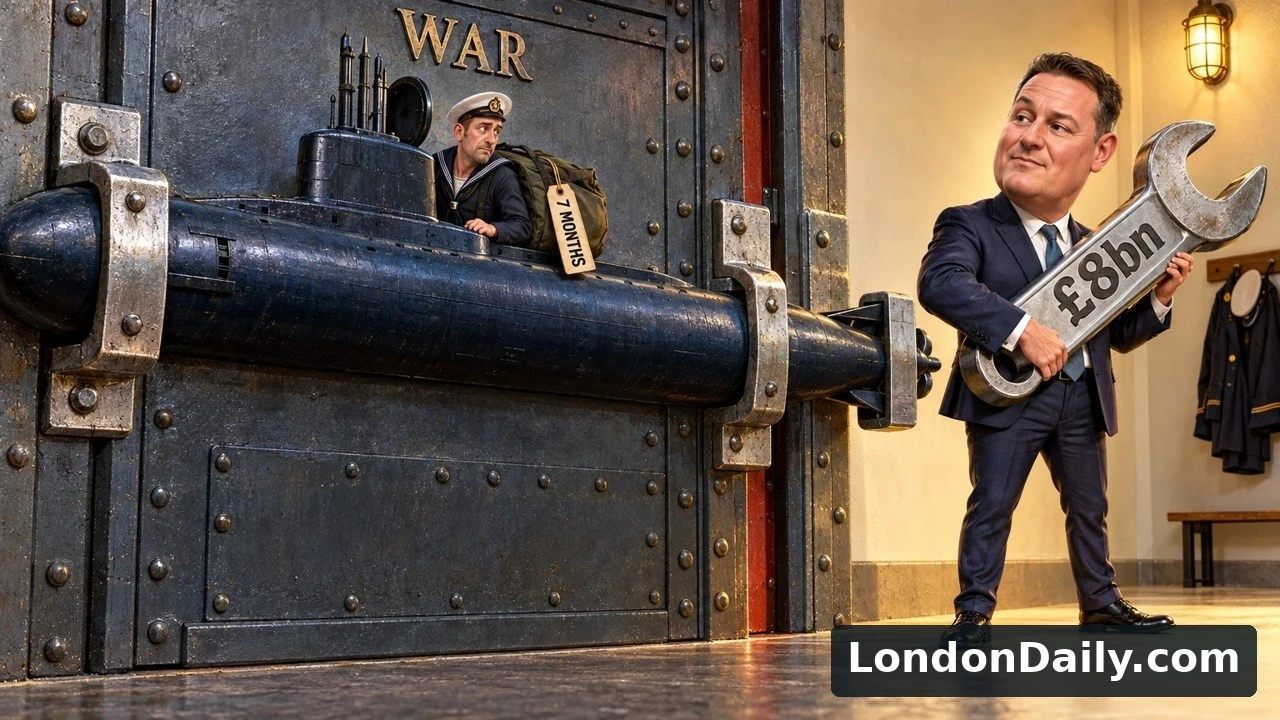
Defence Secretary Wes Streeting has argued that higher British defence spending will make war less likely, setting out the government’s deterrence case as it announced £8 billion for nuclear submarine maintenance.
The investment, announced on Thursday, is intended to reduce the length of time the vessels spend at sea. Earlier this month, one of the country’s four nuclear submarines completed a record seven-month deployment. Streeting called the funding the “single biggest procurement decision of this Parliament” and said Britain would have to spend more on defence.
His argument links stronger military capability, industry and alliances to a reduced willingness among adversaries to challenge Britain. “The deterrent effect is so strong that our adversaries wouldn’t want to test us, so that’s the goal,” he said. The spending is therefore presented as a means of preventing conflict, rather than simply preparing to fight one.
Streeting described the threat from Russia as the worst since the Cold War, citing a Russian missile’s incursion into Polish airspace last week. He said he had been in Poland last Friday and characterised the breach of Polish, and therefore Nato, airspace as something that would have been unthinkable five years ago. He also met President Volodymyr Zelensky and other Ukrainian officials in Kyiv last weekend.
The broader spending argument sits alongside a dispute over where Britain’s defences are sufficient. Scotland’s First Minister, John Swinney, has accused the UK Government of leaving Scotland’s north coast undefended, a claim UK ministers have consistently rejected.
Streeting called the accusation “unfounded and therefore irresponsible” and described the North Sea as “integral to our homeland security”. He compared the North Sea and High North with the borders facing Russia in Estonia, Latvia, Lithuania and Poland, pointing to exercises with Nato allies and the UK-led Joint Expeditionary Force as grounds for reassurance.
Alongside the investment and exercises, the Ministry of Defence has written to former military personnel to check their contact details and skills. Streeting described that step as a “necessary precaution”.








Join the conversation