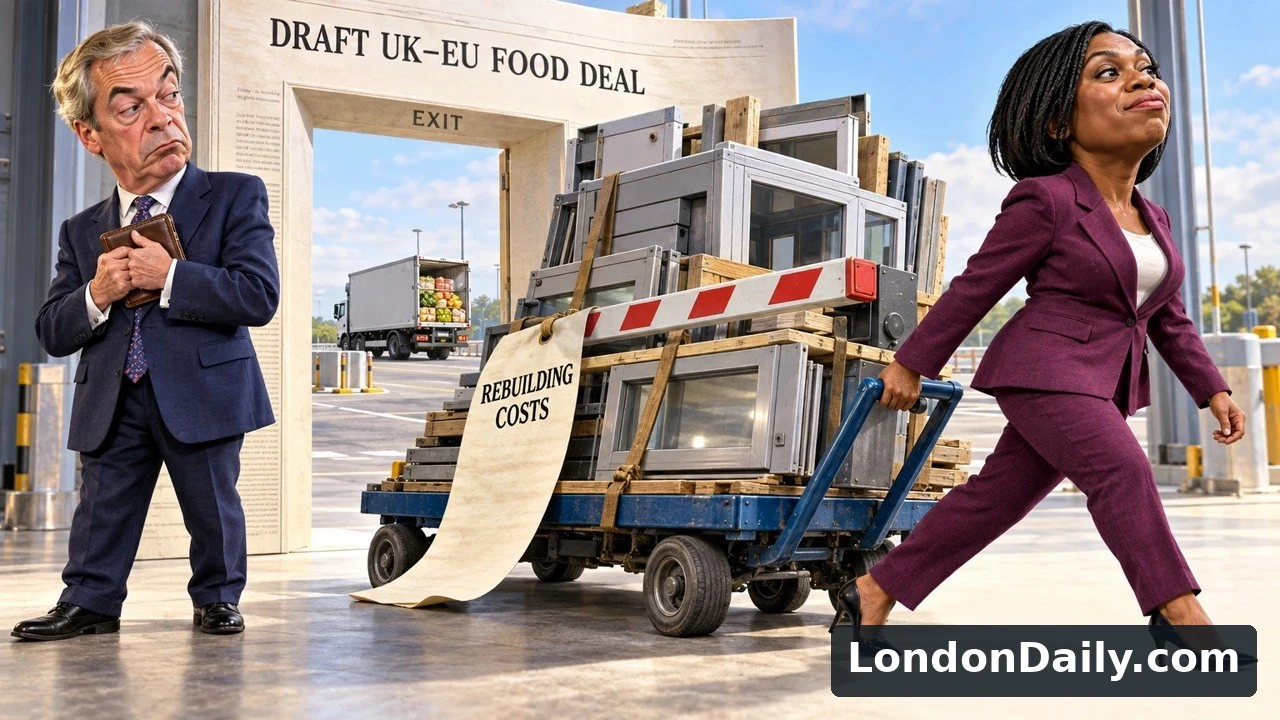
A new UK–EU food trade treaty is expected to contain a 10-year termination clause requiring whichever side ends the agreement to pay to rebuild border-checking infrastructure scaled back under the deal.
The provision gives a financial consequence to opposition pledges to reverse the agreement. Conservative leader Kemi Badenoch has said she would scrap it, while Reform UK’s Nigel Farage has suggested he would refuse to pay.
The food treaty and a separate agreement linking emissions trading schemes, both agreed last week, are due to be published on Thursday afternoon alongside the government’s Cutting Costs Bill. They form part of a post-Brexit reset that also covers a youth experience scheme. Assessments of the effects on different sectors and regions are expected.
For food exporters, the immediate attraction is the removal of substantial paperwork and checks, with border facilities dismantled. An internal analysis forecasts a 16% increase in agricultural exports: a projection, rather than an achieved gain.
Government and industry hope lower costs for producers and sellers will reach customers. Industry insiders caution, however, that any benefit may not be clearly visible at the checkout because of wider economic pressures, particularly the energy price shock resulting from war in the Middle East.
European affairs minister Hamish Falconer said the legislation would eliminate paperwork for food and drink traders, protect billions of pounds of British exports from carbon taxes and make business with the UK’s largest trading partner cheaper and easier. Linking emissions trading schemes is also expected to extend coverage across British aviation and maritime industries.
The legal detail matters beyond trade costs. The treaty will explain how Britain observes and helps shape relevant EU rules without voting on them. Legislation will set out secondary law-making powers, including so-called “Henry VIII powers”, allowing ministers to align UK and EU laws with less parliamentary scrutiny.
The prime minister described the agreements to MPs as “pragmatic” and “not a prelude to anything”. Andy Burnham said rejoining the EU without a referendum would be “unthinkable”. After several former prime ministers urged him not to reopen the Brexit debate, Burnham called them “stuck in the past” and said there would be “no banging on about Europe” from Labour. Badenoch accused him of having “oversold” the deal and of “trying to take Britain back to 2015”.
Publication should clarify both the exit provision and ministers’ proposed powers. The practical trade-off is already apparent: fewer barriers now, alongside regulatory obligations and a potential rebuilding bill if either side walks away.








Join the conversation