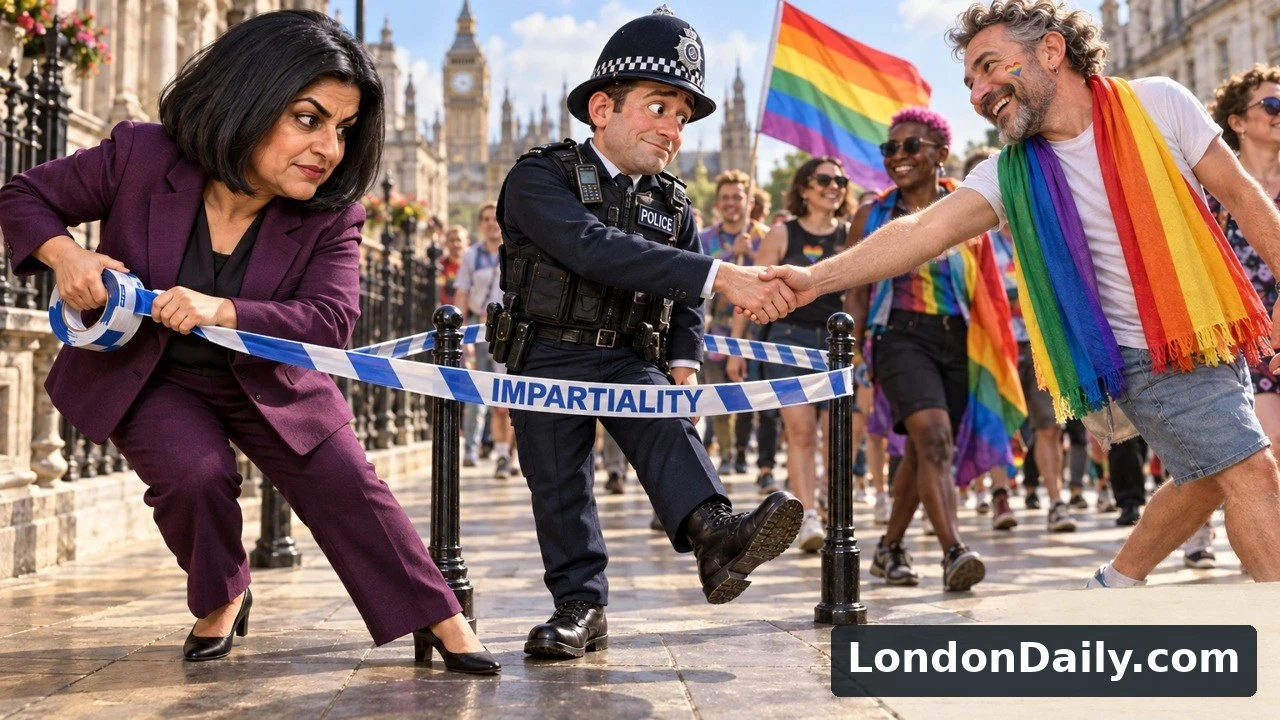
Shabana Mahmood has backed a ban on police officers marching in uniform at Pride events, arguing that participation alongside campaigners on contested gender identity issues can appear political and undermine confidence in impartial policing.
The Home Secretary cited officers’ participation in a Northumbria Pride event last year, which a court found breached their duty of impartiality. She said the judgment showed police had struck the wrong balance by marching.
Mahmood rejected claims of systematic or routine “two-tier policing”, while acknowledging a “few examples” of differential treatment. She argued that these had damaged confidence and allowed a false perception of unequal enforcement to take hold, making a new impartiality standard necessary. She dismissed the suggestion, which she attributed to Reform and others, that officers routinely practised two-tier policing as “utter, complete, ridiculous rubbish”.
Nik Adams, deputy commissioner of City of London Police and police chiefs’ LGBTQ+ lead, warned that her language itself carried consequences: “Using the language about LGBTQ issues being contested makes LGBTQ people in policing and wider society feel less safe, makes their lives feel less valued.” He described those rights as hard won.
The dispute extends beyond marching. Wiltshire Police faces a court challenge next week over a stall at a Pride event in Swindon, following claims that its presence demonstrated a lack of neutrality amid disputes over transgender rights. That challenge is distinct from the Northumbria ruling.
Mahmood said officers should discuss local issues with communities, but should not engage with activist groups pursuing political agendas. One police leader expressed concern about the rhetoric as forces sought to serve all communities amid cultural disputes. Another source called the distinction “an easy slogan” that became more complicated in practice.
The practical difficulty is deciding what counts as political. Officers and chiefs wear red poppies for Remembrance Day, although some opponents regard them as glorifying militarism. Police have also received funding to strengthen protection for Jewish people; some groups they might consult have faced accusations of extremism from pro-Palestinian groups.
Mahmood also called for better recruitment of black officers, saying numbers had barely increased in 30 years. But she criticised the old police anti-racism commitment, arguing that guidance against being “colour blind” and its statement that fair policing “does not mean treating everyone the same” undermined its intended purpose.
Gavin Stephens, chair of the National Police Chiefs Council, said trust depended on visible fairness and impartiality, while discrimination and barriers to justice persisted. “A diverse service is a stronger service,” he said. The unresolved task is to distinguish political endorsement from the community engagement on which police also depend.








Join the conversation