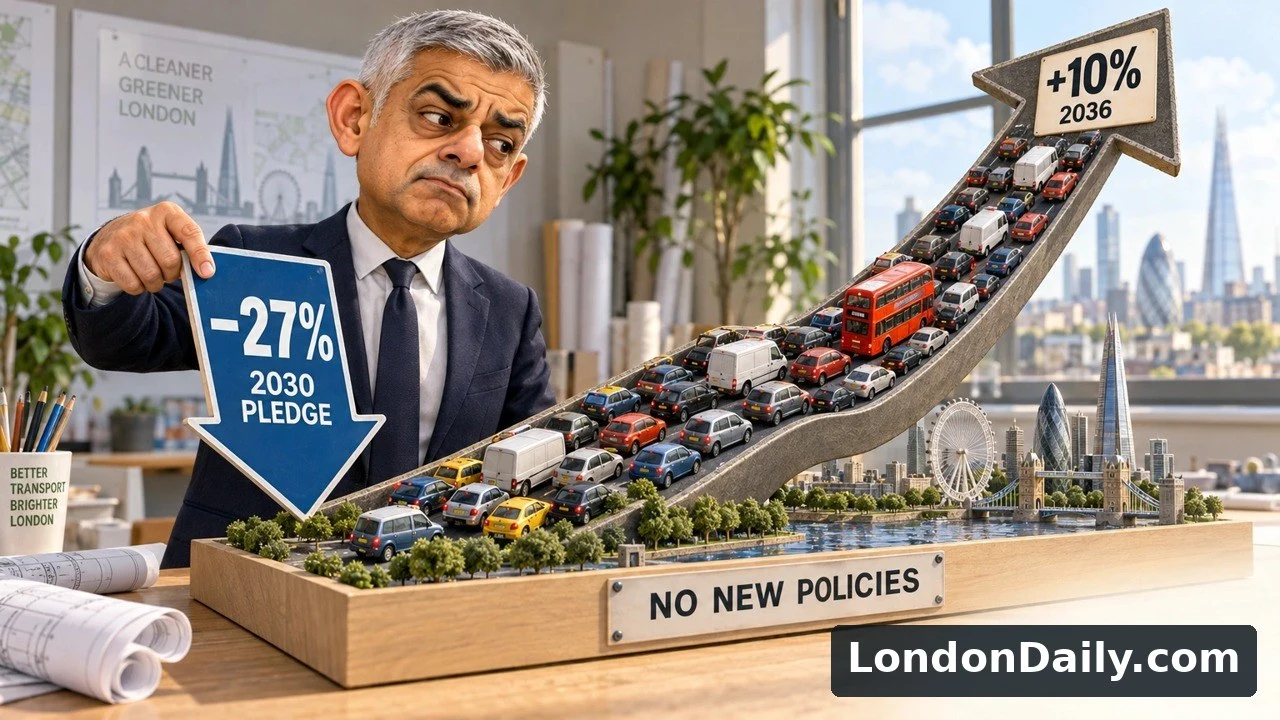
London’s draft development plan models a 10% increase in car and other motor vehicle trips by 2036, a trajectory at odds with Sadiq Khan’s promise to reduce driving and one that could leave passengers facing slower buses and overcrowded Underground stations.
City Hall disputes treating the figures as a prediction. It says the modelling assumes no additional transport policies, excludes recent changes such as the pedestrianisation of Oxford Street, and will help identify future schemes. Officials expect walking and cycling to increase significantly and car use to fall.
Drawn up by the mayor’s office and Transport for London, the draft London plan for 2026–36 examines three population and employment growth scenarios, with implications for transport, housing and other services. The central scenario, regarded as most likely, puts the population at 9.9 million, against 9.1 million currently.
Under that scenario, motor vehicle trips rise by 10% between the 2023 baseline and 2036, public transport journeys by 17%, and walking and cycling trips by 6%. Active travel would therefore increase in number but decline slightly as a share of journeys. In Paris, by contrast, cycling’s share almost tripled in five years.
The practical consequences extend beyond emissions. Average road speeds could fall by 7%, delaying buses. Public transport overcrowding would become more common, with severe pressure at some Underground stations potentially requiring regular peak-time entry closures or trains running through without stopping.
Khan pledged in 2022 to reduce London car use by 27% by 2030. Ralph Smyth, a strategy adviser at Transport Action Network who uncovered the projections, said progress away from driving appeared to have stalled. He accused the mayor of reversing the opportunity to create a cleaner, healthier and less congested city.
Simon Munk, head of campaigns at the London Cycling Campaign, said the plan risked “modelling a future that is already out of date”. He argued that TfL should explain how land-use planning and transport policy would substantially reduce driving.
Mayoral officials point to recent growth in walking and cycling, new cycle lanes and hundreds of school streets restricting motor traffic at drop-off and collection times.
Khan has made progress on air quality, particularly through the ultra-low emission zone’s expansion in 2023, although London trails some European cities. Friends of the Earth campaigner Jenny Bates said electric vehicles would help, “but this will take many years – and it won’t reduce congestion”. She called for less driving, safer walking and cycling routes, and greenery to cool increasingly hot summers.
The projections do not establish that Khan’s targets will be missed. They show the pressures additional policies would need to overcome.








Join the conversation