

Myanmar’s military says new elections will be held after year-long state of emergency
Myanmar’s military on Monday said it would hold new elections after the year-long state of emergency and return power to the winner of the poll, hours after it staged a coup against the democratically-elected government of Aung San Suu Kyi.
“We will perform real multi-party democracy ... with complete balance and fairness,” a statement on the army’s official Facebook page said, adding that power would be transferred after “holding a free and fair general election”.
The military had earlier declared a state of emergency and handed power to the commander-in-chief of the armed forces, Senior General Min Aung Hlaing
, to take control of the country for one year, following its allegations of fraud in the November general election, which Suu Kyi’s National League for Democracy (NLD) party won by a landslide.
Parliament was due to sit on Monday but in the early hours of the morning, Nobel laureate Suu Kyi, President Win Myint and other leaders were detained by the military.
The coup followed weeks of tension between the civilian government and the military over the election outcome, with Senior General Min Aung Hlaing last week pointing out that the 2008 constitution could be “revoked” under certain circumstances.
The 2008 constitution effectively allows the military to take power if they believe the country is undergoing a state of emergency that could cause disintegration of the union or “national solidarity”. The state of emergency must be declared by a civilian president, which did happen on Monday, when First Vice President U Myint Swe – who became the acting president after President Win Myint was detained by the army – signed the declaration.
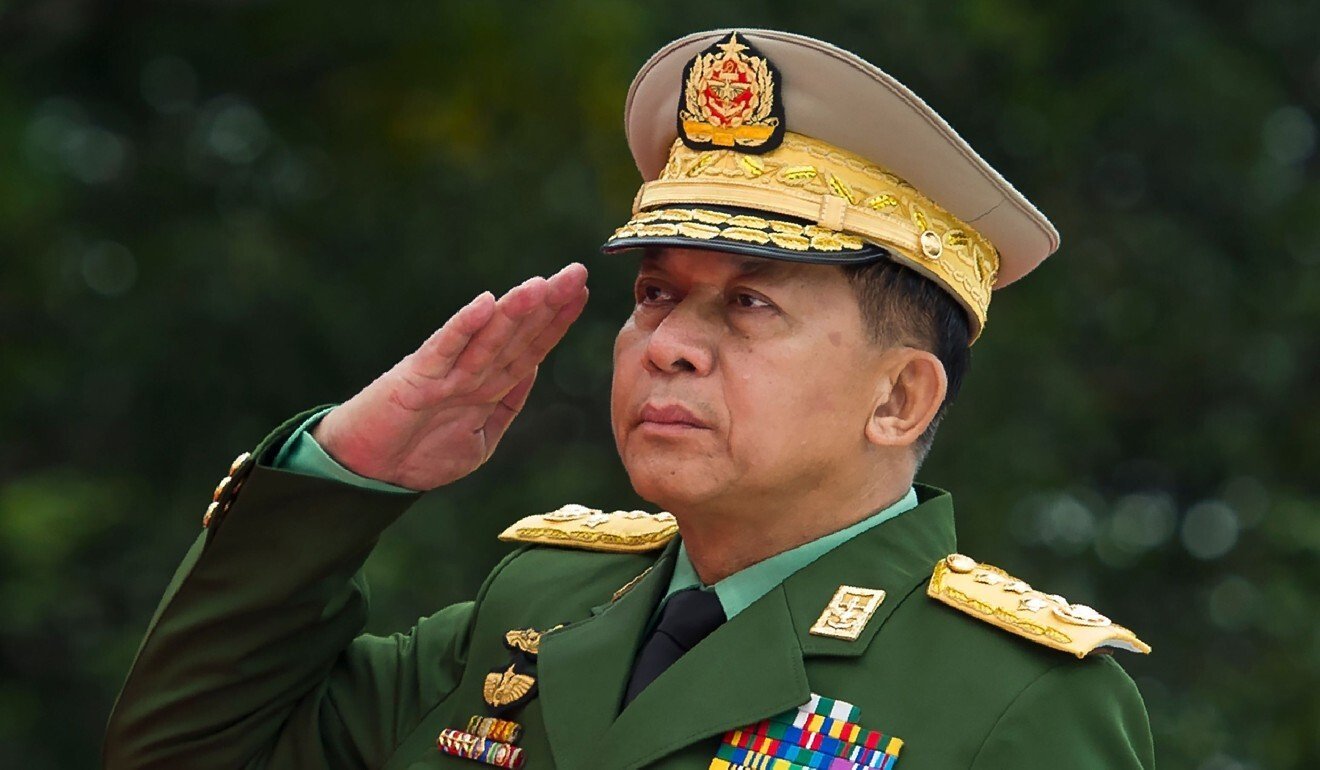
On Monday, the United Nations, the European Union and British Prime Minister Boris Johnson “strongly” condemned the detentions, with the White House saying that Washington opposed “any attempt to alter the outcome of recent elections or impede Myanmar’s democratic transition, and will take action against those responsible if these steps are not reversed”.
US Secretary of State Antony Blinken called on Myanmar’s military leaders to release Suu Kyi and other officials.
China’s Foreign Ministry spokesman Wang Wenbin said Beijing was aware of what had happened in Myanmar and was in the process of finding out more.
“China and Myanmar are good neighbours. We hope that all sides can resolve their differences under the framework of the constitution and law, and safeguard political and social stability,” said Wang at a regular press briefing on Monday.
Zhiqun Zhu, who chairs the international relations department at Bucknell University in the US, said Washington’s statement was “a serious warning”.
Zhu, an expert in Chinese foreign policy and East Asian affairs who wrote the book A Critical Decade: China’s Foreign Policy 2008-2018, added: “China is likely to urge all parties in Myanmar to remain calm and resolve their differences through consultation, not military action.”
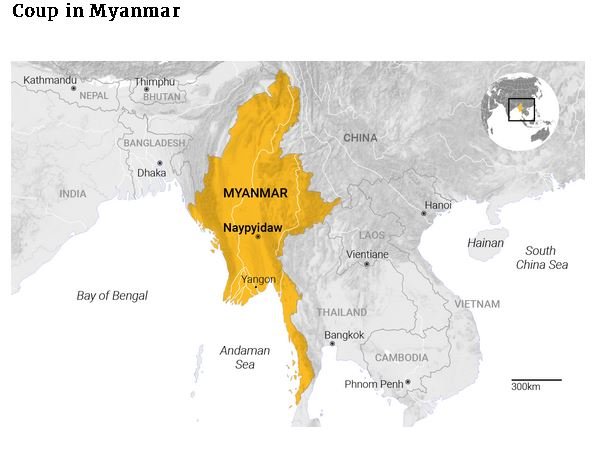
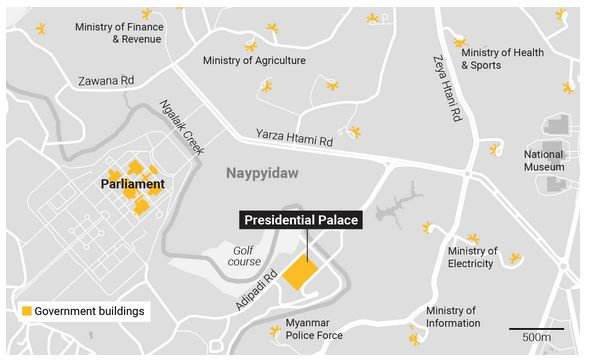
Yun Sun, director of the China programme at the Stimson Centre think tank in Washington DC, pointed out that Chinese foreign minister Wang Yi had visited Myanmar less than three weeks ago and Beijing was unlikely to appreciate the turn of events.
“It was clear that China endorses the NLD government and was looking forward to working with it in its second term, especially in promoting the China Myanmar Economic Corridor,” Sun said, referring to a series of infrastructure projects supporting connectivity between Myanmar and China.
Peng Nian, deputy director and associate fellow of National Institute for South China Sea Studies in Hainan, said political stability in Myanmar was a priority for China.
“It is the biggest precondition for the many Belt and Road Initiative projects in the country, particularly the economic corridor built with Myanmar,” said Peng, referring to Beijing’s ambitious plan to boost global trade and connectivity.
Singapore’s Ministry of Foreign Affairs expressed “grave concern” and said that it hoped the situation would return to normal as soon as possible for its “close friend” Myanmar. Indonesia urged all parties to respect constitutional government and address electoral differences with “available legal mechanisms”, while Malaysia called for peace, security and the rule of law to be prioritised in the country.
The Australian government called for the immediate release of the “unlawfully” detained leaders while Japan said it was monitoring the situation and currently had no plans to repatriate Japanese nationals from Myanmar.
The Yangon Stock Exchange, which now only has six listed companies, said it halted trading due to a connection error, Bloomberg reported.
Several other assets moved on the military action. China rare earth miners such as China Northern Rare Earth Group High-Tech Co and China Rare Earth Holdings Ltd, which get large supplies from Myanmar, fell in trading Monday.
Singapore-listed conglomerate Yoma Strategic Holdings Ltd, which gets all of its revenue from Myanmar, requested a trading halt, adding that it had told staff to work from home.
“Some of our businesses are being disrupted intermittently due to outage in the telecommunication network, and our business heads are working closely with our frontline staff to monitor the situation closely,” said a Yoma spokesperson.
All banks nationwide were closed in Myanmar on Monday.
ROLLBACK OF DEMOCRACY
The NLD swept the polls in November and was expecting to renew Suu Kyi’s lease on power with a new five-year term. But the military alleged the polls were riddled with irregularities , and claimed to have uncovered more than 10 million instances of voter fraud.
It demanded the government-run election commission release voter lists for cross-checking – which the commission has not done.
Maung Zarni, co-founder of Forsea, a grassroots network of pro-democracy scholars and human rights activists across Southeast Asia, said Monday’s developments were a natural result of a constitution that continued to empower the military.
“The coup is constitutional – that is, legal,” he said. “Myanmar’s constitution of 2008 – drawn up by the military – pre-emptively legalises coups against any elected government … Suu Kyi herself has sworn to uphold that constitution of, for and by the military.
“The painful truth is Myanmar military has never left state power. They put Suu Kyi on a long leash. Now they will put her on a shorter lead, if she is ever allowed to play ball with them within the 2008 constitution.”
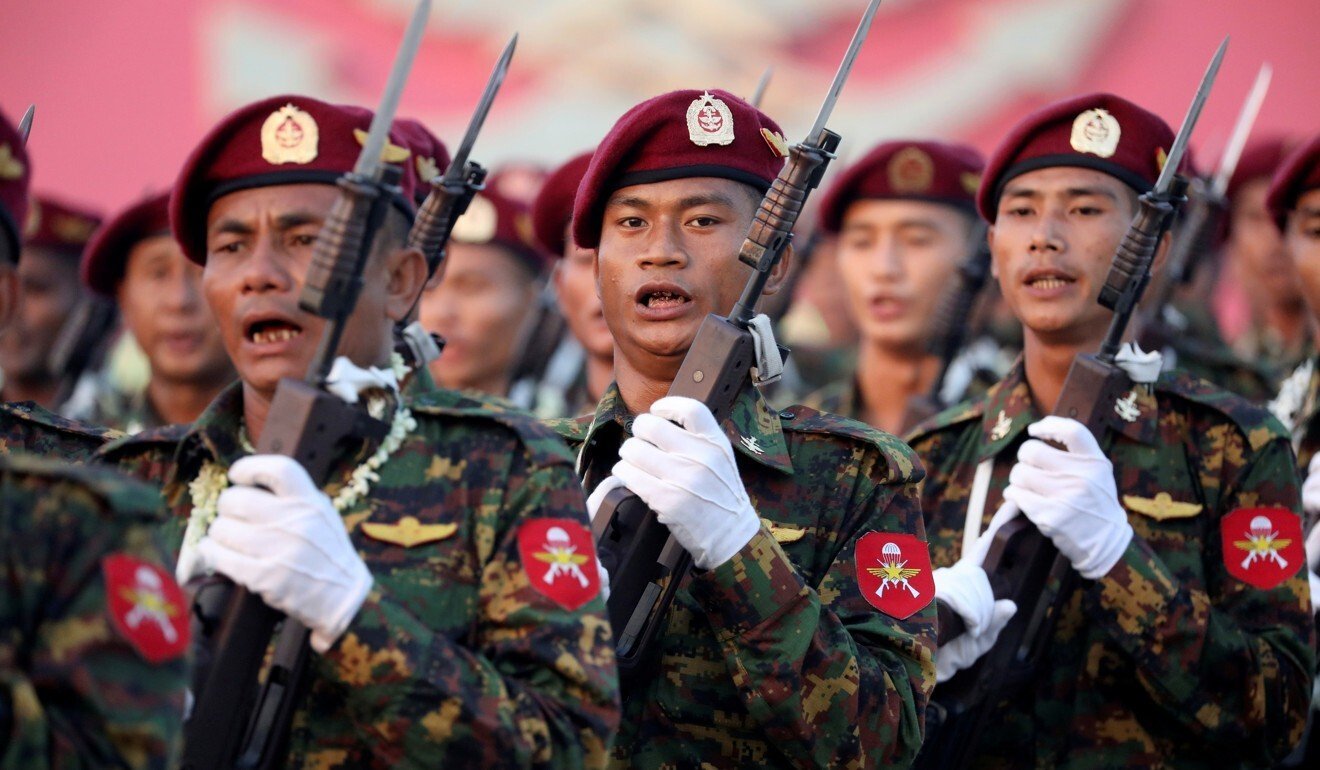
The constitution published in 2008 also reserves 25 per cent of seats in parliament for the military and control of three key ministries in Suu Kyi’s administration.
Zarni added: “Coup or no coup, Myanmar is not democratising or developing economically as long as the military controls the rule of the game.”
Suu Kyi, the daughter of Myanmar‘s independence hero, General Aung San, was once regarded as a beacon for human rights – a principled activist who gave up her freedom to challenge the ruthless army generals who ruled Myanmar for decades.
But her international reputation was tarnished in recent years by the military crackdown on members of the Rohingya ethnic minority, which saw thousands fleeing the country.
Still, she remains popular in Myanmar and her NLD party said on Facebook on Monday that she had issued a pre-emptive call for people to reject any coup.
Communications networks in Myanmar were restricted on Monday, with several mobile phone networks down.
NetBlocks, a non-governmental organisation that tracks internet shutdowns, reported severe disruptions to web connections in Myanmar. Phone numbers in the capital Naypyidaw were also seemingly unreachable.
Myanmar state media MRTV was having technical issues and was unable to broadcast, the network said on Monday.
Analysts agreed that the situation in Myanmar would pose a foreign policy test for the US, which under the current administration is expected to focus more on human rights issues.
Murray Hiebert, a Southeast Asia expert at the Centre for Strategic and International Studies in Washington DC, said Myanmar would be able to rely on the support of China, its largest trading partner, limiting the ability of the US to respond with diplomatic pressure.
“The US as recently as Friday had joined other nations in urging the military not to move forward on its coup threats,” he said. “China will stand by Myanmar like it did when the military kicked out the Rohingya.
“The Biden administration has said it will support democracy and human rights. But the top military officers are already sanctioned so it’s not immediately clear what concretely the US can do quickly.”
According to historian and author Thant Myint-U: “The doors just opened to a very different future. I have a sinking feeling that no one will really be able to control what comes next.
“And remember Myanmar is a country awash in weapons, with deep divisions across ethnic and religious lines, where millions can barely feed themselves.”