London Daily

Focus on the big picture.
Friday, Jun 12, 2026

Covid: Who has to self-isolate, which workers are exempt and what if I'm fully vaccinated?

Covid: Who has to self-isolate, which workers are exempt and what if I'm fully vaccinated?

Changes to self-isolation rules in England and Northern Ireland come into effect on Monday 16 August.

It means that far fewer people will have to quarantine if they have been in contact with someone with Covid.

What rules are changing and when?


Fully vaccinated adults will no longer have to self-isolate for 10 days if they're told they have been in close contact with a person who has Covid.

This rule also applies to everyone under the age of 18.

These changes have already come into force in Scotland and Wales.

Anyone in this situation is now advised instead to take a PCR test as soon as possible. If the result is negative, no further action is needed. However, if the result is positive, they will need to self-isolate just like anyone else.

In Wales and Northern Ireland, people are also advised to take further PCR tests on day two and day eight.

And in England, people are advised to take extra measures like wearing face coverings in enclosed spaces and limiting contact with others, especially the clinically vulnerable.

It's hoped that easing the rules for children will mean fewer will miss school.

Each UK nation has its own contact-tracing service:

* England - NHS Test and Trace
* Scotland - Test and Protect
* Wales - Test, Trace, Protect
* Northern Ireland - Contact tracing service

When do I need to self-isolate?


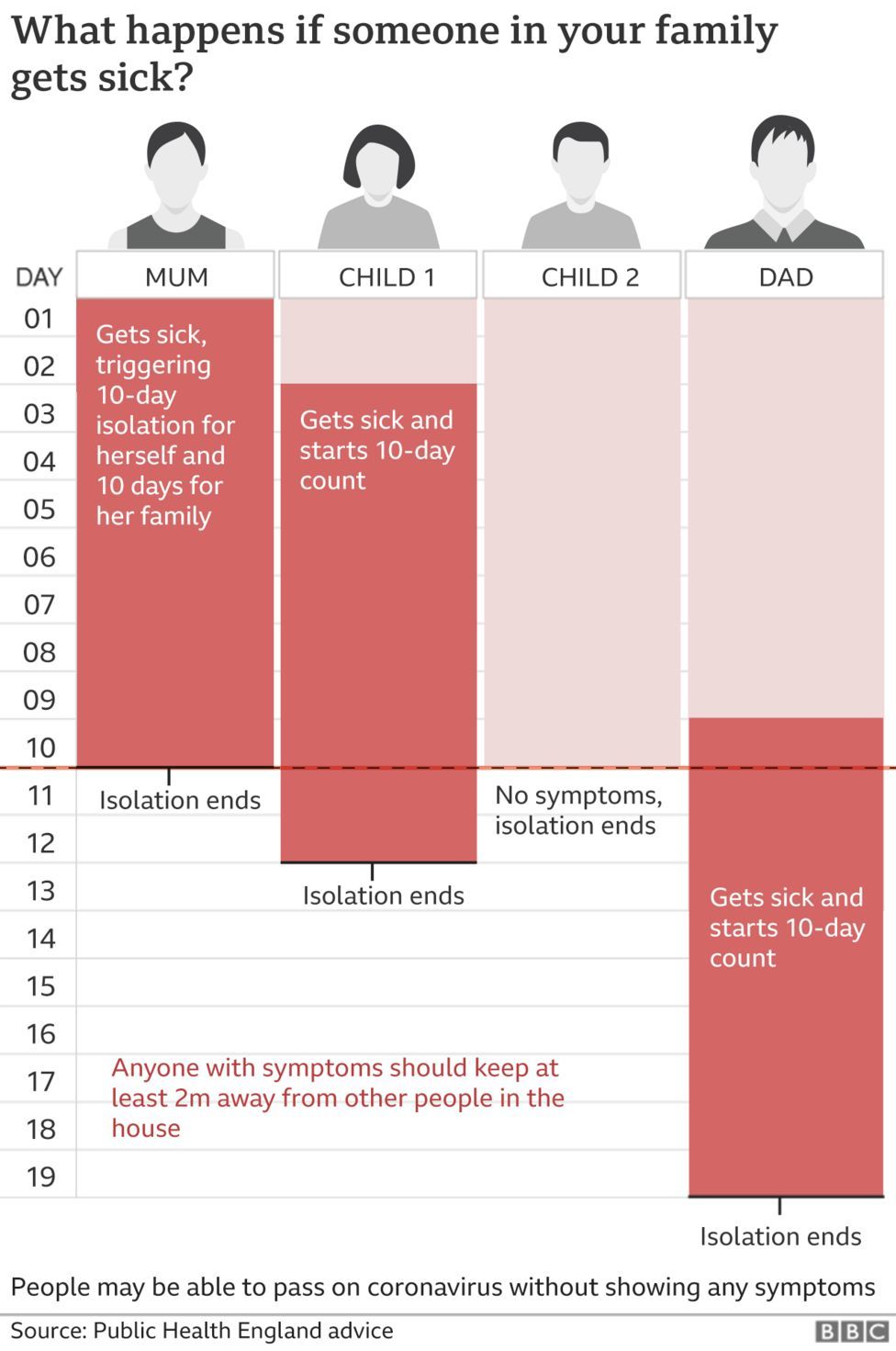
You still need to self-isolate for 10 days if you:

* test positive for Covid-19
* live with someone who tests positive
* are approached by text, email or phone by contact tracers who identify you as a close contact of someone who has tested positive - adults who are not fully vaccinated will have to continue to do this
* arrive in the UK from a red list country
* arrive in the UK from an amber list country (under-18s and fully vaccinated people using the NHS Covid Pass in England and Wales, or equivalent schemes in Scotland and Northern Ireland, are exempt)

You must also self-isolate if you or someone you live with have Covid symptoms. You can stop self-isolating if the person with symptoms gets a negative PCR result.

What if I am 'pinged'?


If you are "pinged" by the NHS Covid app you're advised - but not legally obliged - to self-isolate.

The sensitivity of the NHS Covid-19 app in England and Wales was recently tweaked to ensure that fewer people were advised to quarantine.

What does self-isolation mean?


Self-isolation means staying at home and not going out for any reason.

You should order online groceries, or ask friends or family to help.

No-one from outside your household should come inside, unless to deliver essential care.

If you test positive and feel fine, but subsequently develop symptoms, you must restart your 10-day isolation.

If you have symptoms or test positive, you should:

* Keep your distance from other members of your household
* Leave windows open to improve ventilation
* If possible, sleep and eat in a different room, and use a separate bathroom
* If you share a bathroom, use it after everyone else and clean it thoroughly

Will I be paid if I have to self-isolate?


A £500 grant is available in England to people on low incomes who have to self-isolate. This includes parents who can't work because their child has to self-isolate. It is a single payment to cover 10 days' isolation.

In Scotland people can apply for the Self-Isolation Support Grant, worth £500. There is a similar scheme in Wales. In Northern Ireland, a discretionary payment is available.

You may also be entitled to Statutory Sick Pay, which is worth £96.35 a week. Employers with their own sick pay scheme will pay more.

How are the rules enforced?


Anyone who does not self-isolate could be fined. In England, fines start at £1,000 rising to £10,000.

However, there have been concerns about how many people follow the rules. Some studies have suggested fewer than 20% do so.

Newsletter

Related Articles

0:00
0:00
Close
NHS Trust Secures Funding for AI Tool to Detect Heart Failure Earlier
Government Unveils £4.5 Billion Investment Plan for Walking and Cycling Infrastructure
Nationwide Reports UK House Prices Falling as Borrowing Costs Remain Elevated
Centre for Social Justice Says Two Million Britons Are Using Illegal Loan Sharks
UK Carmakers Warn EU Local Content Rules Could Damage British Manufacturing
UK Government Imposes Emergency Ban on Seven Potent Synthetic Opioids
Royal Navy Completes Major North Atlantic Anti-Submarine Exercise Off Norway
NHS Figures Show Nearly 3,000 Patients a Day Receiving Care in Hospital Corridors
CBI Cuts UK Growth Forecast as Middle East Tensions Drive Inflation Risks Higher
Dan Jarvis Appointed UK Defence Secretary Following Major Government Reshuffle
University College London Study Links Physical Punishment to Higher Risk of Bullying
East Midlands Railway Unveils First Refurbished Train in £60 Million Modernization Programme
RNLI Issues National Water Safety Appeal Ahead of Expected Heatwave
Climate Change Raises Subsidence Risks for Millions of Homes Across Southeast England
Manchester Advances Plans for Underground Piccadilly Station With £1 Million Funding Commitment
Anti-Immigration Violence Continues in Belfast Amid Heightened Security Concerns
UK Law Locks Great British Railways Into Public Ownership
Office for National Statistics Adopts Supermarket Checkout Data for Inflation Measurement
Applied Atomics Launches With $500 Million Space Infrastructure Order Book
BYD Plans Nationwide Rollout of Ultra-Fast EV Charging Network
UK House Prices Unexpectedly Fall in May
CBI Warns UK Growth Is Becoming Increasingly Dependent on Public Spending
Makerfield By-Election Fuels Speculation Over Labour’s Future Leadership
Britain Declines to Join EU SAFE Defence Fund
UK Unveils 2040 Emissions Target Despite Strong Political Opposition
Government Orders Full Review of Palantir’s NHS Data Contract
UK Borrowing Costs Climb as Markets Price in Further Bank of England Rate Rises
Resident Doctors Confirm Five-Day NHS Strike Across England
Violent Anti-Immigrant Riots in Belfast Spark Political and Diplomatic Tensions
United Kingdom Sees Recovery in Horizon Europe Research Funding Share to 9.3 Percent
UK Inflation Holds at 2.8 Percent as Office for Budget Responsibility Flags Persistent Price Pressures
United Kingdom Launches National Anti-Fraud Framework to Combat Rising Pension Scam Losses
United Kingdom Expands Sanctions on Israeli Groups While Funding Palestinian Authority Salaries and Gaza Mine Clearance
United Kingdom Issues Three-Month Ultimatum to Major Technology Firms Over Child Online Safety Controls
United Kingdom Government Moves Toward Blanket Social Media Ban for Children Under Sixteen
Widespread Anti-Immigration Rioting Erupts Across Belfast After Knife Attack Linked to Asylum Seeker
Farmers Warn of Crop Losses Following Months of Unseasonal Rainfall
Civil Aviation Authority Launches Review of Regional Airport Operations
Met Office Issues Heat-Health Alert Across Parts of England
National Grid Introduces New Measures to Protect Winter Energy Supply
Northern England Rail Upgrades Receive Additional Government Funding
Wales Advances Green Hydrogen Strategy to Decarbonize Heavy Industry
UK Expands Recruitment Incentives to Address Shortage of STEM Teachers
High Court Opens Door to Climate Liability Claims Against Major Industrial Emitters
Police Service of Northern Ireland Investigates Major Personnel Data Breach
Defense Ministry Overhauls Procurement System to Accelerate AUKUS Submarine Program
Net Migration Remains Above Government Expectations, New Data Shows
UK and Scottish Governments Agree Framework for Expanded North Sea Wind Development
UK Treasury Launches New Tax Incentives to Boost AI and Semiconductor Investment
Bank of England Signals Continued Caution on Interest Rate Cuts
×