London Daily

Focus on the big picture.
Saturday, Jun 20, 2026

Covid in Scotland: Senior pupils to wear masks in class at level 3 and 4

Covid in Scotland: Senior pupils to wear masks in class at level 3 and 4

Senior pupils and their teachers are being advised to wear face coverings in classrooms for schools in the new level 3 and 4 restriction areas.

The Scottish government has released new guidance on school safety to take account of the five-level Covid alert system, which begins on Monday.

Other guidance advises staff to wear face coverings in all schools, where social distancing is not possible.

And parents should wear masks even at drop-off and pick-up.

That applies even if they are not entering the school, Deputy First Minister John Swinney told the daily media briefing.

Mr Swinney said the main change from previous advice was for schools in level 3 and 4.
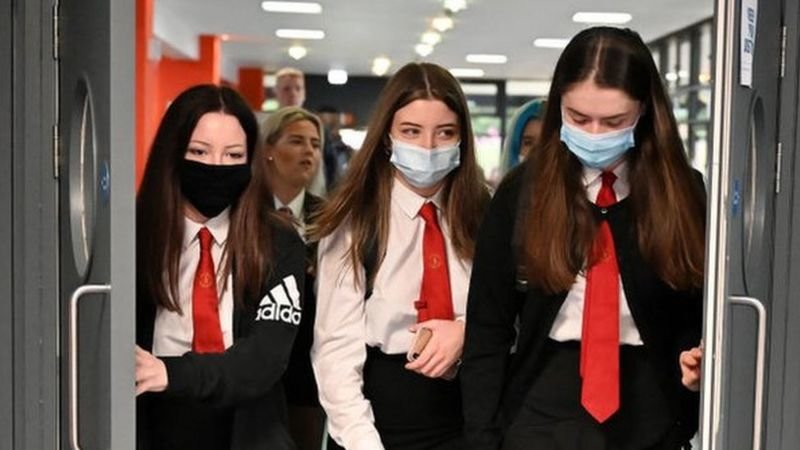

Face coverings were already required in corridors, communal areas and on buses


No local authority has yet been placed in level 4, the closest to lockdown.

However, most of the central belt of Scotland is in level 3, including Glasgow and Edinburgh as well as Lanarkshire, Ayrshire and the Lothians. Dundee, Stirling and Falkirk are also in level 3. About 3.5 million people in total.

Mr Swinney, who is also the education secretary, said pupils in S4 to S6 and their teachers in these areas should wear face coverings in classrooms, as well as when they are moving around the school and in communal areas.

He said: "The evidence suggests there is slightly higher infection and transmission risks for people around the age of 16 to 17 so the use of face coverings is an additional precautionary measure in areas where there is increased incidence of the virus."

The updated guidance says all adults should wear face coverings in schools where they cannot stay at least two metres away from other adults and pupils - although Mr Swinney said there were some exemptions to this for primaries one and two.

Staff in primary schools should now wear face coverings in communal areas, such as staff rooms, canteens and corridors.

Mr Swinney said none of the areas in the new framework for dealing with Covid required school closures or blended learning. Although he said that remote learning remained a "contingency".

Guidance for school staff and pupils at the highest clinical risk (shielding) has also been updated.

At Level 3, parents or guardians should discuss with their GP or clinician whether children who are shielding should attend school.

At Level 4, the current advice is that children on the shielding list should not attend school in person. However, the government said it would look at how it could use individualised risk assessments to maximise attendance.

Also at this highest level, greater levels of testing will be required in response to outbreaks in schools.

'Legitimate concerns'


Scotland's biggest teaching union, the EIS, said it supported stronger advice in areas such as the use of face coverings.

But it was "dissatisfied" with the lack of specification on social distancing between pupils, which it said remained impossible to achieve in full classrooms.

General Secretary Larry Flanagan added: "The EIS is clear that Level 4 should trigger an automatic consideration of moves towards blended or remote learning. Schools cannot stay open at any cost; the safety of pupils and staff has to be the priority, especially those with increased vulnerabilities."

Scottish Conservative education spokesman Jamie Greene said: "Parents across Scotland understood the guidance around staff wearing masks in schools, and older pupils wearing them in public areas, but the SNP has not explained why this latest move is necessary.

"Nor have they addressed legitimate concerns about pupils' wellbeing, particularly for those with additional support needs."

UsForThem Scotland, a group campaigning for normal schooling through the pandemic, also asked for data on how effective mask-wearing in school was.

Newsletter

Related Articles

0:00
0:00
Close
UK Health Authorities Introduce Drug Price Concessions Amid Record NHS Medicine Shortages
Sir David Attenborough Supports Sherwood Forest Conservation Efforts After Loss of Major Oak
Aardman Animations Marks 50 Years With Major Exhibition in Bristol
Drax Cleared After Investigation Into Wood Pellet Sourcing Practices
Jaguar Land Rover Shifts Toward Hybrid Vehicle Production for US Export Strategy
UK Police Arrest Liberal Democrat MP Cameron Thomas on Suspicion of Assault
Health Concerns Grow Over Elevated Kidney Cancer Rates Near Lancashire PFAS Factory
Royal Navy F-35 Jets Conduct First NATO Air Warfare Exercise from Finnish Airspace
UK NHS Issues Price Concessions for Medicines Amid Severe Drug Shortages
Heathrow Third Runway Project Faces Sharp Downward Revision in Expected Economic Benefits
Amber Heat Warning Issued Across Parts of England and Wales as Temperatures Rise
Train Collision Near Bedford Disrupts UK Rail Network and Leaves Multiple Injured
Bank of England Data Suggests Brexit Has Reduced UK Economic Output by Around Six Percent
UK Borrowing Costs Hold Near 4.8 Percent as Political Uncertainty Fuels Market Pressure
Andy Burnham Emerges as Front-Runner to Succeed Keir Starmer After Landslide Makerfield Victory
Prime Minister Keir Starmer Faces Mounting Pressure to Resign After Labour By-Election Defeat in Makerfield
Payment Fraud Losses Reach £1.28 Billion and Raise National Security Concerns
Lending to Small Businesses Climbs to Highest Level Since Late 2024
Middle East Conflict Clouds UK Economic Recovery Despite Strong First-Quarter Growth
Bank of England Moves to Simplify Capital Rules for Smaller Lenders
UK Government Fast-Tracks National Security and Cyber Resilience Legislation
Ofcom Investigates Telegram Over Alleged Role in Organising Arson Attacks
MPs Press Fujitsu to Speed Compensation for Post Office Horizon Victims
Bank of England Delays Final Basel III Implementation Changes to Support UK Banking Competitiveness
Pound Falls as Political Uncertainty and Bank of England Signals Weigh on Markets
0Andy Burnham Wins Makerfield By-Election and Emerges as Main Challenger to Keir Starmer
Dorset Council Tests AI Tools to Streamline Local Planning Applications
UK Researchers at Kew Gardens Use AI to Speed Up Identification of Threatened Plant Species
UK Gilt Yields Ease Toward 4.8% as Inflation and Labour Market Data Weigh on Bonds
Bank of England Data Shows Resilient SME Lending Despite Economic Slowdown
UK Finance Reports Weakening Services Activity as Business Confidence Softens
UK Introduces Mandatory Internal Complaints Process Under Data Use and Access Act
Bank of England Governor Andrew Bailey Flags Geopolitical Uncertainty as Key Risk to Inflation Outlook
Bank of England Holds Interest Rates at 3.75% as Policymakers Signal Cautious Stance on Inflation Risks
Cornwall Clergy Raise £40,000 for Church Repairs Through Everest-Themed Charity Challenge
UK Business and Social Landscape Reflects Strain From Geopolitical and Domestic Pressures
Tensions Grow in UK Over Sikh Kirpan and Religious Symbolism in Public Debate
Energy Price Cap Increase Set to Lift UK Household Bills by 13 Percent
University of Reading Ranked 196th in QS World University Rankings
UK Maritime Archaeologists Identify 17th-Century Dutch Shipwreck Off Devon Coast
Oxford Union Islam Debate Sparks Protest From Faith Leaders in UK
UK Social Cohesion Debate Intensifies After Religious Prejudice Survey Findings
UK SME Lending Rises Despite Geopolitical Uncertainty and Cautious Outlook
Foreign Demand for UK Gilts Remains Sensitive to Global Inflation Trends
Labour Party Faces Leadership Pressure After Weak Local Election Results in UK
Transport Costs Drive Inflation Pressure as Petrol Prices Push Up UK CPI
British Chambers of Commerce Cuts Growth Forecast as Middle East Conflict Weighs on Investment
UK Economy Grows 0.6 Percent in First Quarter but Outlook Remains Weak
Bank of England Holds Interest Rates at 3.75 Percent as Inflation Risks Persist
Energy Price Cap Rise Expected to Keep UK Inflation Above Target Through 2026
×