London Daily

Focus on the big picture.
Thursday, Jan 15, 2026

Covid-19: UK deaths likely to come down slowly, Whitty warns

Covid-19: UK deaths likely to come down slowly, Whitty warns

The number of daily coronavirus deaths in the UK is likely to come down "relatively slowly", England's chief medical officer has warned.

Prof Chris Whitty said the UK was going to see "a lot more deaths" over the next few weeks before the effects of the vaccination programme were felt.

Current restrictions were "just about holding" in lowering infection rates, he told a Downing Street briefing.

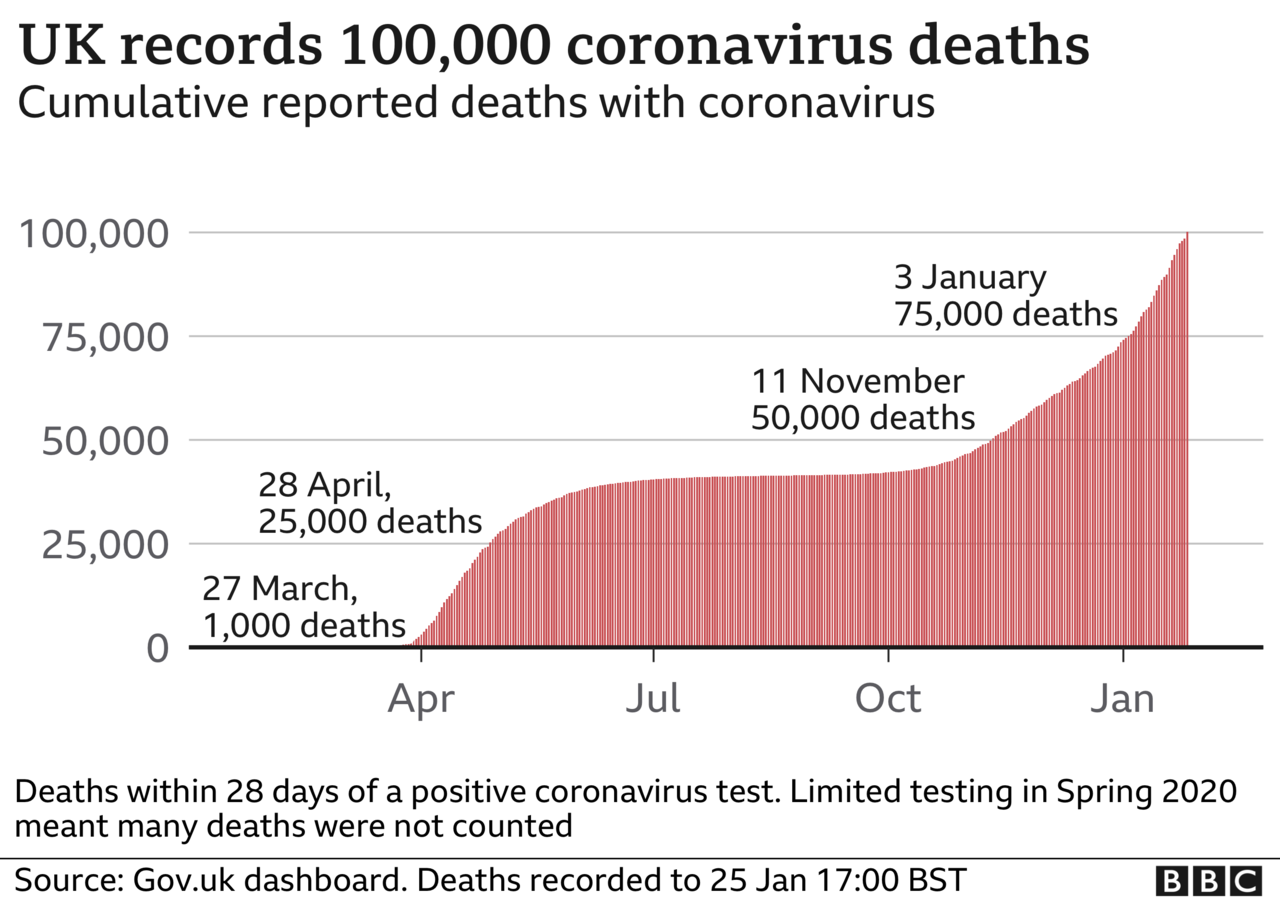
It comes as the UK surpassed 100,000 coronavirus deaths on Tuesday.

A further 1,631 deaths within 28 days of a positive test were recorded in the daily figures.

And 20,089 coronavirus cases were reported on Tuesday, continuing a downward trend in the number of UK cases seen in recent days.

'Incredibly high number'


Prof Whitty told a Downing Street news conference the rolling seven-day average for deaths was 1,242 - "an incredibly high number" - and unlikely to come down quickly.

"I think we have to be realistic that the rate of mortality, the number of people dying a day, will come down relatively slowly over the next two weeks - and will probably be flat for a while now."

Prof Whitty said the number of people testing positive for coronavirus was "still at a very high number, but it has been coming down".

But he cautioned against relaxing restrictions "too early", as Office for National Statistics data showed a "rather slower" decrease.

The number of people in hospital with Covid-19 in the UK had "flattened off", he said, but was still an "incredibly high number" and "substantially above the peak in April".


Prof Whitty said the new, more transmissible variant discovered in the south east of England at the end of last year had altered the UK's situation "very substantially" and had made it "much harder" to bring infection levels down.

"We were worried two weeks ago that the measures we have at the moment were not enough to hold this new variant," he told the news conference.

"I think what the data I showed you at the beginning of the slide sessions shows is that the rates are just about holding with the new variant, with what everybody's doing.

"It's going to be much harder because of this new variant and I think we have to be realistic about that."

Sir Simon Stevens, chief executive of NHS England, said that more than a quarter of a million severely ill coronavirus patients have been looked after in hospital since the pandemic started last year.

"This is not a year that anybody is going to want to remember nor is it a year that across the health service any of us will ever forget," he said.



The daily Covid figures have seen the number of deaths top 100,000. But they also contain some signs of hope.

Just over 20,000 new infections have been reported - down from 22,000 yesterday.

This compares to an average of 60,000 at the start of the year.

It is a sharp fall, although Prof Whitty cautions it may actually be a little slower than that.

Not everyone who is infected comes forward for testing and the government surveillance programme which involves random testing of the population suggests the fall has not been quite so great.

Nonetheless, it is clear the infection rate is coming down - and that offers hope.

Hospital cases have plateaued and should soon start falling. That will eventually lead to a reduction in the number of deaths.

Then, in February, the vaccination programme should start having an impact, leading, hopefully, to a rapid drop in deaths.

Prime Minister Boris Johnson told the briefing the coronavirus infection rate remained "pretty forbiddingly high" to ease lockdown restrictions, which have been in place in England since 5 January.

But he said "at a certain stage we will want to be getting things open".

He added: "What I will be doing in the course of the next few days and weeks is setting out in more detail, as soon as we can, when and how we want to get things open again."

Under the national lockdown, people in England must stay at home and only go out for limited reasons - including for food shopping, exercise, or work if they cannot do so from home. Similar measures are in place across much of Scotland, Wales and Northern Ireland.

'Drastically reduced'


Meanwhile, the epidemiologist whose modelling prompted the UK government to impose the first lockdown has told BBC Radio 4's PM he believes more action in autumn last year could have "drastically reduced" the number of lives lost in the second wave - some 60,000.

Prof Neil Ferguson said: "They couldn't have been eliminated, but they could have been drastically reduced by earlier action, unfortunately.

"How much is difficult to judge, the new variant was unpredictable and did change our understanding of how much was needed to control spread, but we did just let the autumn wave get to far, far too high infection levels."

Reacting to the UK's death toll, Mr Johnson said he took "full responsibility" for the government's actions, but added: "We truly did everything we could."


Prof Chris Whitty described today as a very sad day, as England surpassed 100,000 Covid deaths


Newsletter

Related Articles

0:00
0:00
Close
UK Launches First-Ever ‘Town of Culture’ Competition to Celebrate Local Stories and Boost Communities
Planned Sale of Shell and Exxon’s UK Gas Assets to Viaro Energy Collapses Amid Regulatory and Market Hurdles
UK Intensifies Arctic Security Engagement as Trump’s Greenland Rhetoric Fuels Allied Concern
Meghan Markle Could Return to the UK for the First Time in Nearly Four Years If Security Is Secured
Meghan Markle Likely to Return to UK Only if Harry Secures Official Security Cover
UAE Restricts Funding for Emiratis to Study in UK Amid Fears Over Muslim Brotherhood Influence
EU Seeks ‘Farage Clause’ in Brexit Reset Talks to Safeguard Long-Term Agreement Stability
Starmer’s Push to Rally Support for Action Against Elon Musk’s X Faces Setback as Canada Shuns Ban
UK Free School Meals Expansion Faces Political and Budgetary Delays
EU Seeks ‘Farage Clause’ in Brexit Reset Talks With Britain
Germany Hit by Major Airport Strikes Disrupting European Travel
Prince Harry Seeks King Charles’ Support to Open Invictus Games on UK Return
Washington Holds Back as Britain and France Signal Willingness to Deploy Troops in Postwar Ukraine
Elon Musk Accuses UK Government of Suppressing Free Speech as X Faces Potential Ban Over AI-Generated Content
Russia Deploys Hypersonic Missile in Strike on Ukraine
OpenAI and SoftBank Commit One Billion Dollars to Energy and Data Centre Supplier
UK Prime Minister Starmer Reaffirms Support for Danish Sovereignty Over Greenland Amid U.S. Pressure
UK Support Bolsters U.S. Seizure of Russian-Flagged Tanker Marinera in Atlantic Strike on Sanctions Evasion
The Claim That Maduro’s Capture and Trial Violate International Law Is Either Legally Illiterate—or Deliberately Deceptive
UK Data Watchdog Probes Elon Musk’s X Over AI-Generated Grok Images Amid Surge in Non-Consensual Outputs
Prince Harry to Return to UK for Court Hearing Without Plans to Meet King Charles III
UK Confirms Support for US Seizure of Russian-Flagged Oil Tanker in North Atlantic
Béla Tarr, Visionary Hungarian Filmmaker, Dies at Seventy After Long Illness
UK and France Pledge Military Hubs Across Ukraine in Post-Ceasefire Security Plan
Prince Harry Poised to Regain UK Security Cover, Clearing Way for Family Visits
UK Junk Food Advertising Ban Faces Major Loophole Allowing Brand-Only Promotions
Maduro’s Arrest Without The Hague Tests International Law—and Trump’s Willingness to Break It
German Intelligence Secretly Intercepted Obama’s Air Force One Communications
The U.S. State Department’s account in Persian: “President Trump is a man of action. If you didn’t know it until now, now you do—do not play games with President Trump.”
Fake Mainstream Media Double Standard: Elon Musk Versus Mamdani
HSBC Leads 2026 Mortgage Rate Cuts as UK Lending Costs Ease
US Joint Chiefs Chairman Outlines How Operation Absolute Resolve Was Carried Out in Venezuela
Starmer Welcomes End of Maduro Era While Stressing International Law and UK Non-Involvement
Korean Beauty Turns Viral Skincare Into a Global Export Engine
UK Confirms Non-Involvement in U.S. Military Action Against Venezuela
UK Terror Watchdog Calls for Australian-Style Social Media Ban to Protect Teenagers
Iranian Protests Intensify as Another Revolutionary Guard Member Is Killed and Khamenei Blames the West
Delta Force Identified as Unit Behind U.S. Operation That Captured Venezuela’s President
Europe’s Luxury Sanctions Punish Russian Consumers While a Sanctions-Circumvention Industry Thrives
Berkshire’s Buffett-to-Abel Transition Tests Whether a One-Man Trust Model Can Survive as a System
Fraud in European Central Bank: Lagarde’s Hidden Pay Premium Exposes a Transparency Crisis at the European Central Bank
Trump Announces U.S. Large-Scale Strike on Venezuela, Declares President Maduro and Wife Captured
Tesla Loses EV Crown to China’s BYD After Annual Deliveries Decline in 2025
UK Manufacturing Growth Reaches 15-Month Peak as Output and Orders Improve in December
Beijing Threatened to Scrap UK–China Trade Talks After British Minister’s Taiwan Visit
Newly Released Files Reveal Tony Blair Pressured Officials Over Iraq Death Case Involving UK Soldiers
Top Stocks and Themes to Watch in 2026 as Markets Enter New Year with Fresh Momentum
No UK Curfew Ordered as Deepfake TikTok Falsely Attributes Decree to Prime Minister Starmer
Europe’s Largest Defence Groups Set to Return Nearly Five Billion Dollars to Shareholders in Twenty Twenty-Five
Abu Dhabi ‘Capital of Capital’: How Abu Dhabi Rose as a Sovereign Wealth Power
×