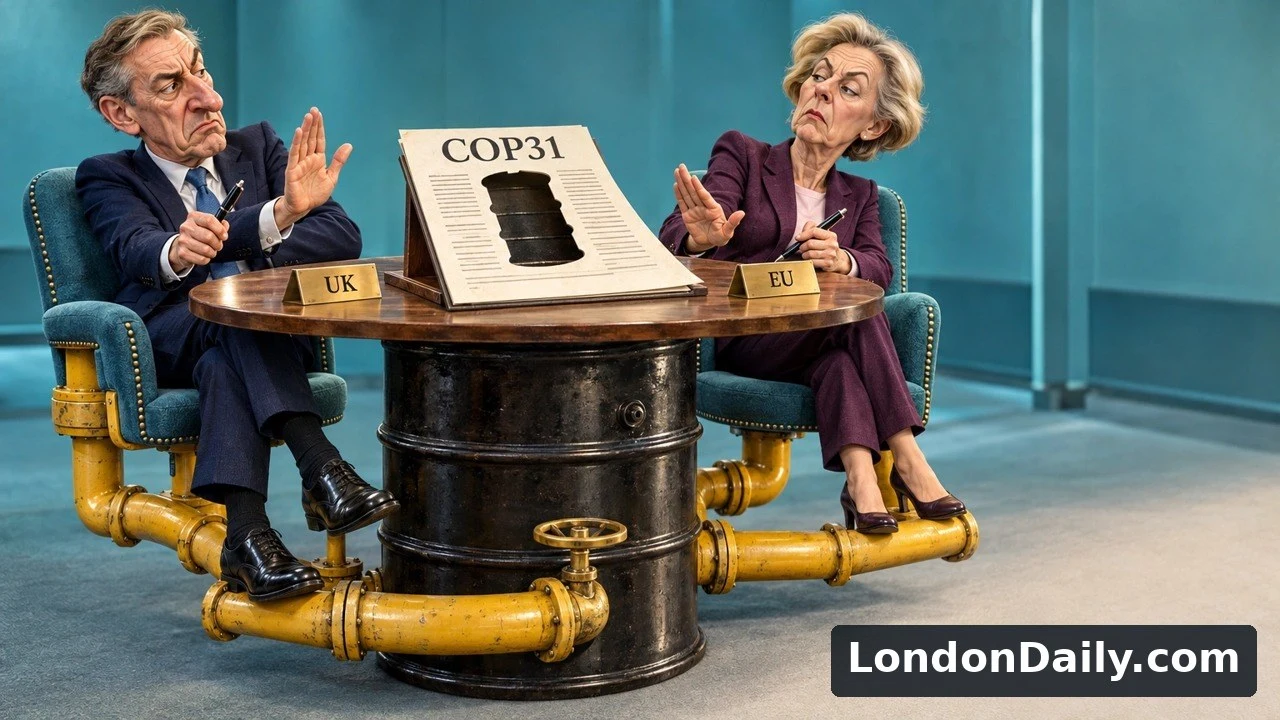
The Cop31 climate talks in Antalya, Turkey, collapsed after Britain and the European Union rejected a communiqué that made no mention of fossil fuels, leaving Western nations and oil and gas producers unable to reach agreement.
The omission was the immediate obstacle. Beneath it lies a harder economic disagreement: poorer countries still depend on fossil fuels for development, while Western governments seeking action on emissions continue to need them too. Wars in Ukraine and Iran have underlined that continuing dependence.
Britain and the EU’s rejection demonstrated that they would not accept a statement silent on fossil fuels. Yet their position was not enough to secure agreement. The breakdown illustrates the limits of Western influence when other participants have different economic priorities.
There is also a credibility tension in urging countries across Africa and Asia towards electrification while Western economies remain reliant on fossil fuels and China dominates the renewable technology market. That tension does not settle what an agreement should contain, but it complicates the case Western governments are making.
Andy Burnham addressed a half-empty room in Antalya a fortnight earlier. That attendance is a concrete detail, though it cannot establish wider public attitudes towards the talks or climate policy.
The failure leaves a legitimate question about the annual COP process: can it reconcile these competing interests? One collapsed conference demonstrates the difficulty, not that negotiations have necessarily exhausted their usefulness. The unresolved task remains substantial: agreeing how to slow global warming while accelerating adaptation to its effects, without overlooking the energy on which economic development still depends.








Join the conversation