London Daily

Focus on the big picture.
Wednesday, Jul 15, 2026

UK wealth gap widens in pandemic as richest get £50,000 windfall

UK wealth gap widens in pandemic as richest get £50,000 windfall

Resolution Foundation finds rising house and asset prices have ‘turbo-charged’ gap between richest and poorest

Britain’s wealth gap has ballooned during the pandemic with the richest 10% gaining £50,000 on average, dwarfing increases for the poorest third of the population, according to a thinktank report.

The Resolution Foundation said wealth had increased during lockdown as a result of a lack of spending opportunities and rising house prices, but the benefits had been skewed to the richest by a ratio of more than 500 to 1.

Jack Leslie, a senior economist at the thinktank, said it was rare for wealth to increase during a recession but the impact of events during 2020 and 2021 had been to “turbo-charge” the gap between rich and poor.

The Resolution Foundation – which focuses on improving living standards for those on low and middle incomes – said the findings of the report should cause the government to rethink its decision to scrap the £20 a week increase to universal credit in September.
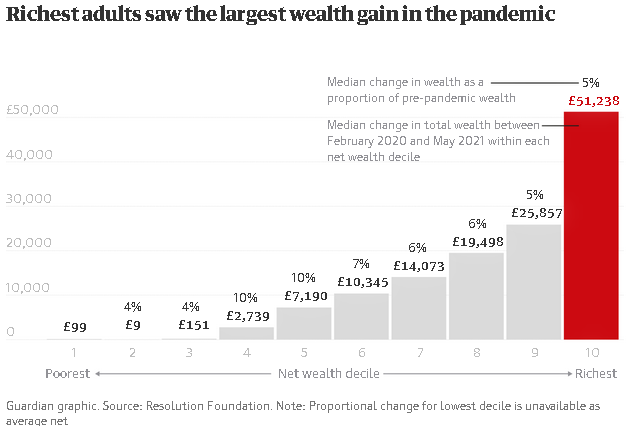

The report, produced in partnership with the Standard Life Foundation, found that the average household had enjoyed a windfall of £7,800 per adult during the crisis – the first time wealth has increased during a recession since the mid-1940s.

“The Covid-19 crisis has seen a highly unusual combination of a sharp reduction in economic activity, and a sharp increase in household wealth. Many families have been forced to save rather than spend during lockdowns, while house prices have continued to soar even while working hours have plummeted,” Leslie said.

Britain suffered its biggest-one year fall in output in more than 300 years in 2020 but since the start of the crisis in February 2020 total household savings had risen by £200bn, household debts (excluding credit cards) decreased by about £10bn, and house prices – which fell by an average of 22% over the previous four recessions – rose by 8%.

The thinktank report said total UK wealth had increased by £900bn to £16.5tn during the course of the pandemic, but the poorest households were more likely to have run down rather than increase their savings, and had not shared in the house price boom because they were less likely to own a home in the first place.

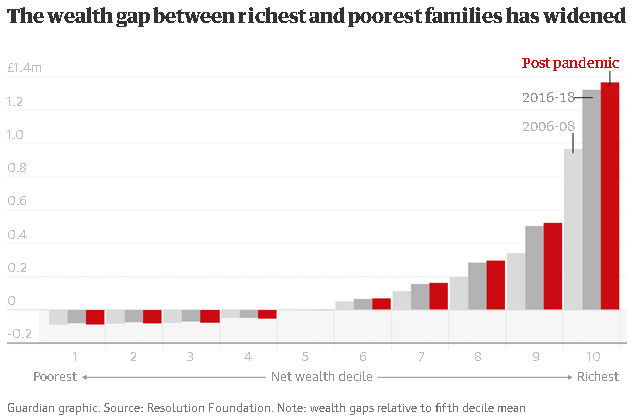
“As a result, the rising wealth gaps that marked pre-pandemic Britain have been turbo-charged by the crisis,” Leslie said. “With policymakers facing many tough decisions in the autumn – from protecting households as unemployment rises to paying for a decent system of social care – they can no longer afford to ignore the dominant role wealth is playing in 21st-century Britain.”

The richest fifth of households were four times as likely to have increased their savings during the crisis as the poorest fifth of households (47% versus 12%), and 2.5 times as likely to have reduced their debts. The thinktank said this reflected pandemic-induced spending reductions being concentrated among those on higher incomes.

According to the report, adults in the richest 10% of households now have wealth of £1.4m each following the £50,000 increase during the crisis, while the poorest 30% gained an average of just £86 per adult in additional wealth.

The wealth gap between the average and the wealthiest 10% of households had increased by £44,000 during the crisis (after a £350,000 increase between 2006-08 and 2016-18), the Resolution Foundation said. During the same period, the gap between the average and the poorest 10th of households had also grown, by £7,000 (a bigger increase than seen during the whole 2006-08 and 2016-18 decade).

Mubin Haq, the chief executive of Standard Life Foundation, said: “The rise in wealth for those at the bottom has been paltry even taking into account the £20 a week increase in universal credit payments to those on the lowest incomes. Wednesday’s announcement of the cut to UC risks further widening the wealth divide which ballooned during the pandemic.”

Newsletter

Related Articles

0:00
0:00
Close
Forget Tinder: The Surprising Platform Where People Find Love
Harvard Astrophysicist to Lead U.S. Scientific Advisory on Unidentified Aerial Phenomena
On the Island That Did Not Yield to Trump, There Is No Electricity, and 10 Million Live in Darkness
Emergency Sirens Activated Across Bahrain as Interior Ministry Issues Shelter Directives
Key Trends to Watch
United Nations Expert Calls for Full Implementation of Supreme Court Ruling on Legal Definition of Sex
Industry Coalition Urges Labour Lawmakers to Back Continued North Sea Oil and Gas Production
Parliamentary Committee Calls for Tougher Restrictions on Unhealthy Food Advertising
Government Expands Awaab's Law to Cover Heat and Additional Housing Hazards
Energy Regulator Opens Independent Investigation Into National Grid Operator
United Kingdom and European Union Sign Landmark Gibraltar Border Agreement
Chancellor Unveils Financial Services Reform and Artificial Intelligence Strategy at Mansion House
Counterterrorism Police Take Over Investigation Into Killing of Former Minister Ann Widdecombe
Beer Industry Warns UK Rules Could Limit Growth of Alcohol-Free Market
Home Office Faces Legal Challenges Over Asylum Seeker Accommodation Closures
UK Heatwaves Linked to More Than Two Thousand Seven Hundred Deaths as Climate Debate Intensifies
Home Secretary Faces Pressure Over Political Security After Ann Widdecombe Murder Investigation
United Kingdom Opens Trade Consultation With Indonesia, Philippines, United Arab Emirates and Uruguay
Robert Jenrick Joins Reform UK After Leaving Conservative Party Leadership Role
Counter-Terrorism Police Take Over Investigation into Murder of Former MP Ann Widdecombe
Andy Burnham Secures Strong Labour Backing in Race to Succeed Keir Starmer
Global Markets Slide as Middle East Conflict Escalation Sends Oil Prices Higher
UK Prime Minister Keir Starmer Offers Condolences Following Death of Qatar’s Father Amir
UK Regional Innovation Policy Focuses on Research Clusters Across Scotland, Wales, and Northern England
UK Corporate Transparency Rules Set to Become More Strict Under Modern Slavery Reform Plans
UK Civil Service Estate Strategy Shifts Government Activity Away From London
UK Strengthens National Security Powers Through New Threat Designations
Greater Manchester Police Conduct Drink and Drug Driving Operations After Football Events
UK Government Advances Darlington Economic Campus With Construction Milestone
UK Authorities Increase Football-Related Security Operations After Tournament Fixtures
UK Invests Fifty-One Million Pounds in National Cryogenics Facility and Regional Innovation Hubs
UK Moves Toward Tougher Modern Slavery Reporting Rules With Corporate Penalties
UK Government Reports Forty-Three Million Pounds in Savings From Office Estate Reform
UK Government Expands Civil Service Regional Strategy With Manchester and Darlington Campus Projects
UK Designates Iran’s Islamic Revolutionary Guard Corps as National Security Threat
United Kingdom Financial Markets Monitor Business Response to Economic Policy Changes
Scottish Renewable Energy Expansion Highlights Need for Faster Grid Development
Wales and Regions Strengthen Focus on Economic Development Through Tourism and Investment
Retail Industry Warns High Street Businesses Remain Under Pressure
Police Chiefs Highlight Growing Challenges Managing Protests and Public Order
Agriculture Leaders Seek Clarity on Post-Brexit Farming Support and Environmental Rules
Transport Unions Warn of Further Industrial Action Over Pay and Working Conditions
Welsh Tourism Sector Reports Strong Growth Driven by Domestic and International Visitors
National Infrastructure Review Gains Support as Leaders Seek Faster Project Delivery
Financial Markets Assess Impact of United Kingdom Corporate Tax Policy Changes
Northern Ireland Assembly Debates Cross-Border Trade and Infrastructure Cooperation Plans
Government Opens Consultations on Housing Reform and Planning System Changes
Scottish Government Faces Pressure to Accelerate Offshore Wind and Grid Expansion
National Energy System Operator Warns Grid Investment Is Needed for Future Electricity Demand Growth
United Kingdom Research Council Invests in Artificial Intelligence and Biotechnology Innovation Hubs
×