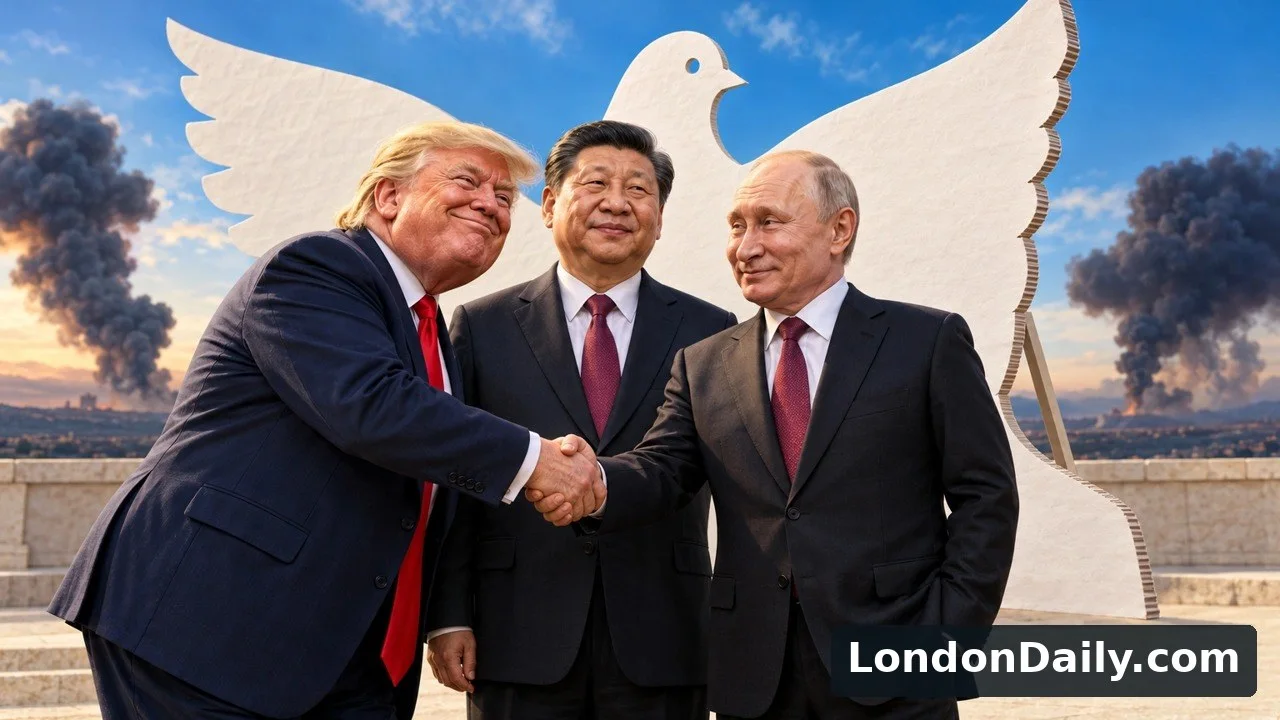
Donald Trump greeted Vladimir Putin as a friend while Xi Jinping looked on at the Apec summit in Shenzhen, prompting criticism that the American president was lending legitimacy to Russia’s leader while allowing China to dominate the diplomatic stage.
Trump clasped Putin’s hand at the opening of the gathering. On spotting him before their trilateral talks, he asked, ‘Who is he?’ and then laughed: ‘He’s my friend!’ Later, the American and Russian presidents sat on opposite sides of their Chinese host.
‘Trump greeting Putin with such warmth is beyond nauseating,’ said Daniel Shapiro, the former US ambassador to Israel. His criticism concerned the reception afforded to Putin while Russia continues its invasion of Ukraine.
Mark Almond, director of the Crisis Research Institute in Oxford, interpreted the staging as a display of American and Russian subordination to Xi. He argued that both leaders had arrived seeking Chinese help with wars and trade difficulties. That is a judgement about diplomatic power, rather than something a photograph or seating arrangement alone can establish.
Trump also told Xi: ‘It’s an honour to be your friend.’ The three leaders subsequently issued a ‘peace declaration’, although Russia’s war in Ukraine and America’s war with Iran continued. Critics on social media contrasted the declaration with allegations of killings, rape and the abduction of 20,000 Ukrainian children by Russian forces.
Almond argued that Beijing benefits from the other powers’ conflicts while expanding its own military capacity. He also accused China of supporting Russia with weapons and technology, supplying intelligence to Iran, threatening Taiwan and conducting espionage across the West.
There was little announced economic progress to accompany the diplomatic warmth. No significant business deals or trade breakthroughs emerged. Trump said aboard Air Force One that he and Xi had not discussed tariffs, following the disruption caused by his duties on Chinese and other imports last year and a subsequent temporary truce.
China accounts for a third of global manufacturing, making an escalating trade war costly for both countries. Almond argued that Trump faces the additional constraint of voters’ sensitivity to prices. He attributed Republican midterm Senate losses in Kansas, Texas and Alaska to anger over petrol costs following the Iran war, while noting that Xi faces no comparable electoral pressure.
The distinction is consequential: cordial exchanges produced neither an announced trade settlement nor an end to the wars. Whether Xi’s prominence translates into lasting concessions from Washington or Moscow remains unresolved.








Join the conversation