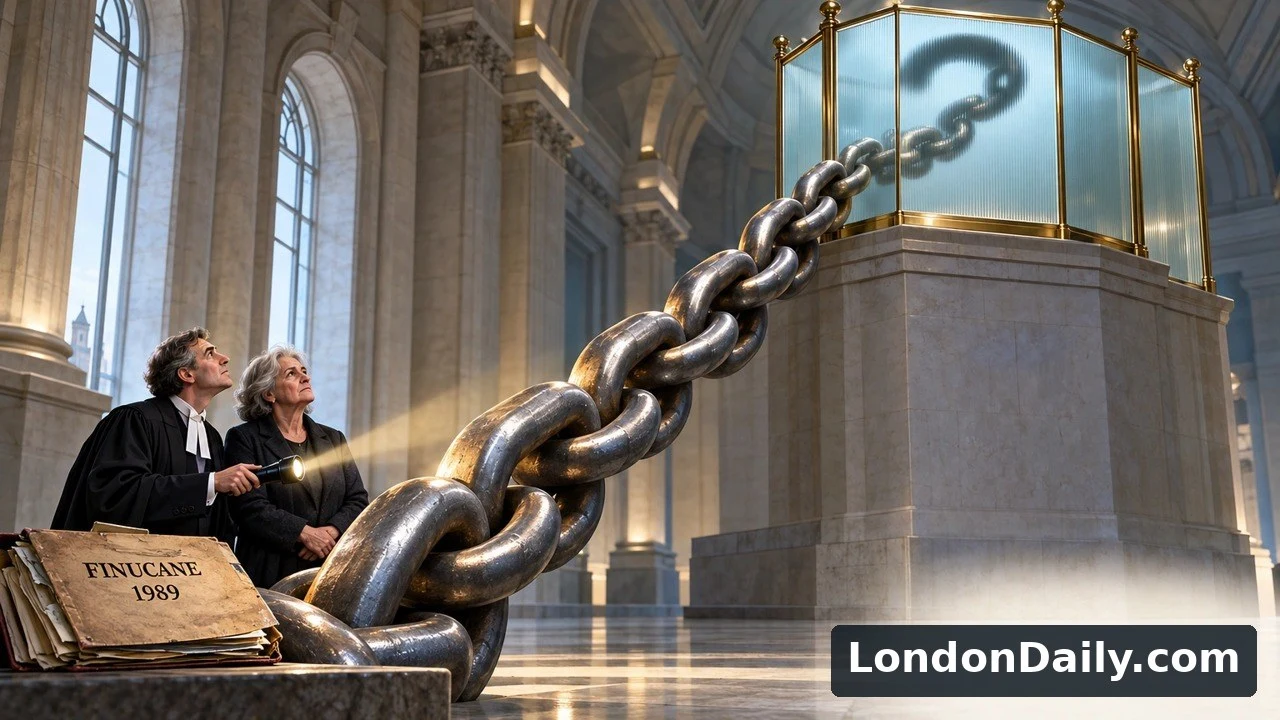
Pat Finucane was murdered because his effectiveness as a solicitor increasingly challenged Northern Ireland’s security forces, his family’s barrister has told the public inquiry into his assassination.
Danny Friedman KC, representing 21 relatives, said the inquiry must establish who instructed the gunmen and “how far up the chain of command” responsibility reached. His central contention was that the killing reflected deliberate state practices rather than institutional failure alone.
Finucane, 39, was shot dead by loyalist paramilitaries at his north Belfast home on Sunday 12 February 1989, in front of his wife Geraldine and their three children. Several previous examinations have found evidence of state collusion; the family campaigned for decades for a public inquiry to establish the extent of security force involvement.
Sir Gary Hickinbottom, the inquiry chairman, is hearing opening statements from core participants. Friedman’s submissions on Tuesday set out the family’s case, not the inquiry’s conclusions.
He argued that Northern Ireland’s emergency legal arrangements, the state’s longstanding relationship with armed loyalism and its agent system must be examined together. Finucane belonged to a generation of lawyers who began taking the state to court in the 1980s, he said. His challenge to coroner procedural rules was, Friedman argued, part of the chain of events leading to his death.
The barrister also described hostility towards Finucane when John Stalker, then Greater Manchester’s deputy chief constable, was investigating alleged security force shoot-to-kill incidents. Friedman said Royal Ulster Constabulary officers berated Stalker for speaking to Finucane at a Crumlin Road Courthouse remand hearing. He alleged that the officers knew state crimes had occurred and feared an effective lawyer might expose them.
Friedman expressly rejected any suggestion that the cabinet had collectively agreed to the murder. He nevertheless said ministers had pressed for charges not to be brought against one of the killers and had failed to order a public inquiry. The family’s position, he said, was that the relevant practices were deliberately kept outside ordinary command structures, public scrutiny and the law.
That distinction between “institutional failure or institutional design” places the inquiry’s focus beyond the gunmen themselves: on the extent of state involvement, official knowledge and responsibility.
In an interview played to the inquiry, Geraldine Finucane said: “I wanted to know who instructed the gunmen, I wanted to know how far up the chain of command this went.”
Nearly 38 years after the murder, Friedman said, she still sought those answers. Her daughter Katherine had questioned how anyone could grieve without knowing the full circumstances. He argued that the family must be able to follow the inquiry, see evidence tested and understand its answers, both to address their continuing harm and prevent repetition.








Join the conversation