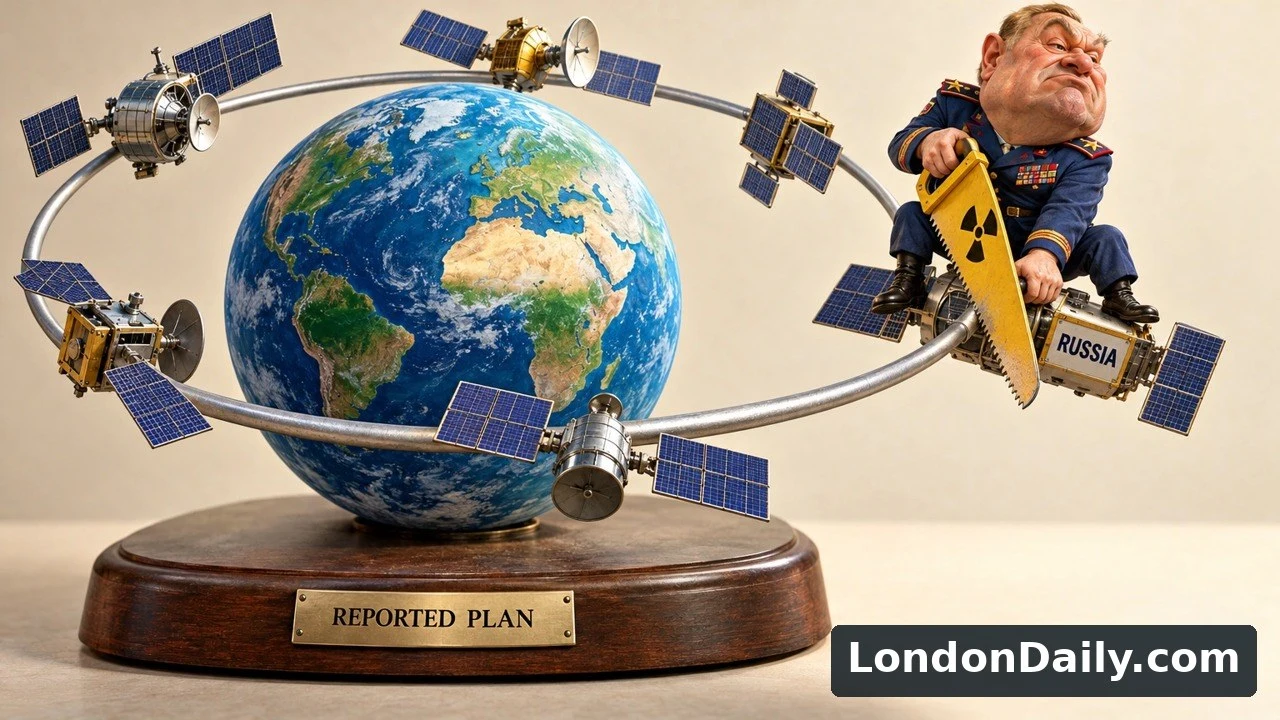
Russia has reportedly assembled a nuclear-armed satellite that could be launched within 60 days, prompting concern over a weapon whose effects could damage Moscow’s own infrastructure as well as that of its adversaries.
A joint investigation by several German media organisations attributed the warning to Germany’s foreign intelligence agency, the BND. It identified the satellite as Sputnik-S and said preparations were nearing completion. Western leaders are taking the reports seriously, although nuclear specialists question both the limited detail and the military rationale.
The potential consequences extend beyond an initial explosion. Researchers at the universities of Wisconsin-Madison and Princeton modelled a nuclear detonation 500km above Earth, releasing fast-moving electrons that become trapped in its magnetic field.
Their scenario estimated that the initial blast would disable about 3 per cent of roughly 16,000 satellites in low Earth orbit. Repeated exposure to the resulting radiation belt would raise that figure to 98 per cent within a week. This is a modelled outcome, not a demonstrated capability of the reported Russian satellite.
Communications, GPS navigation and weather monitoring would be vulnerable. Elon Musk’s SpaceX operates about 65 per cent of low-orbit satellites, making it particularly exposed. Its Starlink internet service supports Ukraine’s battlefield capabilities against Russia.
There is historical evidence of the danger. During the early-1960s Starfish Prime test, a US thermonuclear explosion at an altitude of 400km south-west of Hawaii crippled a third of the world’s satellites and knocked out 300 Hawaiian street lights.
Dr Bleddyn Bowen, an associate professor of astropolitics at Durham University, questions why Moscow would put a nuclear weapon in orbit when an existing ground-launched missile could deliver one into space. Orbiting warheads would themselves be vulnerable and inaccessible for physical maintenance, potentially for years, leaving uncertainty over their reliability.
“You don’t really gain much from doing that,” he said.
Bowen, who has advised the Ministry of Defence and US Space Force, also warned that the effects would be indiscriminate. Russian and Chinese satellites could suffer alongside Nato infrastructure, while an electromagnetic pulse could disrupt terrestrial electricity grids. Western Russia’s proximity to Europe would offer no immunity.
He said the reported plan would breach the 1967 Outer Space Treaty and the 1963 Partial Nuclear Test Ban Treaty, and suggested it might amount to Russian “sabre-rattling”.
The distinction is between a reported deployment plan and a decision to use such a weapon. Bowen warned that a space detonation could be interpreted as the opening wave of a nuclear strike, prompting retaliation: doubts about its military usefulness do not remove the risk of escalation.








Join the conversation