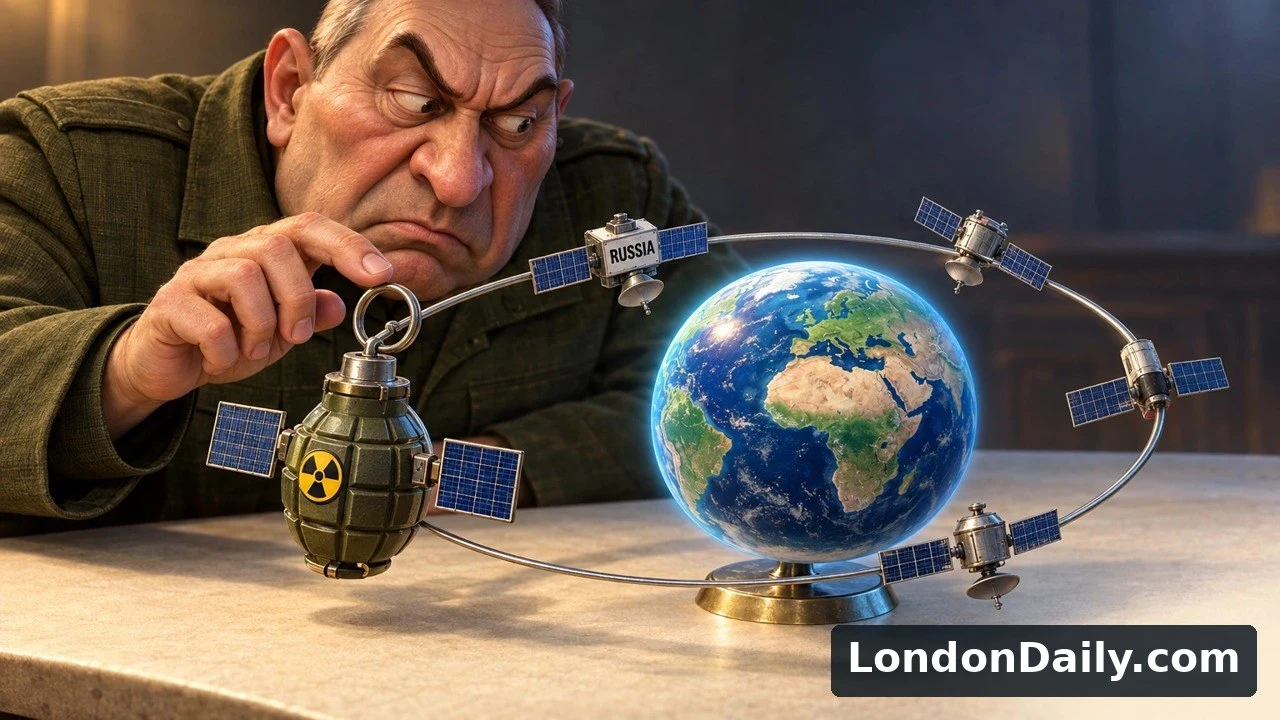
Russia could launch a nuclear-enabled satellite named Sputnik-S within 60 days and have it operational shortly afterwards, German reports citing western intelligence assessments suggest, prompting warnings about damage lasting years if a weapon were detonated in orbit.
NDR, WDR and Süddeutsche Zeitung reported that western intelligence services, including Germany’s Bundesnachrichtendienst, and armed forces had exchanged information indicating the satellite was assembled several years ago and is stationed in the Moscow region. A German government spokesperson said the intelligence reports were being taken “very seriously”.
The distinction between launching a satellite and detonating a weapon is crucial. Specialists describe potentially extensive damage, but question whether Moscow would accept the consequences for its own spacecraft.
Without an atmosphere, a nuclear explosion produces no mushroom cloud: its energy is released as radiation. Jonathan McDowell, an astrophysicist and honorary professor at Durham University’s Space Research Centre, said X-rays and other radiation could damage satellites within line of sight across thousands of miles. Trapped particles could then create an artificial radiation belt, threatening spacecraft for several years, potentially a decade.
About 17,000 satellites occupy low Earth orbit, extending up to 1,200 miles above Earth. They support weather forecasting, climate monitoring and military operations. They include Starlink, Elon Musk’s broadband network, which is crucial to Ukraine’s resistance to Russia’s invasion. The International Space Station, with Russia as a partner, is also there, as would be Musk’s proposed space datacentres. Higher-orbit television, GPS and communications satellites would be harder to affect.
Keith Ryden, professor of space engineering at Surrey University, said low-orbit satellites were not designed for unexpectedly high radiation levels. Replacing them would present another constraint: the industry could not rapidly rebuild and launch the spacecraft required.
There is a precedent. The US Starfish Prime nuclear test in 1962, 250 miles above Earth, shortened the lives of Telstar 1 and Ariel-1. McDowell said severe radiation affected at least half the satellites then operating, while its artificial belt persisted for five years. In Hawaii, streetlights failed, alarms sounded and telephone calls were disrupted. A future explosion could similarly affect electronics below, depending on location, and produce enormous auroral displays.
A European security official doubted Russia would detonate a device: damage to western economies could also come at the expense of Russian and potentially Chinese satellites. Citing Russia’s nuclear alert and subsequent troop and weapons movements in 2022, the official said: “They were bluffing then – and this looks like a bluff now”. McDowell was also sceptical, arguing that detonation would be viewed as an act of war.








Join the conversation