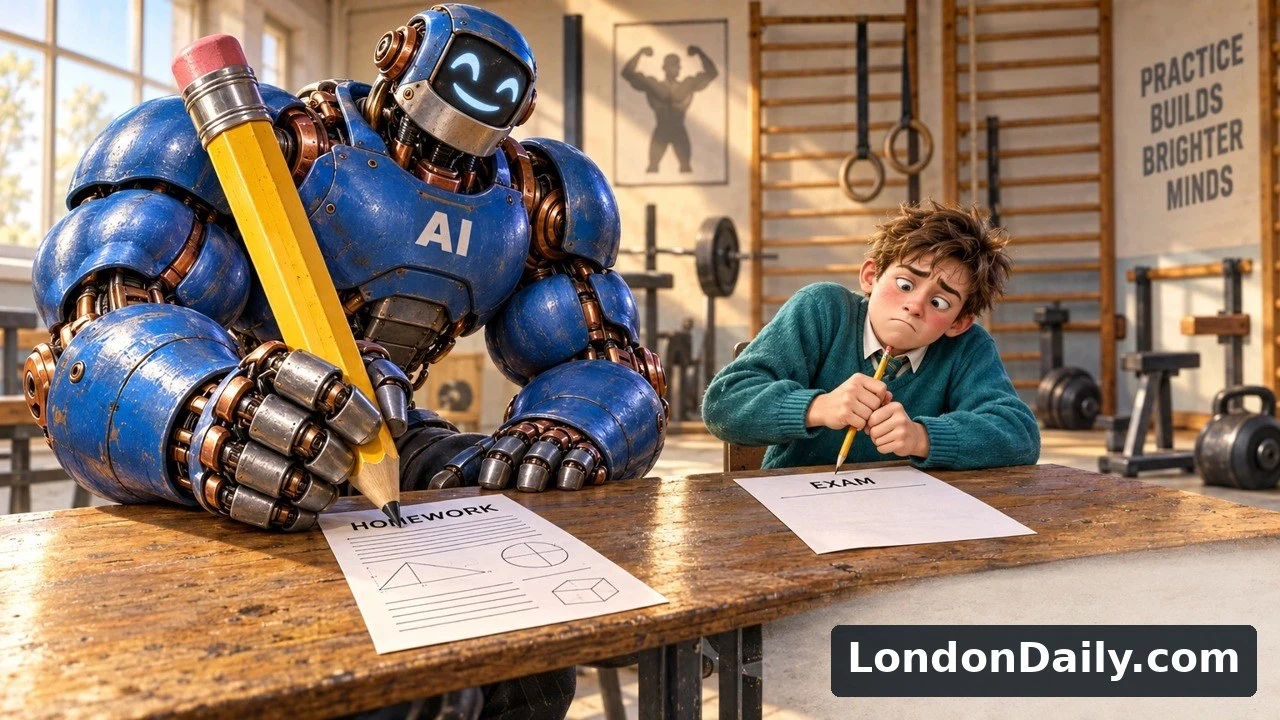
Secondary pupils using AI produced better homework more quickly but performed worse in exams without it, a Chinese study found, exposing a gap between completing an assignment and learning enough to work independently.
The 2026 research followed more than 26,000 students over two and a half years. Unaided exam scores fell by up to 24 per cent, with greater AI use associated with larger falls. That finding does not mean every educational use has the same effect: a 2025 Harvard physics study found students using a purpose-built AI tutor, offering one step at a time, learned more than twice as much in less time.
Rose Luckin, professor emerita at UCL, draws the distinction plainly: “It makes them lazier when it does the thinking for them, and sharper when it makes them explain their thinking.” She argues that assignments need redesigning so students cannot simply delegate the intellectual work.
The scale of adoption makes that an immediate challenge. A survey of more than 2,000 UK children for Safer Internet Day 2026 found 97 per cent of eight- to 17-year-olds used AI tools. The Higher Education Policy Institute’s 2026 undergraduate survey found 94 per cent used generative AI to support assessed work. One respondent said: “I’m not using my brain at all.” Teacher Tapp found the share of secondary teachers reporting unauthorised pupil use rose from 15 per cent in 2023 to 58 per cent in 2026.
Young people also face difficulty obtaining the workplace experience needed to judge AI’s answers. London’s online job adverts fell 64 per cent between their May 2022 peak and February 2026. Nearly a quarter of economically active 16- to 24-year-olds in the capital were unemployed early in 2026. Only 17 per cent of London’s 16- to 18-year-old leavers entered sustained work or apprenticeships in 2022–23, against 25 per cent in Greater Manchester.
Daniel Reast, a Centre for London senior researcher and co-author of Held Back, says hiring costs and economic weakness remain bigger causes than AI. Its contribution cannot yet credibly be quantified, he cautions, although it is becoming an additional structural pressure.
Luckin advises students to attempt an answer before asking AI to challenge it. Author Daniel Susskind recommends teaching and testing skills both with and without AI, grounded in reading, writing, maths and independent thinking.
Reast argues that employers removing routine tasks should replace their training value through supervised projects, mentoring and clear progression. London employer investment in training fell by more than 45 per cent in real terms between 2011 and 2024: removing junior work without replacing its learning value risks weakening the route to expertise.








Join the conversation