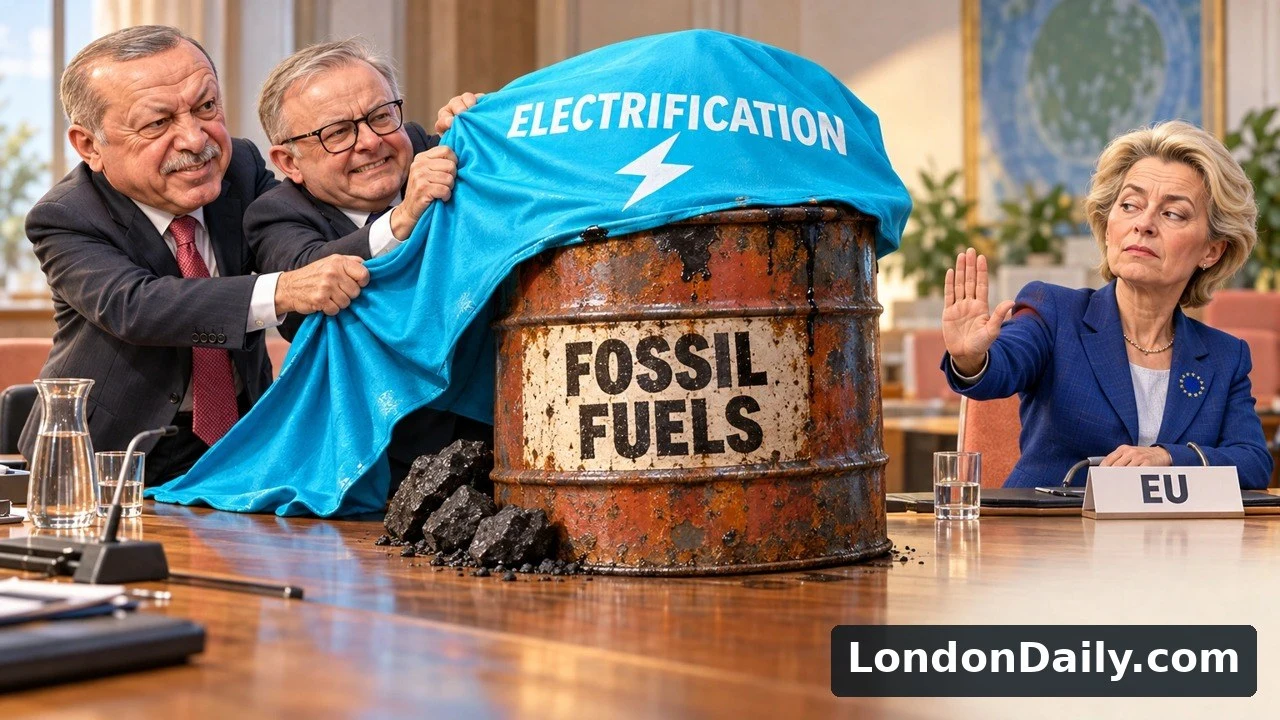
COP31 ended in Antalya, Turkey, two days late without an overarching agreement after the European Union and several other countries rejected a compromise that left fossil fuels out of the summit’s cover text.
Saudi Arabia and Russia blocked references to fossil fuels in negotiating outcomes and the proposed declaration. Turkish and Australian conveners instead offered support for electrification “with the greatest possible use of clean energy”. That appeared acceptable to Saudi Arabia, but the EU, Panama, the Marshall Islands, Vanuatu and Belize rejected it.
The impasse follows COP28’s agreement in Dubai to “transition away from fossil fuels”. It also exposed a distinction: countries could support greater electrification without accepting it as a substitute for addressing fossil fuels. Outside formal negotiations, more than 75 countries and 180 businesses backed a pledge to raise electricity’s share of global final energy use from around 23% to 35% by 2035, including the EU and China.
The hosts’ positions illustrated the tension. Turkish President Recep Tayyip Erdoğan announced two huge oilfields in his opening speech. Australian Prime Minister Anthony Albanese highlighted existential risks to Pacific countries without committing to stop approving new coal and gas projects.
The failed cover text does not dissolve the Paris Agreement: such declarations supplement, rather than constitute, formal negotiations. There was narrower progress on a fair transition to clean energy and alignment of adaptation planning. But Saudi Arabia and Russia also blocked an emissions decision, leaving no dedicated negotiating process on emissions cuts under Paris. A mitigation work programme could be renewed at COP32 in Ethiopia.
Money remained another dividing line. Developed countries demanded faster emissions reductions; developing nations, particularly African countries, argued that implementation required resources. EU climate commissioner Wopke Hoekstra urged delivery of existing pledges rather than fresh commitments.
No concrete progress followed on tripling adaptation finance. Australia and other wealthy countries repeated existing Pacific climate fund pledges, leaving it A$450 million short of its 2026 target of $749 million. Canada and Norway made some new commitments; Solomon Islands Prime Minister Matthew Wale pledged $600,000 to the separate Green Climate Fund.
Australia’s negotiations chief Chris Bowen cited “unbridgeable red lines”. Fiji’s climate minister, Lynda Tabuya, said responsibility belonged to all parties. UN Secretary-General Antonio Guterres blamed “powerful fossil fuel interests”; former UN climate chief Christiana Figueres has described refusing an inadequate deal as potentially “a sign of courage”.
Alternative cooperation is advancing: Brazil’s fossil fuel phase-out roadmap attracted India, Germany and Nigeria, while 57 nations attended a separate transition conference in Colombia. Reforming COP voting would itself require consensus. The rule giving nearly every country a voice also allows determined opponents to block agreement.








Join the conversation