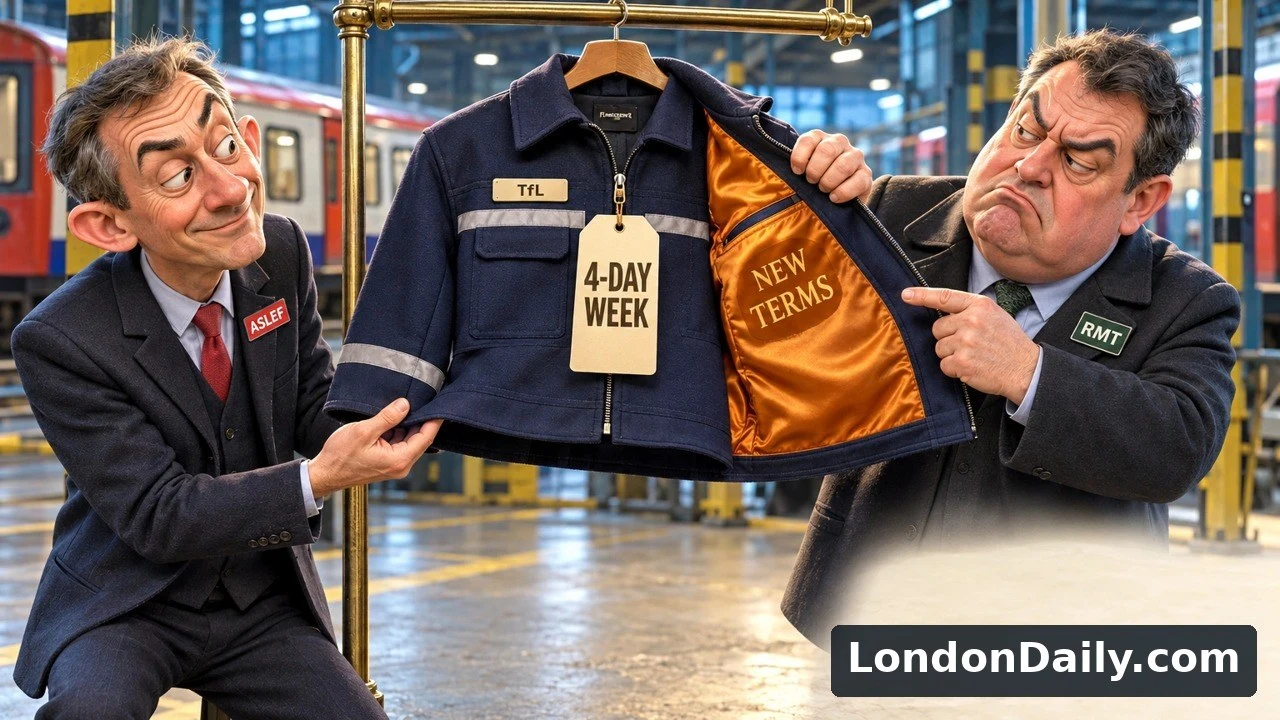
ASLEF has challenged the RMT’s decision to stage eight Tube strikes over a voluntary four-day week, saying management has guaranteed that drivers who retain a five-day week will suffer no detriment.
The disagreement between the unions centres on whether the reforms offer a genuine choice without worsening working conditions. The RMT has rejected a revised Transport for London proposal intended to resolve concerns about drivers having to change depot.
Finn Brennan, ASLEF’s full-time organiser on London Underground, said the union was surprised by the industrial action. He said: “Management have agreed that anyone who wants to keep working a five-day week will be able to do so without suffering any detriment, and we will be holding them to that.”
He added: “A strike designed to stop people having the choice of a shorter working week and more time off is a strange choice to make.”
RMT general secretary Eddie Dempsey offered a different assessment: “London Underground is attempting to dress up a wholesale attack on drivers' working conditions as a voluntary four-day week.”
Drivers were initially offered two options. They could move to a 34-hour, four-day week under new terms and conditions, with a few additional days each year spent on non-driving duties such as safety training. Alternatively, they could retain their current terms, working 38.5 hours a week with time off in lieu for weekly hours beyond 35.
The practical difficulty was rostering both patterns at the same depot. Some drivers choosing five days therefore faced a depot move.
TfL subsequently offered a third arrangement: 36 hours over five days, under new terms and conditions, retaining the same leave allowance and depot. The RMT rejected it. Nick Dent, London Underground’s director of customer operations, said: “Drivers can now choose to remain on a five-day week with a guarantee of remaining at the same depot.”
The Conservatives described the RMT as “militant”, while Reform UK accused it of “holding London to ransom”. Earlier strikes this year disrupted most lines.
The eight strikes are scheduled for 26 November, 17 and 19 December 2026, followed by 4 and 6 January and 17, 23 and 25 February 2027.
The distinction matters: the latest offer protects a five-day pattern and depot placement, but introduces new contractual terms. That concession has not resolved the RMT’s objection to the wider changes.








Join the conversation