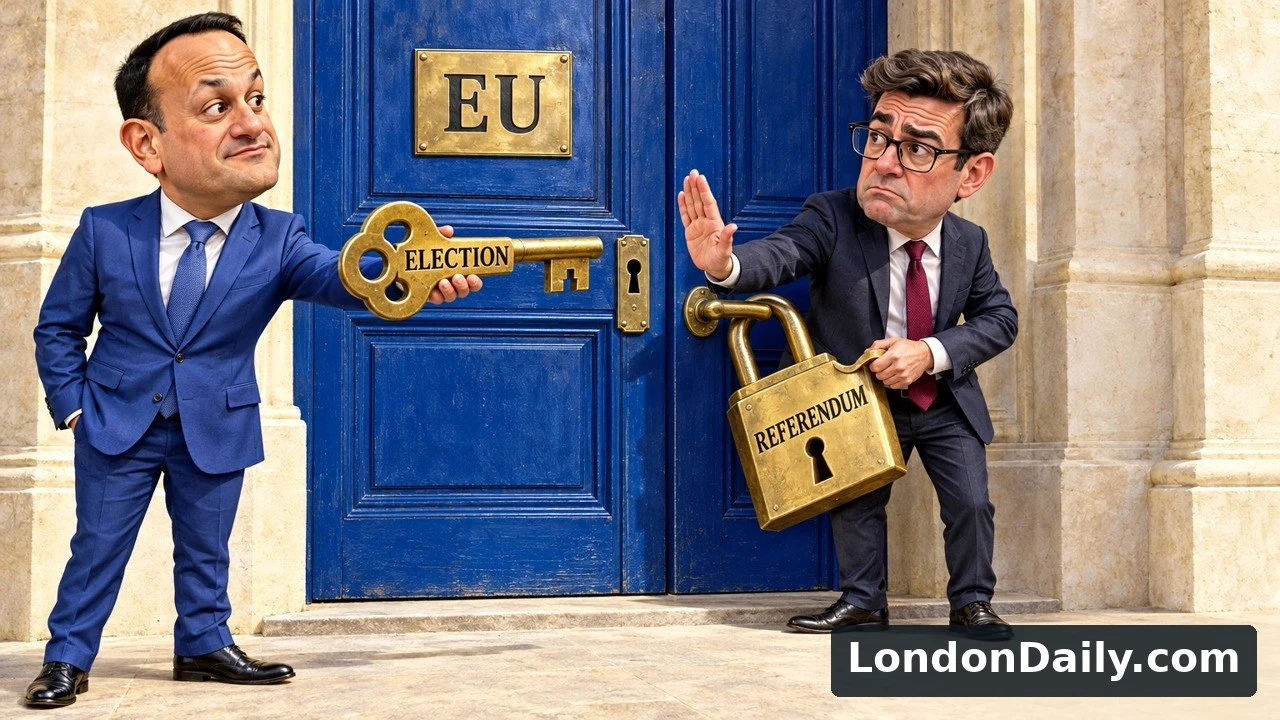
Leo Varadkar has urged Prime Minister Andy Burnham to call an election sooner rather than later with a pledge to take Britain back into the European Union, arguing that an electoral mandate could remove the need for a separate referendum.
The former Taoiseach acknowledged that Burnham had inherited a government without a mandate to rejoin. His proposal is to seek that authority from voters at the next election, making EU membership a central campaign commitment rather than leaving it outside the political choices on offer.
“My ideal scenario would be for Prime Minister Burnham to take a decision to go to the country sooner rather than later, and to make joining the European Union part of that pitch,” Varadkar said.
Speaking at the Brexit Institute in Dublin City University’s Polaris Building, he cited polling which he said suggested that most British people regarded Brexit as a mistake and wanted to rejoin. He also pointed to some polling evidence that prospective Green and Liberal Democrat voters might switch to Labour if doing so offered a route back into the EU.
His constitutional argument rests on parliamentary supremacy: he said a referendum was not required and an election could instead provide the mandate. That is distinct from Burnham’s political commitment. Presenting his EU agreement to MPs on Monday, the Prime Minister said Britain would not rejoin without a referendum and rejected accusations that the deal was a prelude to such a vote.
The agreement, brokered at the EU-UK summit in Brussels last week, covered food and agriculture exports, emissions trading and a youth experience scheme. Its outcomes were the focus of Varadkar’s keynote at an event on economic, defence and security relations, held as part of Ireland’s EU presidency.
Varadkar argued that Burnham’s political honeymoon made early action preferable. He also suggested that rejoining could be completed within one parliamentary term, reasoning that Britain had been outside the bloc for a relatively short period and had converted most European laws into domestic law. That was his assessment, not an agreed accession timetable.
For Ireland, he described closer UK-EU relations and eventual British membership as the best political and economic outcome, while stressing that Ireland would still have to chart its own course.








Join the conversation