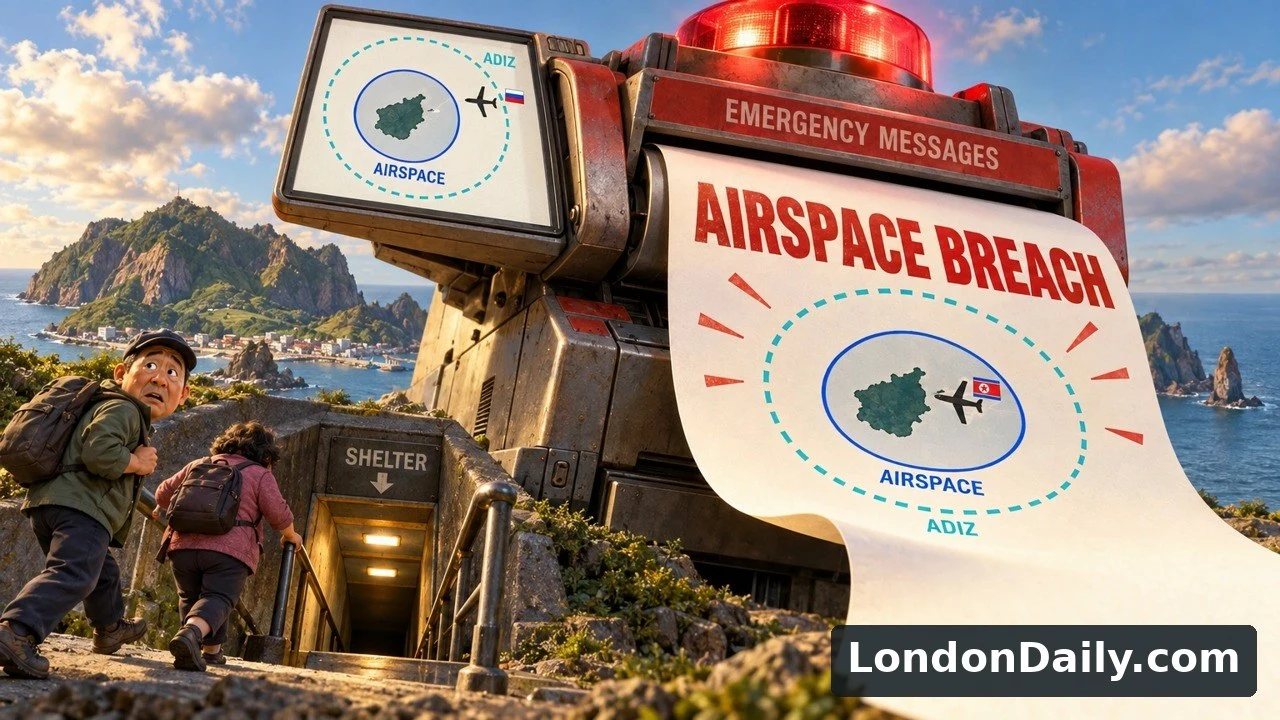
South Korea scrambled fighter jets and briefly urged residents of Ulleung Island to take shelter after Russian warplanes entered its air defence identification zone, but erroneous official messages suggested a territorial airspace breach and wrongly identified the aircraft as North Korean.
The alert caused confusion among the island’s estimated 9,000 residents, 130km east of the Korean peninsula. Issued at 7.52am, it urged people to evacuate to underground shelters. Authorities lifted it three minutes later, saying the aircraft had left the area.
The interior ministry had incorrectly reported that the warplanes breached South Korea’s territorial airspace. The Joint Chiefs of Staff subsequently clarified that they entered only the identification zone over the East Sea, also known as the Sea of Japan.
That distinction matters: an identification zone extends beyond territorial airspace and is used to detect and monitor approaching aircraft for national security. A foreign military incursion into territorial airspace would represent a major escalation.
North Gyeongsang’s provincial government compounded the confusion with a separate message lifting the warning but describing the planes as suspected North Korean aircraft. It corrected their nationality only about 40 minutes later, without explaining the error. Its correction still described an airspace violation, contrary to the military’s subsequent clarification.
Misidentifying the aircraft as North Korean carried particular risks because the two Koreas remain technically at war. The Joint Chiefs of Staff explicitly rejected reports that a suspected North Korean aircraft had violated South Korean airspace.
Military spokesperson Jang Do Young said the Russian aircraft flew close to territorial airspace around Ulleung, prompting coordination with the government over the evacuation alert. Asked whether miscommunication with the safety ministry caused the erroneous warning, he said the military needed to examine the matter further. He suggested the provincial government may have mistakenly sent a message intended for a training exercise.
The defence ministry said the Russian aircraft departed while South Korean forces were taking military measures, including deploying fighters. It did not immediately disclose their number or type, and said it would summon Russia’s military attaché on Tuesday morning to protest.
The encounter follows another on 17 November, when Russian aircraft entered the same identification zone without crossing into territorial airspace. Japan reported that suspected Russian jets briefly entered its airspace that day and protested to Moscow. In the latest incident, why South Korea’s public warnings diverged from the military account remains unresolved.








Join the conversation