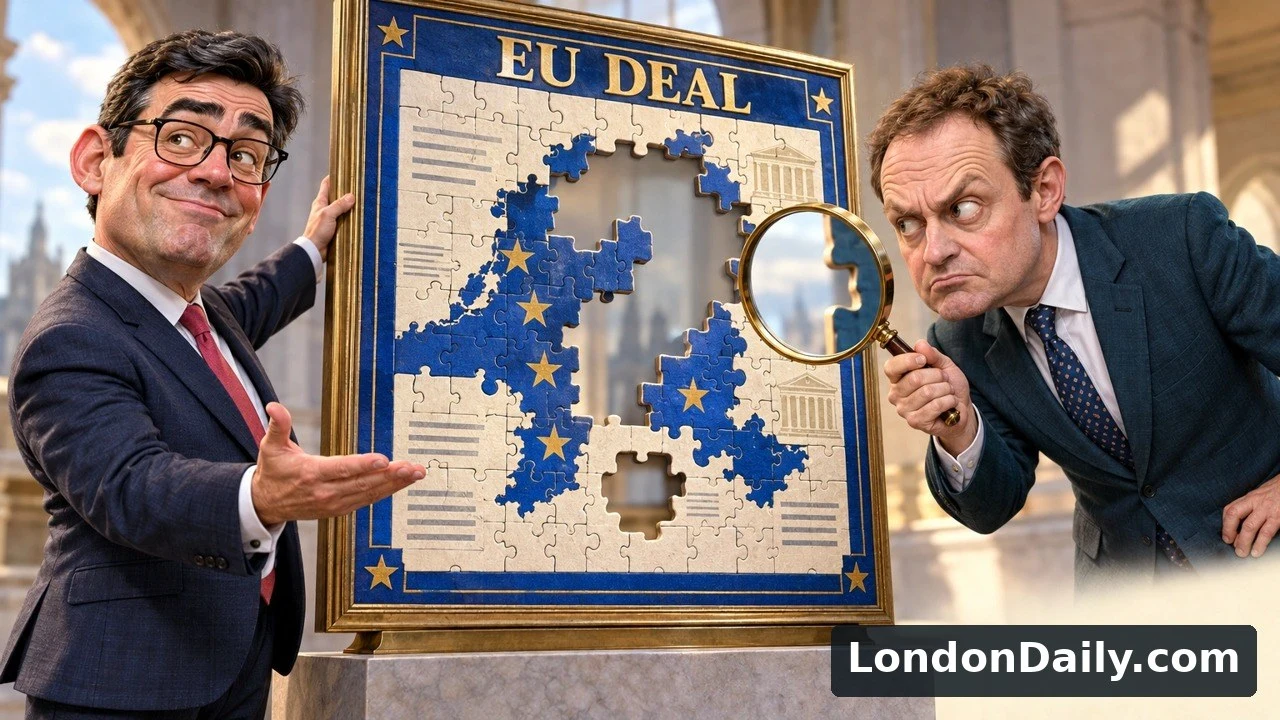
Shadow Foreign Secretary Tom Tugendhat has challenged Andy Burnham to explain which EU laws Britain would accept under his announced agreement, arguing that unresolved questions over parliamentary scrutiny and costs could leave businesses unable to plan.
Burnham announced a deal in Brussels on Friday. Tugendhat disputes how much has been settled, describing a statement welcoming the conclusion of negotiations on food and farming, carbon markets and a youth scheme, accompanied by dates presented as aims rather than firm commitments.
The distinction matters: concluding negotiations does not itself explain how an agreement will operate. Tugendhat says Britain is expected to follow changes to EU food and farming laws after March 2028, but asks which laws, who would settle disputes and what role Parliament would retain. He also questions the implications for existing treaties with Australia and India.
Universities face a separate uncertainty over fees for European students. Tugendhat cites a Russell Group estimate of £570 million a year and says answers are promised within six months. He also cites vice-chancellors’ warnings that the arrangements could bankrupt institutions. These are estimates and warnings, not established losses under a completed agreement.
His wider objection is that another regulatory transition could consume money and political attention without resolving Britain’s underlying economic problems. He says chemical companies spent about £500 million registering products under EU rules, then more under Britain’s system, and could face further expense. For farmers and manufacturers, his argument is that uncertainty over who sets the rules can delay planting and investment decisions.
Tugendhat also argues that finance, services and research depend on regulations Britain must be able to shape. He says the City rebuilt its business after losing its EU passport and should now concentrate on generating investment. His position is not that Brexit solved every problem, but that rejoining would not do so either. He says ministers have left rejoining on the table without specifying a timetable or cost.
He portrays EU rules as difficult to change because they embody bargains between member states, and argues that this constrains technological innovation. He also points to Marine Le Pen’s reported polling lead five months before France votes and the AfD’s influence in Germany as reasons European leaders may be preoccupied with their own politics.
His proposed alternative combines technological development with stronger security co-operation through the Joint Expeditionary Force, which brings together 10 Nato nations guarding the Baltic and High North. With Russia’s war in Ukraine continuing, he argues that Britain should prioritise future alliances rather than reopen past arrangements.








Join the conversation