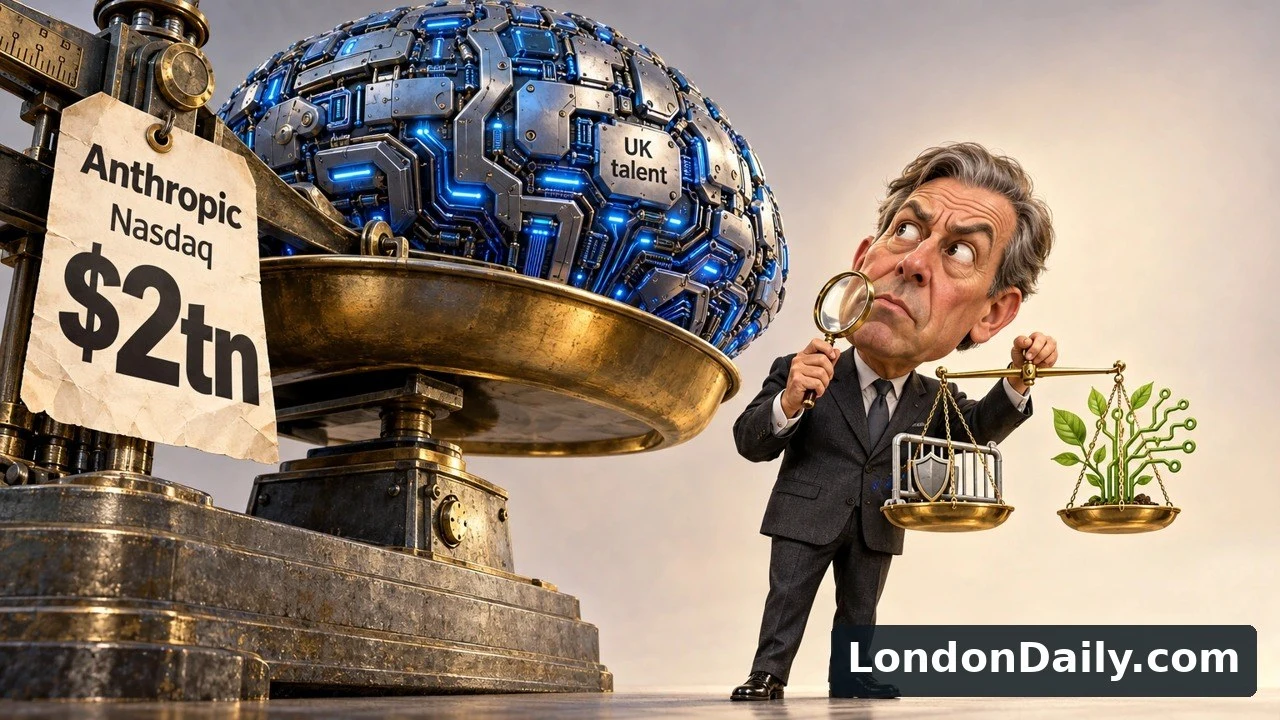
Anthropic reached a $2tn valuation as trading began on Nasdaq on Thursday, creating vast paper fortunes and sharpening Britain’s debate over how to turn its AI research strength into domestic business growth.
The company sold 980 million shares at $83 (£63) each, valuing it at $1.5tn before a 34% opening surge. Some analysts regard the flotation as evidence of lasting momentum; others see late-cycle exuberance. A soaring valuation establishes investor appetite, not which assessment will prove correct.
Each of Anthropic’s seven co-founders held around 1.4%, worth roughly $20bn before the rise. They include siblings Dario and Daniela Amodei and Britain’s Jack Clark, and have pledged 80% of their equity to charity. Another 600 employees hold shares valued at $100m apiece, while thousands more have become paper millionaires.
Anthropic employs around 200 people in Britain, mostly in King’s Cross’s Knowledge Quarter, alongside Google DeepMind, OpenAI and Meta. Britain also launched two government-backed research laboratories in June: one developing open-source AI for widely available hardware, the other exploring learning without vast centralised computing resources.
The gap between research capability and ownership of major businesses predates the current regulatory argument. Arm was sold to SoftBank for £23bn under Theresa May and, ten years later, is worth £200bn following its Nasdaq listing. Google bought DeepMind for £400m in 2014; it now develops and powers Gemini. These histories inform concern about retaining British companies, but do not establish that regulation caused their sale.
Critics of tighter rules warn that Britain could constrain innovation while the US and China foster expansion. Business Secretary Jonathan Reynolds has called for a “noble balance” between safety and innovation, describing greater regulatory flexibility than the EU’s as a Brexit “silver lining”. AI minister Kanishka Narayan likewise identifies a trade-off between public protection and domestic capabilities.
Those seeking binding safeguards cite a different risk. Control AI says its campaign has 180 parliamentary signatories, including former AI minister Jonathan Berry. The joint committee on human rights, chaired by Alex Sobel, called in September for dedicated legislation, arguing existing laws were inadequate. Liam Byrne’s Commons committee also sought to close safeguard gaps.
Ed Miliband said: “The lesson of history is that we cannot leave it to corporations to put in place the guardrails to serve the public interest.” Anthropic’s prospectus itself warns of risks.
Britain’s opportunities include engineering and drug discovery, involving Rolls-Royce, AstraZeneca and GSK. Sir Demis Hassabis’s Isomorphic Labs has raised $5bn at a $50bn valuation. Retaining businesses of that scale, while deciding which safeguards they require, remains a more concrete policy test than matching an American flotation.








Join the conversation