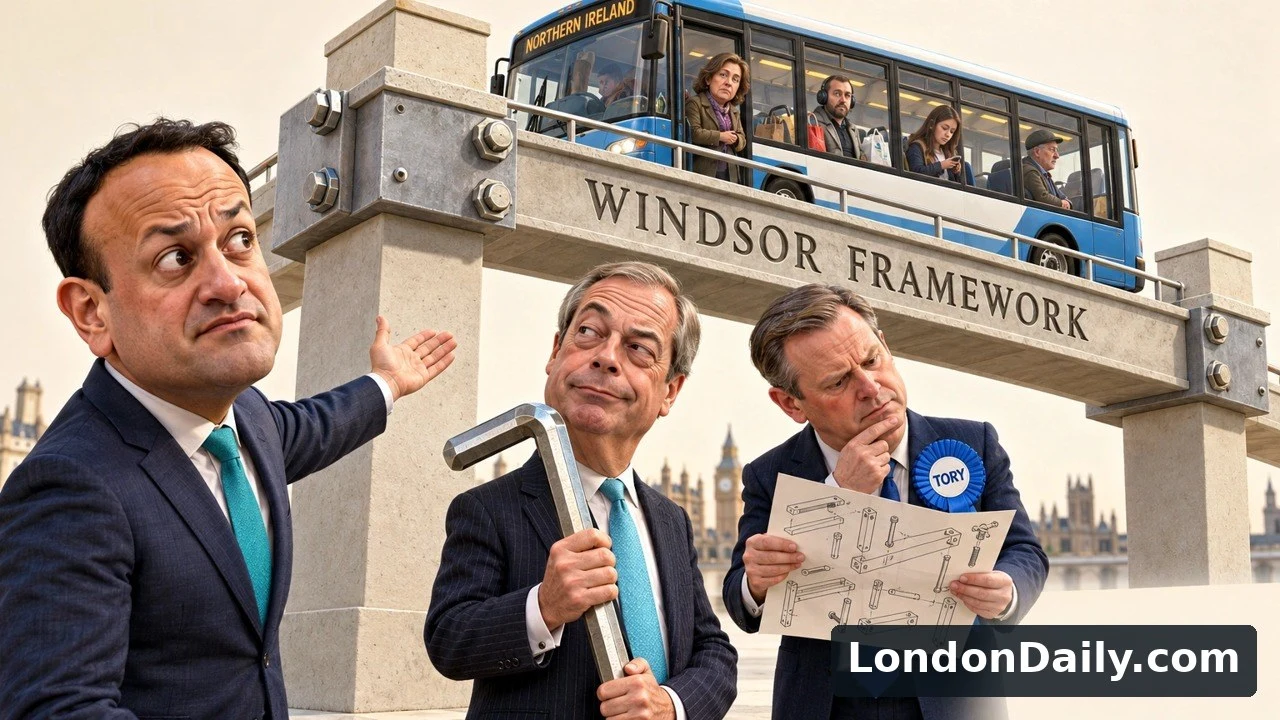
A future Conservative or Reform government could try to dismantle the Windsor Framework and reopen uncertainty over Northern Ireland’s trading arrangements and position within the UK, former Irish prime minister Leo Varadkar has warned.
Speaking at the Brexit Institute in Dublin City University’s Polaris Building, Varadkar said the risk applied to either party governing alone or to a coalition between them. He argued that their approach could reverse the current Labour government’s efforts to draw closer to the European Union.
The Windsor Framework, like its predecessor the Northern Ireland Protocol, was intended to reduce post-Brexit trading friction between Great Britain and Northern Ireland. Varadkar’s concern is that a change of government could unsettle those arrangements rather than simply alter relations between London and Brussels.
He contrasted the UK opposition with right-wing and populist parties elsewhere in Europe, saying few now advocated leaving the EU or the euro after seeing Brexit unfold. The Conservatives and Reform, he said, remained opposed to rejoining and to the recent UK–EU deal.
Both parties have pledged to withdraw the UK from the European Convention on Human Rights. Varadkar said withdrawal would breach the Good Friday Agreement, pointing to the convention’s place in that agreement and the UK–EU Trade and Co-operation Agreement.
He warned of a possible return to the uncertainty of 2018 and 2019, including the prospect of a hard or no-deal Brexit. That was his assessment of a future political risk, not an announcement that either party had decided to scrap the framework.
Reform’s immigration proposals provided a more immediate example of his concerns. In September, Nigel Farage’s party proposed spot checks on buses and trains entering Northern Ireland from Ireland. Varadkar referred more broadly to Reform politicians discussing passport checks in both directions.
He acknowledged that random immigration checks already took place, but distinguished those from a requirement to carry a passport when travelling to Belfast.
Varadkar also suggested that a future Labour government might take the UK back into the EU, presenting that as a possibility rather than an announced policy. His central warning was about the distance between possible outcomes after the next election: closer European ties on one hand, or renewed confrontation over Brexit on the other, with Northern Ireland left facing the consequences.








Join the conversation