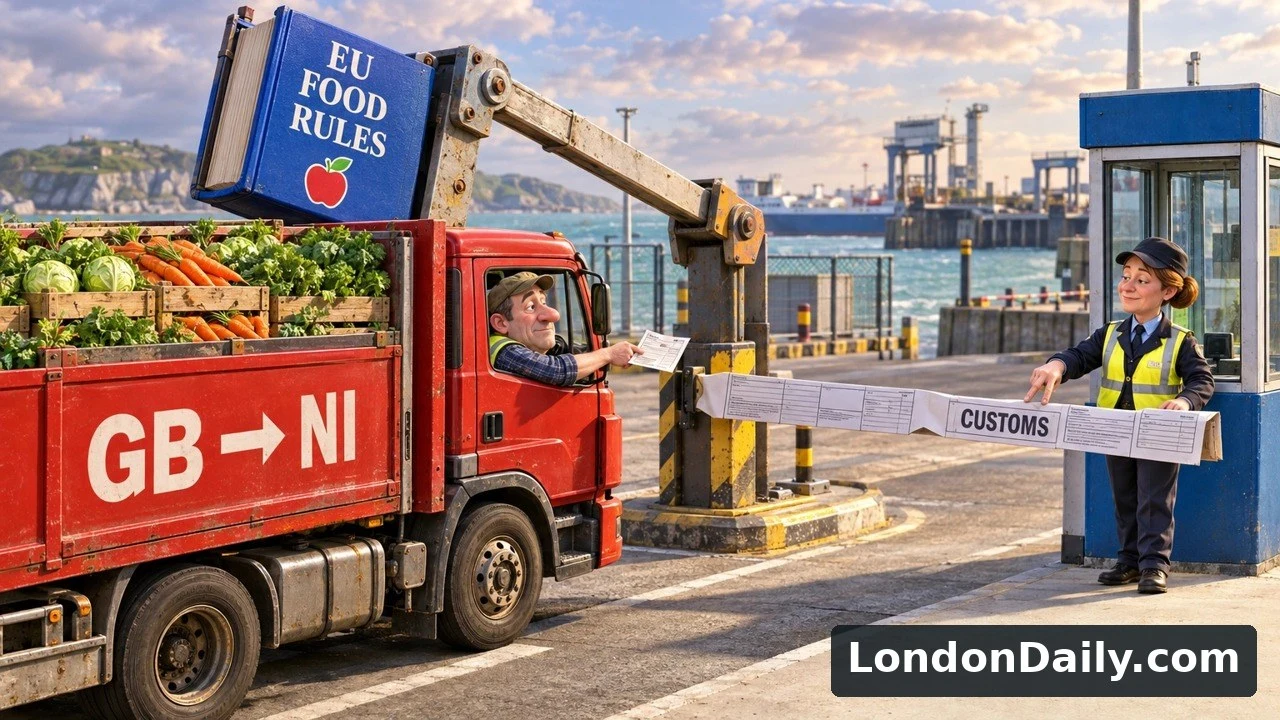
The UK and EU are finalising an agreement expected to end most regulatory checks on agri-food goods moving from Great Britain to Northern Ireland, while leaving the customs border intact.
Confirmation is expected when Prime Minister Andy Burnham meets European Commission President Ursula von der Leyen in Brussels. The proposed agreement would bring the whole UK into alignment with EU rules on food, plants and animals, removing a principal source of post-Brexit trade friction.
Northern Ireland has continued to follow those rules while Great Britain has diverged. Under the new arrangement, regulatory port checks on these goods would largely end, border control posts would become largely redundant and “Not for EU” labels would no longer be required. Livestock checks that pre-date Brexit would continue.
The model is Switzerland’s relationship with the EU: dynamic alignment, requiring domestic laws to change when EU legislation changes. Switzerland follows the rules with little influence over their creation and accepts European Court of Justice oversight.
For businesses, the distinction between standards and customs is crucial. Alignment would substantially remove barriers concerning whether products may legally be sold, but not those concerning tariffs. Customs declarations would remain compulsory, with incorrect paperwork still risking delays.
The arrangements originated in the 2019 Brexit agreement, revised in 2023 as the Windsor Framework. Keeping Northern Ireland under EU goods rules was intended to preserve an open border with the Republic of Ireland. Many nationalists regard this as a necessary compromise; many unionists see the resulting restrictions within the UK as undermining Northern Ireland’s constitutional position. The Democratic Unionist Party blocked power-sharing between 2022 and 2024 in protest.
Economy Minister Caoimhe Archibald welcomed the prospect of reduced trade friction, saying “it's positive, it's moving in the right direction”. She described Brexit as “an act of economic self-harm for Britain” and also welcomed suggested youth mobility measures.
Separately, the DUP, Ulster Unionist Party and Traditional Unionist Voice criticised Northern Ireland Secretary Sir Chris Bryant’s decision on Tuesday not to use the Stormont Brake to block updated EU customs rules. They argued that the changes would restrict access to essential inputs and finished goods from Great Britain.
Electricity market integration is excluded from this agreement, despite speculation that it would feature. Northern Ireland’s energy regulator estimates that linking the UK and EU electricity markets could reduce local wholesale prices by up to 20%; that is not a promised equivalent reduction in household bills.
Those negotiations continue. The UK government says it is seeking an agreement to cut household and business bills and strengthen energy security, but has declined to give a running commentary.








Join the conversation