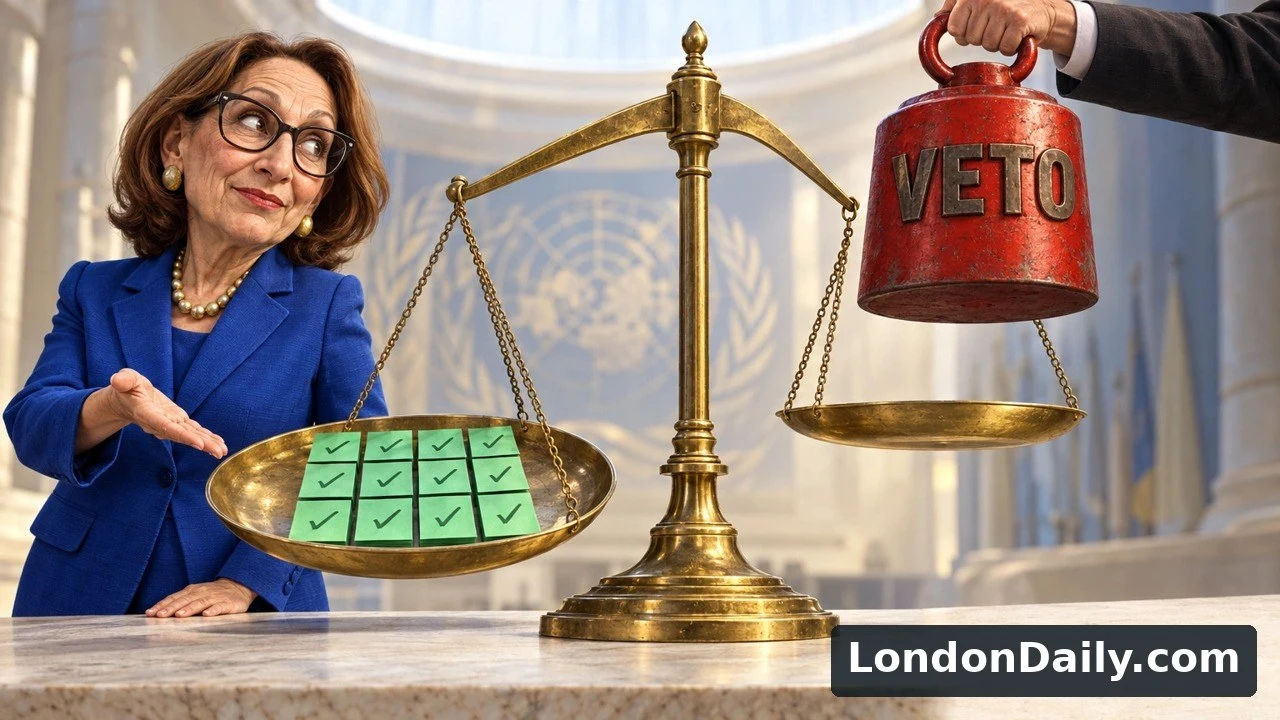
Rebeca Grynspan could be blocked from becoming UN secretary general despite winning support from 12 of the Security Council’s 15 members, with Friday’s ballot expected to expose whether permanent-member opposition still stands in her way.
The Costa Rican economist and UN insider has led seven of eight straw polls since voting began on 30 July. Yet numerical strength alone cannot secure the post: a candidate needs at least nine votes and no veto from any of the five permanent members before being recommended to the General Assembly.
Grynspan received 12 favourable votes and three negative votes on 5 November. In the only previous colour-coded ballot, on 16 October, two permanent members voted to discourage her candidature. Russia and the United States are thought to oppose her, although individual countries’ votes remain secret.
Friday’s poll is scheduled to use red ballots for permanent members and white for the 10 elected members. It should therefore distinguish opposition carrying a potential veto from other negative votes, without identifying each country. After a 140-day deadlock, that distinction could matter more than who tops the tally.
Lana Nusseibeh, the United Arab Emirates’ late entrant, presents the reverse problem. She has American and Russian backing, but in both polls she has contested secured only seven “encourage” votes, six “discourage” votes and two expressions of “no opinion”.
Her diplomatic skills and major-power support have not overcome objections to the UAE’s regional activities or Latin American demands for their region’s turn under an informal rotation principle. Panama and Colombia oppose her on that basis; China has also supported rotation.
Other criticism concerns what opponents call the UAE’s “dollar diplomacy”. Somalia’s president, Hassan Sheikh Mohamud, accused the UAE this week of buying ports, establishing military bases and supporting armed forces outside Somalia’s national security framework without federal approval.
Nusseibeh has denied UAE involvement in arming Sudan’s Rapid Support Forces and says peace in Sudan would be her first priority. Nevertheless, 68 British MPs, including international development committee chair Sarah Champion, last week urged prime minister Andy Burnham to veto her, calling her “a tainted and compromised figure”.
Ukraine also divides the field. Russia opposes Argentina’s Rafael Grossi over his interventions concerning the Zaporizhzhia nuclear plant. Grynspan, 70, meanwhile faces questions about generational renewal from those seeking younger leadership.
The unresolved question is whether Grynspan can turn broad support into permanent-member acceptance, or Nusseibeh can turn powerful sponsorship into enough votes. Neither has yet demonstrated both.








Join the conversation