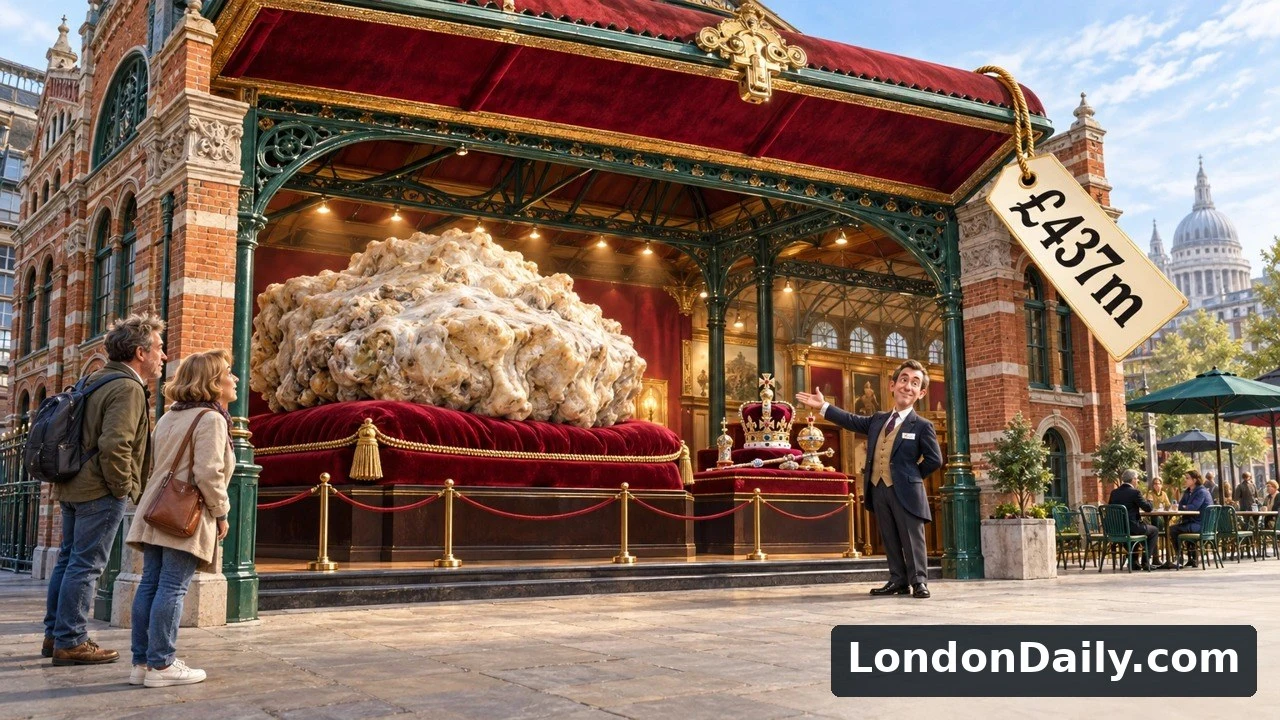
London Museum has moved into Smithfield’s restored Victorian market complex after a £437m transformation, bringing Tudor jewels and a Whitechapel fatberg into a building designed to draw people in from the street rather than keep them at a distance.
The move addresses a longstanding weakness. Its former home, occupied since 1976, attracted 700,000 visitors annually, but struggled to bring them back, says Alec Shaw, director of transformation. The new museum’s answer is architectural as much as curatorial: 250 metres of street frontage, at least four entrances and no ticketing or bag checks.
Architects Asif Khan, Stanton Williams and conservation specialists Julian Harrap Architects have reorganised 44 former market shops into 12 outward-facing units for the museum and partner organisations. Cafés, pubs, galleries and shops are intended to make entering the museum an incidental part of a day out. Plans include 7am opening and Friday and Saturday nights running until midnight, with DJs.
Beneath the main hall, 5,000 objects trace 2,000 years of London’s history through five loosely chronological chapters designed by Atelier Brückner. Displays encompass Roman remains, women’s suffrage and the Cheapside Hoard, discovered in 1912. A window overlooking passing Thameslink trains connects the underground collection with the working city outside.
The building contributes its own exhibits. Horace Jones’s general market opened in 1883; restored brickwork and ironwork remain visible, while fragments of pots, pipes and tiles have been embedded in the polished concrete floor. Work also uncovered vaulted chambers and the intact tiled interior of Lockhart’s Cocoa Rooms, a temperance café dating from 1875, which will serve hot chocolate late into the evening.
There are commercial necessities alongside the public ambitions. The main hall retains space for corporate hire, while the restaurant offers a £34 Smithfield chop. Nearby, the donated century-old Syd’s coffee stall will serve Tuesday-afternoon tea under a family stipulation against serving “posh coffee”.
Discoveries, Covid, inflation and an expanding scope helped push the budget up from an initial £150m. A second phase, due in 2028, will convert the neighbouring 1960s poultry market into conservation laboratories, accessible collection storage and temporary exhibition space.
Preservation was not inevitable. Save Britain’s Heritage contested office redevelopment proposals backed by the City of London Corporation at public inquiries alongside English Heritage in 2007 and the Victorian Society in 2014. The museum now gives the surviving market a public use; whether its open doors produce the hoped-for return visits remains to be seen.








Join the conversation