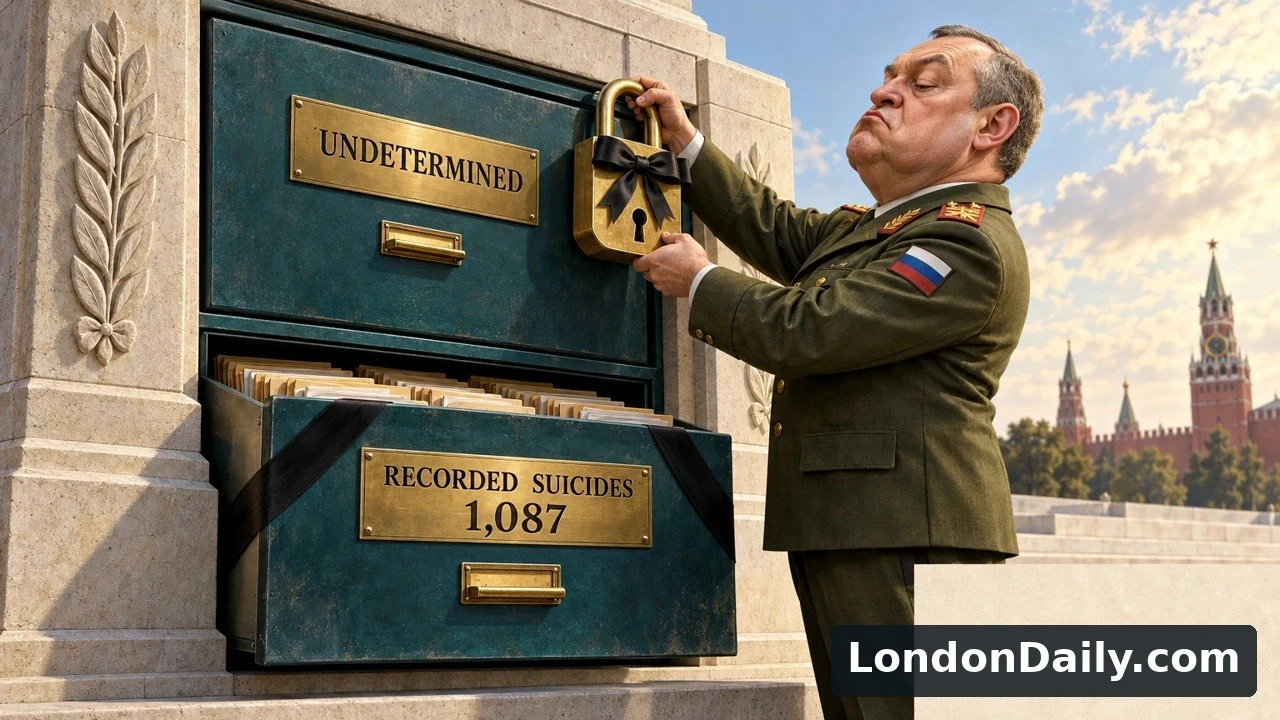
Leaked records from Russia’s state statistics agency list 1,087 military personnel who died by suicide since the full-scale invasion of Ukraine began, with evidence that other deaths were recorded under different classifications.
The Rosstat data includes another 1,038 military-related firearm deaths of ‘undetermined intent’, 885 of them in Ukraine or bordering Russian regions. Experts say this category can conceal suicides; it does not establish that every such death was one.
The records come from more than 11 million death certificates obtained by Cyber Partisans, a Belarusian opposition-linked hacking group, and the Ukrainian hacker collective Silent Crow. The Kremlin publishes no military suicide figures and treats casualty totals as state secrets.
Recorded suicides rose from more than 50 in 2022 to more than 200 in 2024 and 365 in 2025. Almost 300 are already listed for 2026, despite incomplete records and reporting delays. These are rising counts, not a measure of the suicide rate across the armed forces.
At least 614 recorded suicides occurred in occupied Ukraine or bordering Russian regions, principally Belgorod and Bryansk; 113 entries gave no location. Those who died in the war zone included 43 soldiers aged 18 or 19. Another 108 men under 25 died by suicide elsewhere in Russia. Some may have been conscripts, who are not formally deployed to Ukraine but have often faced pressure to sign contracts permitting deployment.
Individual cases expose discrepancies. Officials told Yelena Savenok that her husband Sergei, a 62-year-old lieutenant colonel who volunteered in September 2022, died by suicide in occupied Luhansk in July 2023. A certificate matching his birth date instead records a firearm death of undetermined intent.
Alexander Lazor, 21, died near Solodke in summer 2022. His family was told he had been killed in combat, as the records indicate. Two fellow soldiers, however, said their unit had been told he died by suicide. One suggested concealment to protect the unit’s reputation; that motive remains speculation.
Rob Lee, a senior fellow at the Foreign Policy Research Institute, links the problem to coercion, including abuse and torture, and fear of dangerous missions. Contracts offering effectively no route out compound the pressure, analysts say.
Ivan Chuvilyaev, of the desertion-support group Idite Lesom, calls the figures a low estimate. He and Lee believe many battlefield suicides are recorded as combat deaths. Chuvilyaev says suicidal thoughts are common among soldiers his organisation helps.
The records therefore reveal both a substantial documented toll and a classification problem: the number recorded as suicide cannot settle how many soldiers actually died that way.








Join the conversation