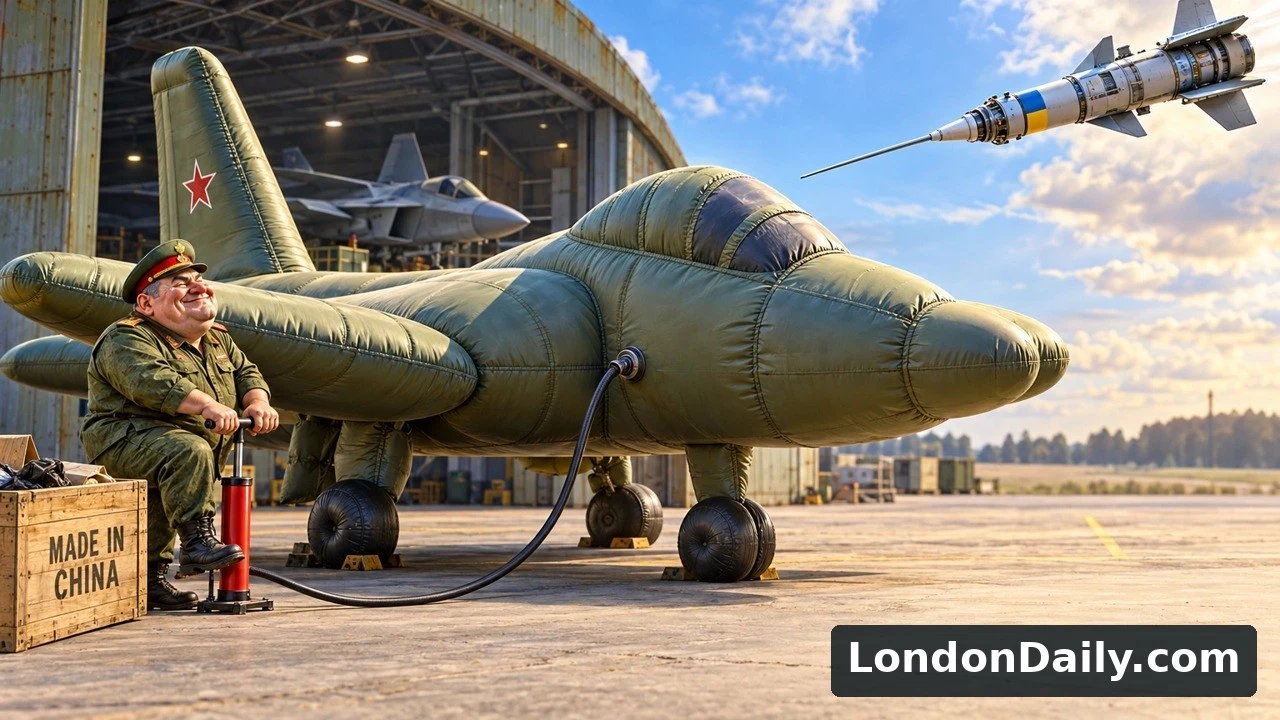
Russia is importing inflatable military aircraft from China to deceive Ukrainian reconnaissance drones and divert attacks from real equipment, using dummy planes that can cost just a few hundred dollars each.
The tactic exploits a costly imbalance: a convincing imitation can draw a precision munition worth far more than the target. As drones make large weapons harder to conceal, decoys offer another means of protecting them. Ukraine uses the same principle, including tanks made from plywood.
Chinese and Russian online marketplaces advertise inflatable aircraft with Russian-language descriptions and customised orders. Gauss, which appears to operate through several firms and brands, promotes imitation tanks, missile launchers, aircraft and hangars. It claims its battlefield-tested products reproduce heat signatures and radio-frequency emissions to deceive surveillance and radar systems. Those performance claims come from the manufacturer.
Robert Tollast, a land warfare research fellow at the Royal United Services Institute, said relatively simple production meant suppliers could provide substantial quantities. “If you can fool enemy reconnaissance, then you are forcing them to waste scarce precision munitions. That problem will compound over time.”
The scale of military deliveries remains uncertain. Import Genius trade data records at least 10 billion roubles (£93m) of Russian imports since the February 2022 invasion under a customs code used by Chinese military inflatable manufacturers. But the category also covers sporting and outdoor equipment, including inflatable pools: the total cannot be treated as spending on military decoys.
Russia has domestic suppliers, including defence contractor Rusbal. Russian media have described Chinese alternatives as substantially cheaper, although a Russian government newspaper said they were less convincing.
Gauss advertising also features a woman named Sheena describing an order for 500 tank-shaped bouncy castles, followed by requests for heating pads, metallic paint and other military shapes. She professed ignorance of their purpose. Neither she nor Gauss immediately responded to a request for comment.
The wider dispute concerns goods with civilian and military uses. China exported nearly $2bn of “high priority” dual-use goods to Russia in the first half of 2025 despite Western export controls. Beijing claims neutrality and says its Russian trade is legal; Nato called China a “decisive enabler” of the invasion in 2024.
Michael Kofman, a senior fellow at the Carnegie Endowment for International Peace, distinguished between lethality and military usefulness: “China is providing something that in itself is not a lethal good, but does have clear military applications.” The practical benefit is protection: an inflatable need not fire a weapon to help keep a real one intact.








Join the conversation