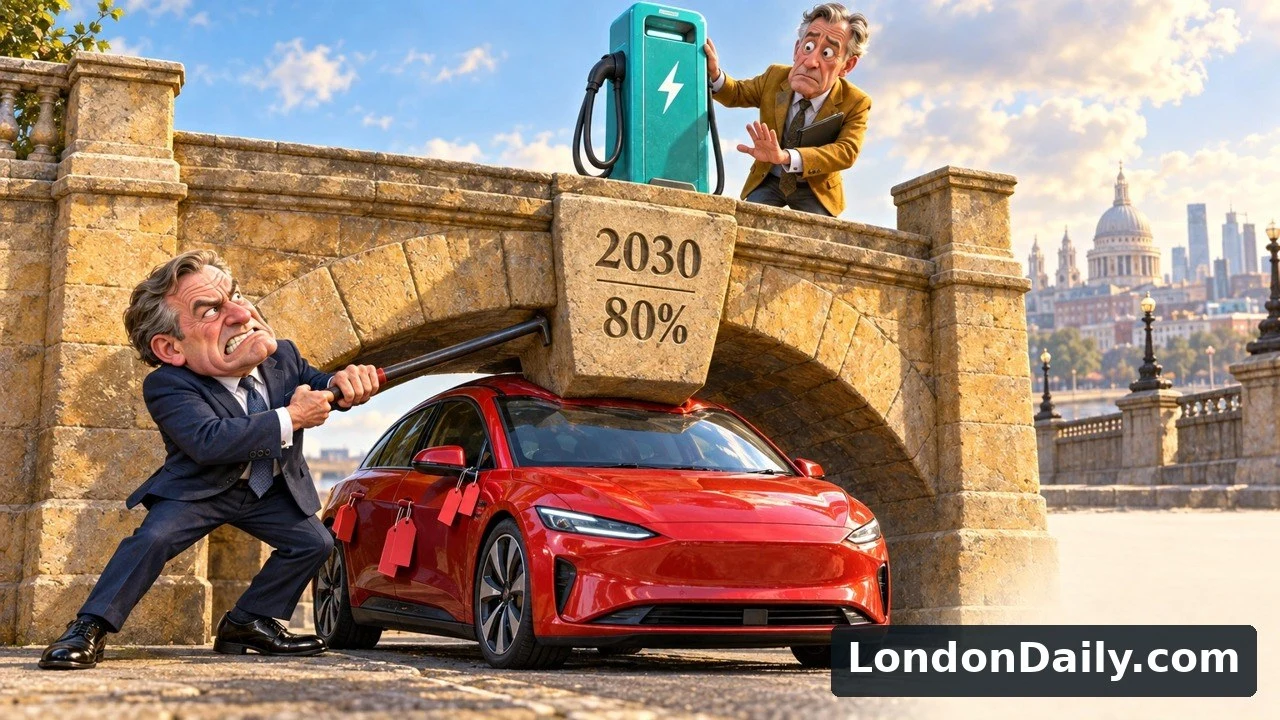
Kia UK’s chief has called for relief from Britain’s electric car sales rules, warning that their “eye-watering” compliance costs threaten the industry rather than support its transition to electrification.
Paul Philpott, Kia UK’s president and chief executive, described the Zero-Emission Vehicle (ZEV) mandate as “the most aggressive regulatory regime in the world”. Speaking at a Society of Motor Manufacturers and Traders (SMMT) dinner in London on Tuesday evening, he urged action to make Britain more attractive for investment.
The mandate sets an electric share of new car sales of 33% in 2026, rising to 80% in 2030. Built-in flexibilities mean manufacturers need not meet those headline percentages, but carmakers say they spend up to £5bn annually on compliance discounts and face hefty fines for falling short.
Their argument is that money used to close the gap between required sales and consumer demand cannot also finance new models, factories and jobs. Mike Hawes, the SMMT’s chief executive, said: “Mandates do not make markets: they compel supply, not demand.” He maintained that the industry’s commitment to electrification was not in question, but that an unprofitable domestic market weakened the case for manufacturing in Britain.
Philpott also warned that proposed EU “made in Europe” rules would exclude UK-made cars from subsidies and tax breaks. He said post-Brexit rules of origin already disadvantaged domestic manufacturers. Hawes argued that the mandate, energy costs and European restrictions together obstructed investment.
Kia is Britain’s second-best-selling car brand after Volkswagen, with models including the Sportage SUV, Picanto hatchback and EV2 electric SUV.
A government consultation launched earlier this year includes options to reduce the 2030 target to 50%, 60% or 70%. Ministers are reportedly divided: Business Secretary Jonathan Reynolds and Transport Secretary Heidi Alexander are said to be more sympathetic to manufacturers, while Energy Secretary Miatta Fahnbulleh and her predecessor, now Foreign Secretary Ed Miliband, are understood to oppose easing over concerns about higher carbon emissions.
Charging companies and their investors warn that retreating from the targets would damage confidence after infrastructure was built around the demand the mandate was expected to generate. Reducing pressure on one part of the industry could therefore unsettle investment in another.
The government says the consultation will not change its commitments to phase out new petrol and diesel cars by 2030, make all new car and van sales zero-emission by 2035, and meet legally binding net zero targets. The 2035 deadline also excludes hybrids: the unresolved decision concerns the pace of the transition, not its stated destination.








Join the conversation