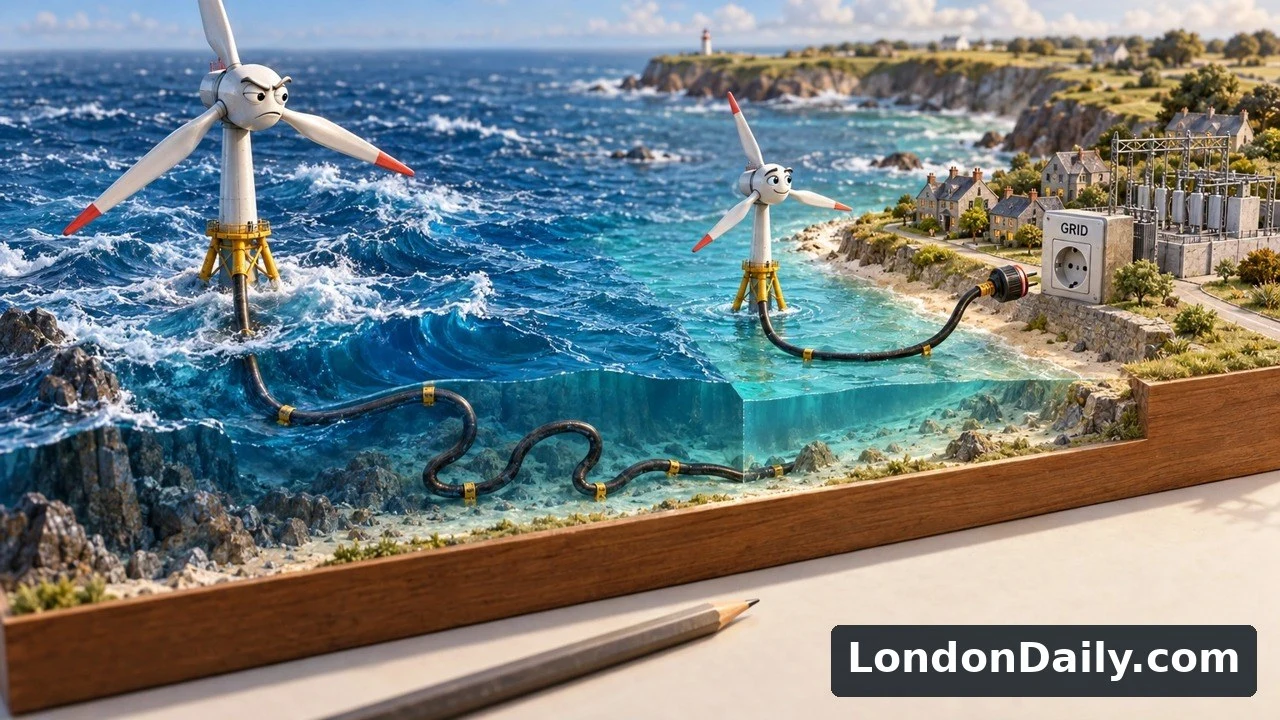
Slower tidal currents around the Isle of Wight and Wales could offer a stronger commercial opportunity than their energy output alone suggests, researchers say, because some sites have better electricity connections and sit closer to demand.
The argument broadens the industry’s focus beyond Britain’s strongest currents. Only a handful of turbines currently operate in Orkney, Shetland and the Pentland Firth, while developers envisage a wider network across Wales, Scotland and the Channel over coming decades. They identify potential UK capacity of 11.5 gigawatts, not an agreed construction programme.
Pablo Ouro, a senior lecturer at the University of Manchester, says slower currents yield less energy, but the most energetic locations are scarce. He sees a commercial case for expanding into more areas, alongside export opportunities.
Danny Coles, a senior research fellow at the University of Oxford, argues that location matters alongside turbine output. Some prospective sites have electricity demand but little renewable generation; installing turbines there could help balance the grid and reduce expenditure on infrastructure and storage. Existing connections can also make lower-flow sites around the Isle of Wight or Anglesey more attractive.
High upfront, operating and maintenance costs, harsh underwater conditions and what industry leaders describe as insufficient government support remain barriers. Sue Bartlett-Reed, chairwoman of the Marine Energy Council, wants ministers to help leading strong-tide demonstration projects expand, while setting a longer-term course for slower-current technologies. She also points to local jobs and growth. The council is contributing to the UK Marine Energy Taskforce’s final report, expected in December.
Most British developers use horizontal-axis turbines, resembling underwater propellers. Tidal Technologies says it is the only British company exploring vertical-axis machines, whose blades run vertically. It argues these can operate in more widely available, slower currents and be grouped more closely together.
The company aims to install its first 3MW unit at Morlais in 2028. Its founders say 250 units could theoretically operate south of the Isle of Wight, supplying every home from Bournemouth to Portsmouth, potentially using a repurposed substation at the former Fawley power station near Southampton. These remain projections rather than an operating scheme.
Morlais has permission for a 240MW site and has built an onshore substation. John Idris Jones, chairman of Menter Mon Morlais Ltd, says the community-led social enterprise seeks both low-carbon power and economic benefits for Ynys Mon, with a direct grid connection giving it wider strategic value. The immediate challenge is turning demonstration capacity into generation at scale.








Join the conversation