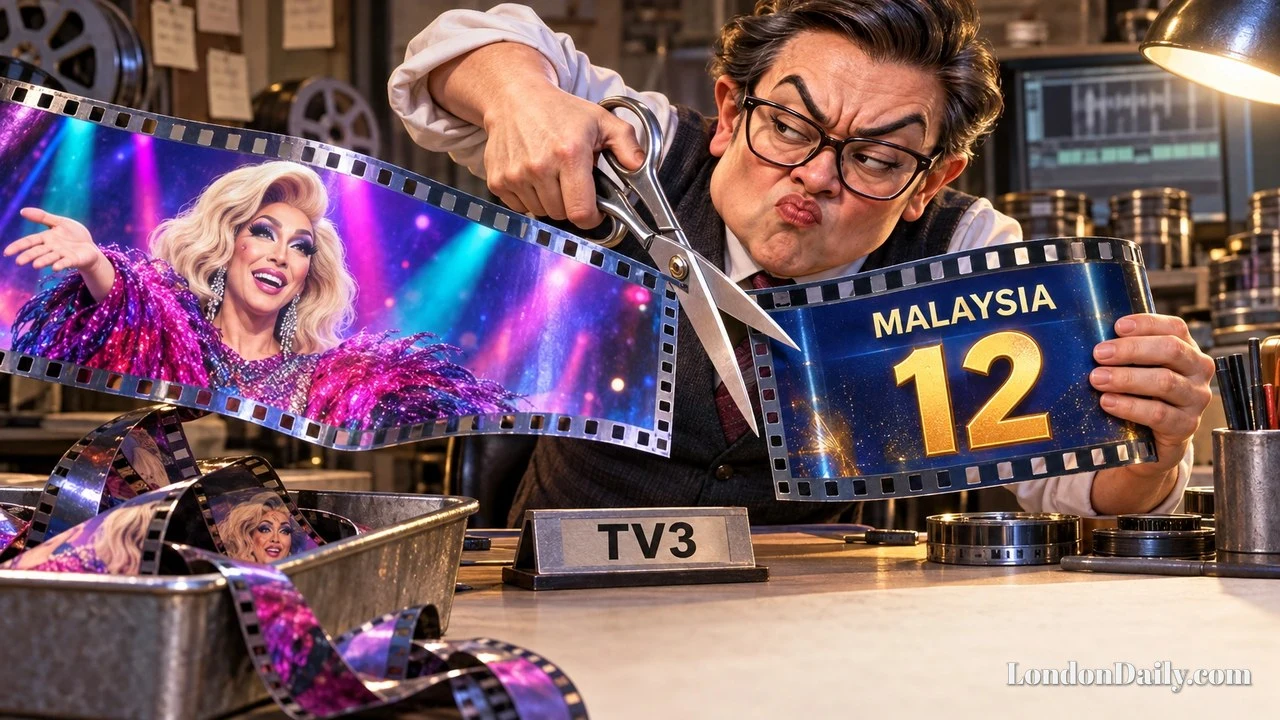
Malaysia’s TV3 appears to have removed appearances by a gay Philippine jury spokesperson and Thai drag performers from the first Eurovision Asia, prompting organisers to seek an explanation for changes they said were confined to the Malaysian broadcast.
Clips circulating online show viewers saw only the scoreboard while Vice Ganda announced the Philippine jury’s maximum 12 points for Malaysia’s Aina Abdul. The international feed showed the announcement during Saturday’s final in Bangkok, won by the Philippines’ Carmelle.
Vice Ganda, who is gay and non-binary, is a leading Philippine television comedian, has fronted the country’s most-watched daytime programme and has campaigned for LGBTQ+ acceptance. Announcing jury points is among a Eurovision final’s most visible roles.
Separate footage shows an opening sequence celebrating Thai culture, featuring drag performers on street-food carts, replaced with a wide shot from rehearsals. Fans accused TV3 of “censorship”. The Guardian said it could not independently review the full broadcast because TV3’s livestream was no longer available online.
Martin Green, Eurovision’s director, said organisers were “surprised and disappointed”. The European Broadcasting Union (EBU), the public-broadcaster alliance that owns Eurovision, will write to Voxovation, which produces the Asian contest under licence, asking it to establish with TV3 why the alterations occurred. Green said other transmissions were unaltered.
Voxovation said it was examining the circumstances with the broadcaster and added: “We are working with the Malaysian broadcaster to make sure this doesn’t happen again.” No explanation from TV3 or its owner, Media Prima, was included in the available reporting.
The episode tests how Eurovision enforces its stated principles. Before the final, EBU communications head Dave Goodman called its values “non-negotiable” when asked about Malaysia and Bangladesh, both competitors where same-sex relations are criminalised.
Malaysia punishes oral and anal sex with up to 20 years’ imprisonment. Rights groups warn of a hardening climate: more than 200 men were detained in a Kuala Lumpur spa raid in November last year, without subsequent charges; 20 people were arrested at an LGBTQ+ Halloween party in 2022.
In 2023, a festival was cancelled and foreign-performer entry rules tightened after the 1975’s singer criticised Malaysia’s laws and kissed a male bandmate on stage. TV3 apologised in February 2025 after male red-carpet guests wore clothing resembling women’s dress.
There is an enforcement precedent. In May 2018, the EBU ended its Mango TV partnership after the Chinese streaming service dropped Ireland’s and Albania’s entries and blurred a rainbow flag, citing its “values of universality and inclusivity”. Neither the EBU nor Voxovation has said whether Asian contest agreements require unedited transmission, or what consequences a breach would carry.








Join the conversation