

Macron narrowly survives crucial no-confidence votes in parliament
Emmanuel Macron’s government narrowly survived a no-confidence vote in the French parliament Monday, after it pushed through a deeply unpopular pensions overhaul without a vote last week, sparking outrage and spontaneous protests across the country.
In a high-stakes vote in France’s lower house of parliament, 278 MPs, mostly from the left and the far right, voted in favor of a cross-party motion of no confidence, falling just short of the 287 votes needed to topple the government. A second motion, backed only by the far-right National Rally, did not garner enough votes.
The outcome of the first vote was much tighter than anticipated and increases the pressure on Macron to withdraw his reform. It may also give a boost to the protest movement led by trade unions against the measures. The French president will also be under pressure to respond either by addressing the country or reshuffling his government.
Speaking ahead of the votes, the centrist MP Charles de Courson, one of the authors of the cross-party motion, accused Macron’s government of lacking “courage” during the parliamentary debates.
“You could have submitted [your reform] to a vote, and you probably would have lost it, but that’s the game when you are in a democracy,” he told MPs.
The leader of Macron’s Renaissance parliamentary group Aurore Bergé lashed out at accusations the government had failed to seek compromises with MPs and accused opposition parties of working against the common good.
“When people speak of a grand coalition, it should be so that people work together for the good of the country. It’s the opposite that you are offering us … you want to bring our country to a halt, in our institutions and … in the street,” she said.
The motions of no confidence were proposed last week after Macron authorized the use of a controversial constitutional maneuver on Thursday to bypass a vote in parliament on his pensions reform bill. The French president wants to raise the legal age of retirement to 64 from 62, in an effort to balance the accounts of France’s indebted state pension system and to bring France’s retirement age in line with other European countries such as Spain and Germany where it ranges from 65 to 67 years old.
The no-confidence motions were voted on in the National Assembly as industrial action disrupted flights, public transport, waste collection and refineries ahead of a nationwide day of protests on Thursday. Trade union leaders hope for a show of force against the government and have also warned that social unrest risks spiraling after several protests in Paris turned violent in recent days.
“I send this alert to the president, he has to withdraw the bill before there’s a disaster. [Our protests] have been very controlled since the beginning, but the temptation of violence, of radicalization … is there,” said CFDT trade union leader Laurent Berger on Sunday.
While the government has survived efforts to topple it, speculation is now running high that Macron will want to replace his beleaguered Prime Minister Elisabeth Borne in a government reshuffle aimed at refreshing his image. According to an IFOP-JDD poll published on Sunday, Macron’s popularity rating fell by 4 points in one month to 28 percent.
A tight win for Macron
Monday’s no-confidence motions had been widely seen as unlikely to pass ahead of the vote because the French National Assembly has been deeply divided since parliamentary elections last year. While Macron’s Renaissance party has lost its absolute majority, opposition parties backing the no-confidence motion failed to get enough votes because most MPs from the conservative Les Républicains refused to support it.
Still, more conservative MPs than expected decided to ignore the party line and back the cross-party motion of no confidence, exposing the deep divides within Les Républicains.
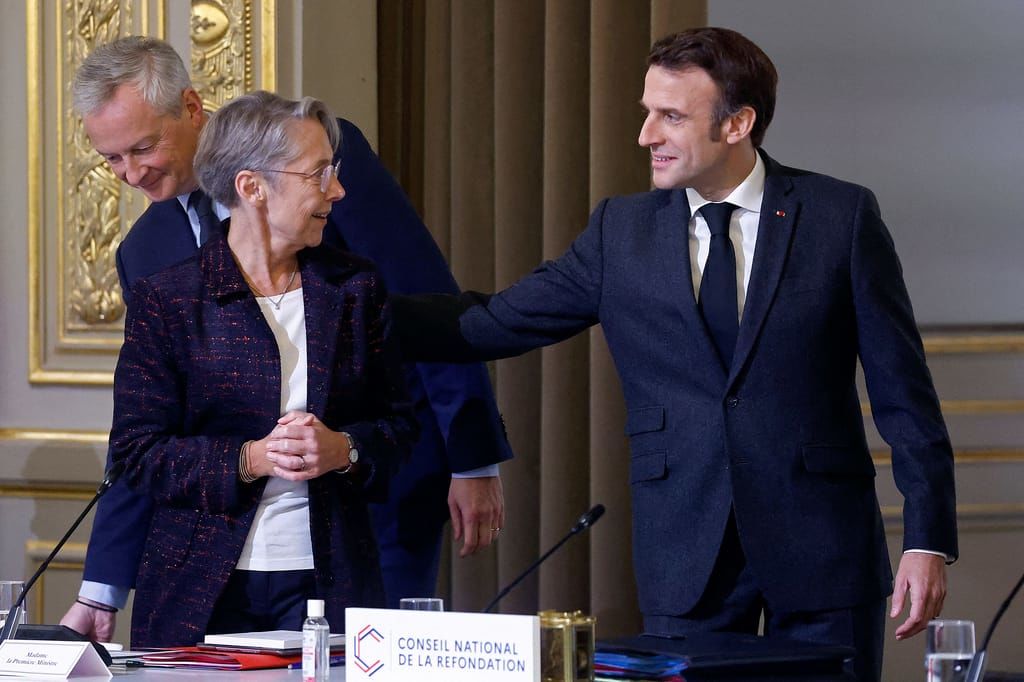 Elisabeth Borne will live to see another day as French Prime Minister
On Monday, one of the leading rebels, conservative MP Aurélien Pradié, said voting in favor of the motion of no-confidence was needed to “emerge from the chaos.”
“The Macron club has not understood what is going on. And if we need to jolt them with a motion of no-confidence, I will back it and lend my voice to the people who feel disdained,” he told Europe 1 radio.