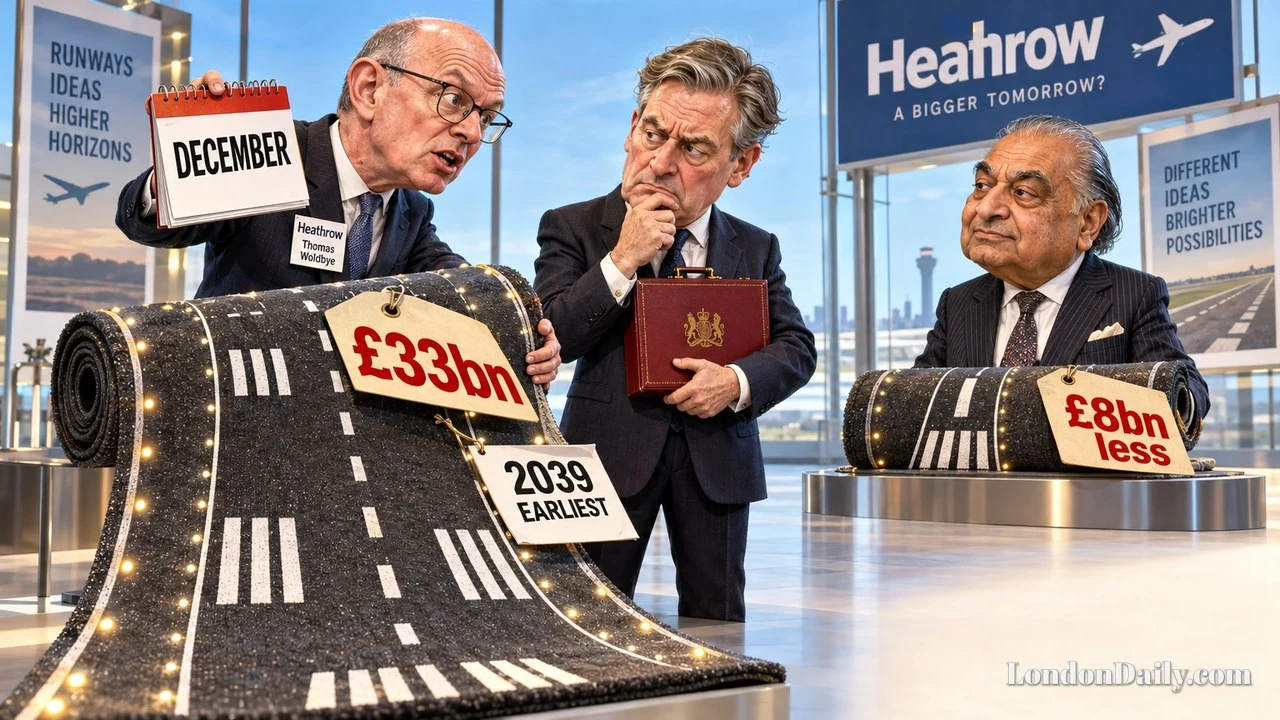
Heathrow’s chief executive has set a December deadline for government backing of its third runway, warning that investors could withdraw as Andy Burnham withholds support and a cheaper rival proposal gathers backing.
Thomas Woldbye wants reassurance for a £33bn scheme within a wider £49bn airport investment programme. Heathrow’s investors include sovereign wealth funds from Saudi Arabia, Qatar, Singapore and China. His warning puts financing pressure on a decision whose consequences would extend well beyond the deadline: the runway would open no earlier than 2039.
The expansion debate stretches back at least to the Department for Transport’s 2006 report. Heathrow handled 84.5 million passengers last year and is operating at capacity, refusing airlines seeking additional flights. Istanbul has overtaken it as Europe’s busiest airport, while Paris Charles de Gaulle, Amsterdam Schiphol and Frankfurt compete for business.
Business groups and trade unions support expansion for its employment and economic benefits. Heathrow contributes £13.5bn to UK GDP, handles £300bn in annual trade and supports between 105,000 and 120,000 local jobs. Its cargo operation processes 1.59 million tonnes annually, representing 75 per cent of goods passing through Britain’s airports. The proposed runway could create another 33,000 jobs; those projected gains are distinct from the airport’s existing contribution.
Opponents, including Sadiq Khan and Ed Miliband, cite environmental concerns. Residents beneath the proposed flight path face noise, air pollution, additional road traffic and construction disruption. The local stakes therefore include both livelihoods dependent on Heathrow and the costs borne by neighbouring communities.
Burnham declined five times at Labour’s conference to endorse the runway, calling it “principally a matter for Londoners”. He previously favoured regional airport expansion, including Manchester. Aviation minister Keir Mather said Burnham recognised Heathrow’s national economic importance alongside the consequences for London. Burnham is awaiting the Heathrow Expansion National Policy Statement consultation and a Commons Transport Select Committee report, both expected in November.
John Healey supports expansion on growth grounds. Conservative leader Kemi Badenoch and shadow chancellor Andrew Griffith also back it, with Griffith promising legislation to remove obstacles. Their party’s mayoral hopeful, Sir James Cleverly, has expressed scepticism and prioritised Londoners, particularly those in west London.
Hotel businessman Surinder Arora offers a different route: a shorter runway proposal costing £8bn less and avoiding relocation of part of the M25. Motoring groups and nearby residents support it. He is seeking airline and airport-user backing amid concerns about charges and construction time.
That alternative leaves two decisions unresolved: whether Heathrow should expand, and whose scheme should deliver it.








Join the conversation