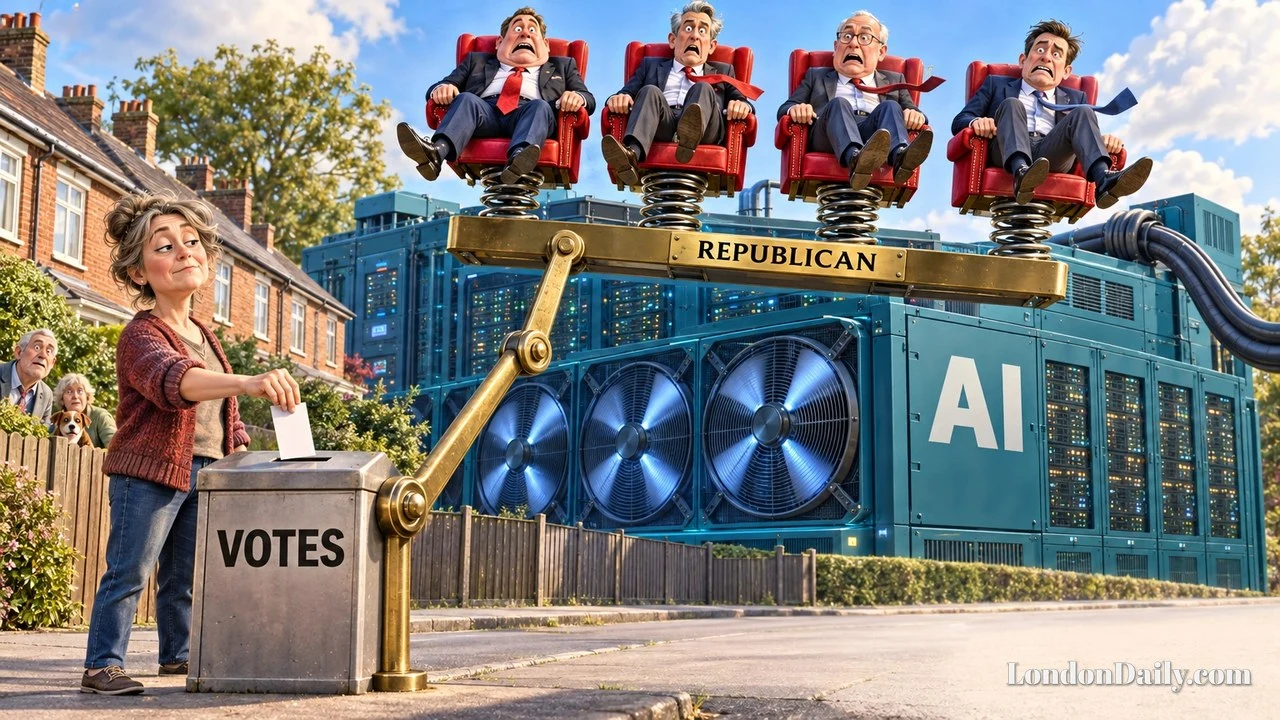
Opposition to noisy, energy-intensive data centres helped turn artificial intelligence into an electoral liability in America’s November 2026 congressional midterms, as regulation supporters outspent industry allies and Democrats captured four Republican-held districts targeted by safety campaigners.
The campaign brought an abstract argument about humanity’s future into residential neighbourhoods. Will Lawrence won in Michigan after campaigning against local server farms. Exit polls indicated that AI and data centres were a decisive or major consideration for 56% of voters, though that does not establish what determined individual results.
Regulation-supporting groups spent $44.4 million, against $27.9 million from industry supporters. Democratic election advertising mentioning data centres rose from none during 2020–24 to 659 advertisements this cycle. Another 387 directly attacked technology giants, with combined spending exceeding $103 million.
The confrontation followed an industry-backed attempt in May 2025 to prevent states enforcing their own AI rules for ten years through budget legislation. The Senate rejected the provision by 99 votes to one that July.
In August 2025, Andreessen Horowitz and OpenAI established Leading the Future, a super PAC equipped with $100 million to deter lawmakers from restricting deployment. Its approach followed cryptocurrency interests’ use of campaign spending against regulatory opponents.
Supporters of rapid development argued that regulation would obstruct progress and hand China technological leadership. Safety researchers and effective altruists warned instead of possible human extinction within decades or centuries. Campaigners translated those concerns into arguments about jobs, children’s safety and infrastructure.
Their coalition included technology-policy veterans, consumer advocates, competition campaigners and wealthy AI engineers. Former congressman Brad Carson founded Public First; lawyer Jay Schuster organised Silicon Valley donors; Democratic strategist Rishi Bharwani also helped lead the effort.
The split extended into industry. Sam Altman’s OpenAI favoured faster deployment and fewer barriers, while Dario Amodei’s Anthropic backed regulation and channelled about $40 million to Public First-linked organisations ahead of its expected flotation.
Yet money did not guarantee victory: New York safety candidate Alex Bores lost June’s Democratic primary despite $19 million from regulation supporters against $8 million from the opposing lobby.
Other pressures included a widely circulated Anthropic researcher’s resignation and September’s Hugging Face security breach. Character AI, sued by Pennsylvania governor Josh Shapiro over alleged impersonation of a medical professional and harm to children, recently declared bankruptcy.
Unlike America’s campaign-finance battle, the European Union imposed its AI Act from above. China combines centralised algorithm and content controls with state-led infrastructure expansion despite residents’ objections. Israel retains lighter regulation and support for innovation. The American results expose a constraint on expansion: financing technology does not settle where communities will accept it.








Join the conversation