London Daily

Focus on the big picture.
Tuesday, Jul 07, 2026

Fuel duty cut by 5p a litre to help motorists to suffer less from the super high taxes that makes gasoline so expensive

Fuel duty cut by 5p a litre to help motorists to suffer less from the super high taxes that makes gasoline so expensive

The cut aims to deal with soaring costs, but the RAC says prices will remain at a high level.

The chancellor has announced a 5p a litre cut to fuel duty as motorists struggle with record fuel prices.

Rishi Sunak said the move, which kicked in at 18:00 GMT on Wednesday and will last until next March, was "the biggest cut to all fuel duty rates ever".

However, motoring company the RAC said the 5p cut only took prices "back to where they were just over a week ago".

It said the reduction would take £3.30 off the cost of filling a typical 55-litre family car.

Motorists have been hit by record pump prices since Russia's invasion of Ukraine led to an increase in the cost of oil because of supply fears.

Average pump prices hit new records on Tuesday, with petrol topping £1.67 a litre and diesel close to hitting £1.80 for the first time, the RAC said.

That left the cost of filling an average family car with petrol at more than £92 and nearly £99 for diesel.

Fuel duty - a government tax which makes up part of the price when you buy petrol or diesel - is currently 58p per litre and has been for 11 years.

The Treasury said the fuel duty cut - the first is more than a decade - would cost it £2.4bn and means a one-car family will save £100 on average over the next 12 months.

The average van driver will save £200, it said, while hauliers will save £1,500.

But RAC head of policy Nicholas Lyes said the cut was "a drop in the ocean" given the recent huge rise in fuel costs, which have not fallen despite crude oil coming off its record highs of earlier in March.

He also warned there was a "very real risk retailers could just absorb some or all of the duty cut themselves by not lowering their prices".

"If this proves to be the case it will be dire for drivers," Mr Lyes said. "It also wouldn't be totally unexpected based on the biggest retailers not reducing their prices late last year when the oil price fell sharply."

The RAC added although fuel duty had been cut to 53 per litre, it could take time to be reflected in pump prices due to it being charged on wholesale purchases by retailers, who are yet to buy new fuel at the lower rate.

In response to Rishi Sunak's Spring Statement, supermarket chains Asda and Sainsburys said they would reduce pump prices by 6p a litre, including a 1p reduction in VAT.

The average price of a litre of petrol has risen by more than 40p since last year's Spring Statement, which means the government is getting an extra 7p per litre in VAT, which is the other tax the government imposes on fuel.

Diesel prices are up by nearly 50p a litre, almost 9p of which is VAT.
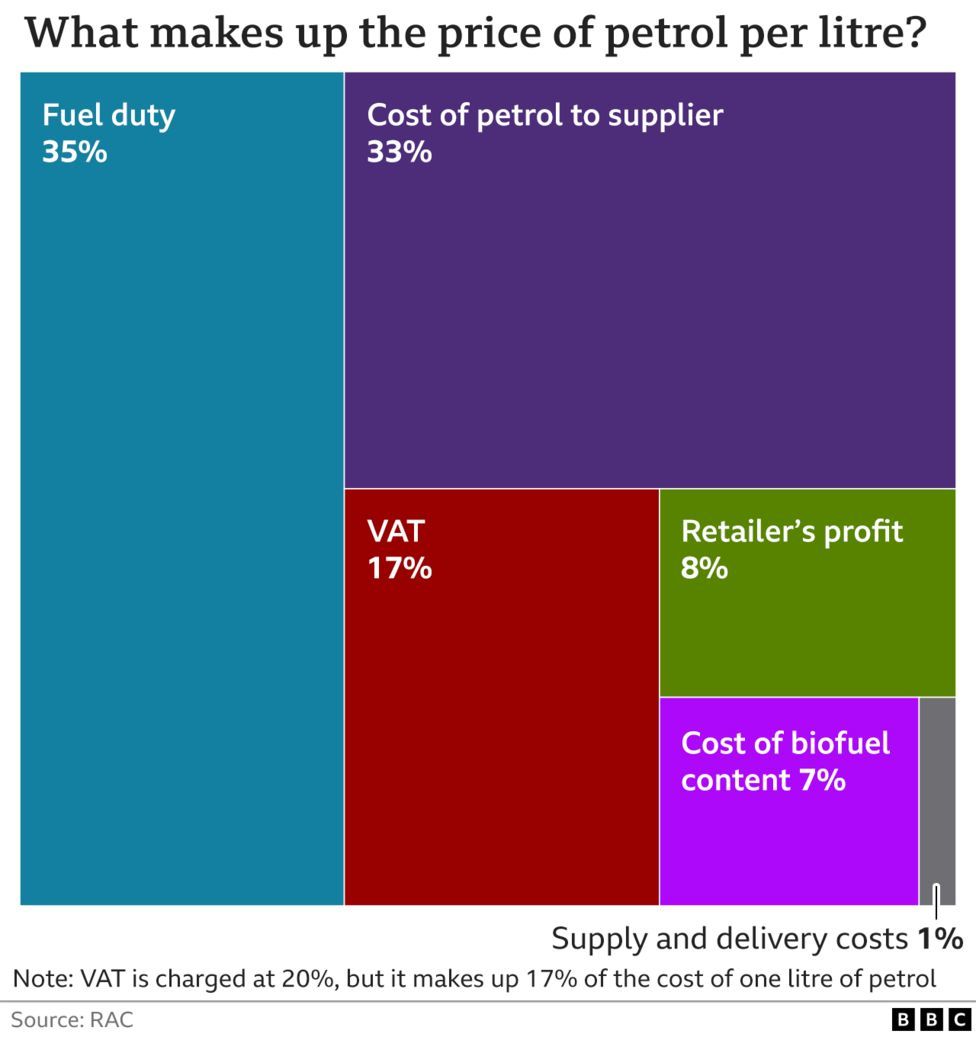

The Treasury said it had acted now because: "Unique circumstances globally, including the war in Ukraine, have pushed pump prices up to unprecedented levels."

AA president Edmund King said he was concerned that the benefit would be lost unless retailers passed it on. "Since the start of the year, the 20p-a-litre surge in pump prices has been the shock that rocked the finances of families."

He said there had been a substantial reduction in wholesale fuel costs since 9 March.

"That needs to drive lower pump prices also," he added. "The road fuel trade shouldn't leave the Treasury to do the heavy lifting when cutting motoring costs."

Fuel prices, which were already rising as global economies recovered from the coronavirus pandemic, surged after the war in Ukraine pushed up global oil prices.

Changes in prices at the pump are mainly determined by crude oil prices and the dollar exchange rate, because crude oil is traded in dollars.

Russia is one of the world's major oil exporters and it is being targeted by economic and trading sanctions.

After Brent crude oil - a global benchmark for prices - hit a near 14-year high of $139 a barrel during the early stages of the conflict, prices fell back to around $100, but have since risen again and were trading at about $120 a barrel on Wednesday.


Newsletter

Related Articles

0:00
0:00
Close
UK Met Office Issues Heatwave Alerts for London and Southern England
Keir Starmer Blocks Earlier World Cup Kick-Off Time for England Match Against Mexico
NHS Digital Transformation and Media Consolidation Highlight UK Policy Priorities
UK Government Pushes Digital Trade Rules to Cut Export Costs for Businesses
Bank of England Plans Leverage Rule Changes to Support Government Bond Market
UK Police Operation Targets Organised Immigration Crime Networks With Hundreds of Arrests
Yvette Cooper Calls for Global AI Rules to Prevent Security Risks
NHS Begins Major AI Expansion Through £10 Billion Digital Investment Programme
UK Government Tightens Rules on Political Donations to Limit Foreign Influence
Keir Starmer Defends UK Defence Spending Plan at NATO Summit in Turkey
Comcast’s Sky Agrees £1.6 Billion Deal to Acquire ITV Media and Entertainment Division
Senior NHS Doctors Vote in Favour of Renewed Strike Action Over Pay Dispute
Andy Burnham Set to Succeed Keir Starmer as Labour Leadership Nominations Open
Microsoft Lays Off 4,800 Employees and Xbox Suffers the Hardest Blow
Deep Purple Has Released Its Best Album in Decades
Office for National Statistics Updates Historical Investment Data Review to Improve Accuracy
Department for Science, Innovation and Technology Highlights Economic Gains From Digital Inclusion
Debate Intensifies Over UK Defence Strategy and Domestic Security Priorities
Report Warns Full Transport Accessibility Could Add £176 Billion to UK Economy Annually
Medicines Regulator Approves First Targeted Treatment for Advanced Merkel Cell Skin Cancer
Government Commits £22 Million to Brighton Seafront Infrastructure Renewal and Transport Safety
National Security Bill Returns to House of Commons Amid Calls to Protect Humanitarian Work
Government Tightens Overseas Political Donation Rules to Strengthen Safeguards Against Foreign Influence
NHS Maternity Reform Expands Central Oversight After Critical National Review
Dover Border Warnings Highlight Post-Brexit Pressure on Cross-Channel Trade
Private Nuclear Consortium Advances £35 Billion Small Reactor Strategy in UK
UK Labour Leadership Signals Shift Toward Reindustrialisation and Regional Power
House of Lords Debates Rail Nationalisation Bill to Create Great British Railways
Scottish Affairs Committee Expands Inquiry Into SNP Financial Conduct
Evri Launches £1.2 Million Defamation Case Against BBC Over Panorama Investigation
Port of Dover Warns of Border Delays as EU Entry-Exit System Looms
Nigel Farage Referred to Standards Watchdog Over Alleged Undeclared Benefits
UK Government Faces Scrutiny Over Claimed AI Datacentre Investment After FOI Findings
UK and India Finalise Trade Agreement Rules Ahead of Mid-July Implementation
UK Government Establishes National Maternity Commissioner After Major Review of NHS Care Failures
Private Consortium Plans £35 Billion UK Nuclear Programme Targeting Small Modular Reactor Rollout
Andy Burnham Sets Out Ten-Year Reindustrialisation and Devolution Plan as Leadership Transition to UK Premiership Advances
Morocco and France Advance as 2026 FIFA World Cup Enters Quarterfinals.
Historic 2026 Tour de France Opens in Barcelona With Revamped Team Time Trial.
Global Mergers and Acquisitions Approach $4 Trillion Defying Geopolitical Tumult.
Negotiators Advance 20-Point Framework for Gaza Ceasefire and Demilitarization.
OECD Warns Middle East Conflict Will Depress Global Economic Growth.
Ukrainian Drones Strike Major Oil Terminal in St. Petersburg.
World Meteorological Organization Issues Urgent Alert Over Rapidly Intensifying El Niño.
United States Commemorates 250th Anniversary With Diplomatic Summits and Global Flotilla.
Iran Begins Days-Long Funeral for Supreme Leader Khamenei Amid Strait of Hormuz Standoff.
Technology giant reports surging carbon emissions driven by artificial intelligence infrastructure demands.
Artificial intelligence adoption accelerates workforce reductions across the technology and financial sectors.
Global technology and financial conglomerates collaborate to launch a new stablecoin standard.
United States regulators lift export restrictions on a major frontier artificial intelligence model.
×