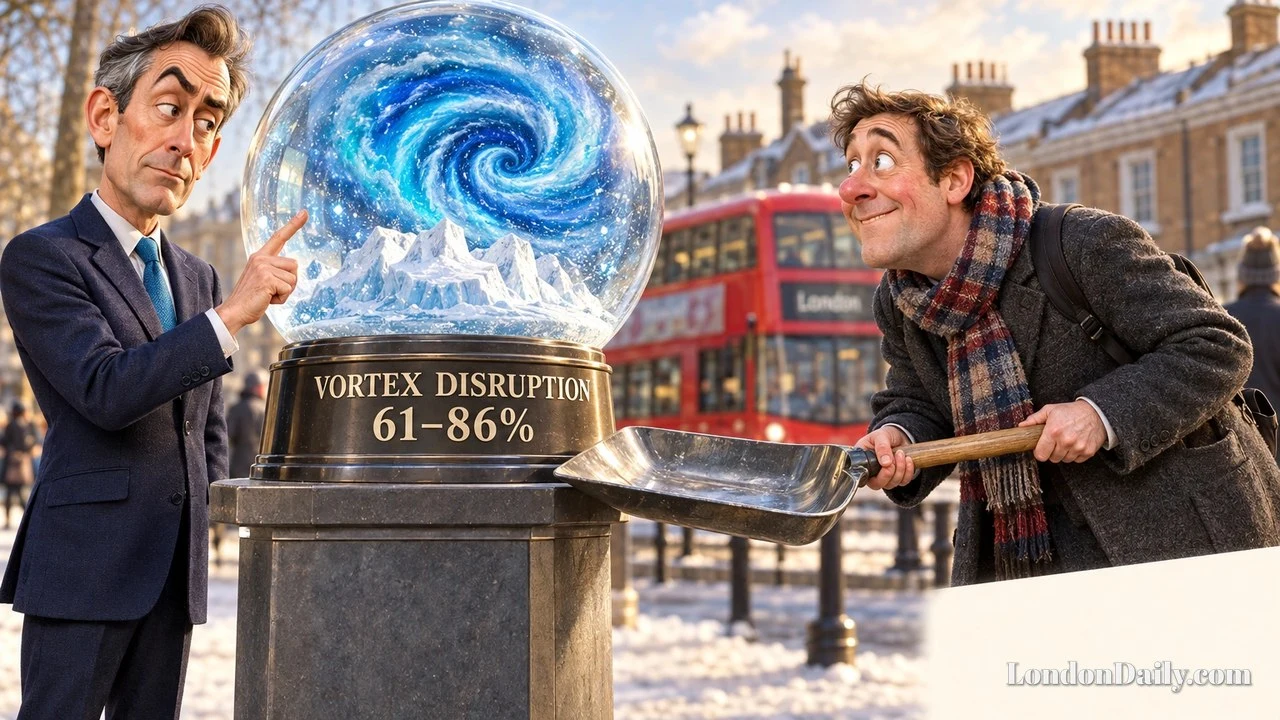
Forecasters are predicting a potentially record-breaking disruption to the polar vortex this winter, raising the possibility of heavy snow and freezing conditions in London. Forecast models put the likelihood of a major stratospheric disturbance at between 61% and 86%, though those figures are not the probability of snow in the capital.
The polar vortex is a vast circulation of icy air high in the stratosphere above the North Pole, which normally helps confine extreme cold to the Arctic. During a sudden stratospheric warming, atmospheric waves travelling upwards from the Earth’s surface can disrupt or fracture that circulation.
Dr Judah Cohen, an atmospheric and environmental research scientist at the Massachusetts Institute of Technology, expects an unusually significant event. “This will be, I think almost undoubtedly, the largest, earliest disruption of the polar vortex on record,” he said.
The forecasts link the heightened risk to a powerful El Niño, described as a ‘Super El Niño’. The Met Office’s explanation is more conditional: following an El Niño peak, the stratospheric polar vortex can weaken later in winter, increasing the likelihood of sudden stratospheric warming and, in turn, cold weather.
What matters for London is how that disturbance changes the circulation below. The Met Office said: “The stratospheric sudden warming can sometimes cause the jet stream to ‘snake’ more, and this tends to create a large area of blocking high pressure”.
Such blocking usually develops over the North Atlantic and Scandinavia. It can bring prolonged dry, cold weather to Britain and northern Europe, while southern Europe experiences milder, wetter and windier conditions.
Any effect would rarely be immediate. The typical interval before cold conditions reach Britain is two to four weeks, leaving a possible London freeze towards late winter if the vortex collapses. An overnight low of -1°C has also been forecast for the capital, but the severity of any later cold spell remains uncertain.
Heavy snow and plunging temperatures could disrupt London’s transport network and increase household energy costs. The distinction is between a forecast disturbance high above the Arctic and its eventual effects on London: the former increases the risk of a freeze without settling when, or how severely, the capital would be affected.








Join the conversation