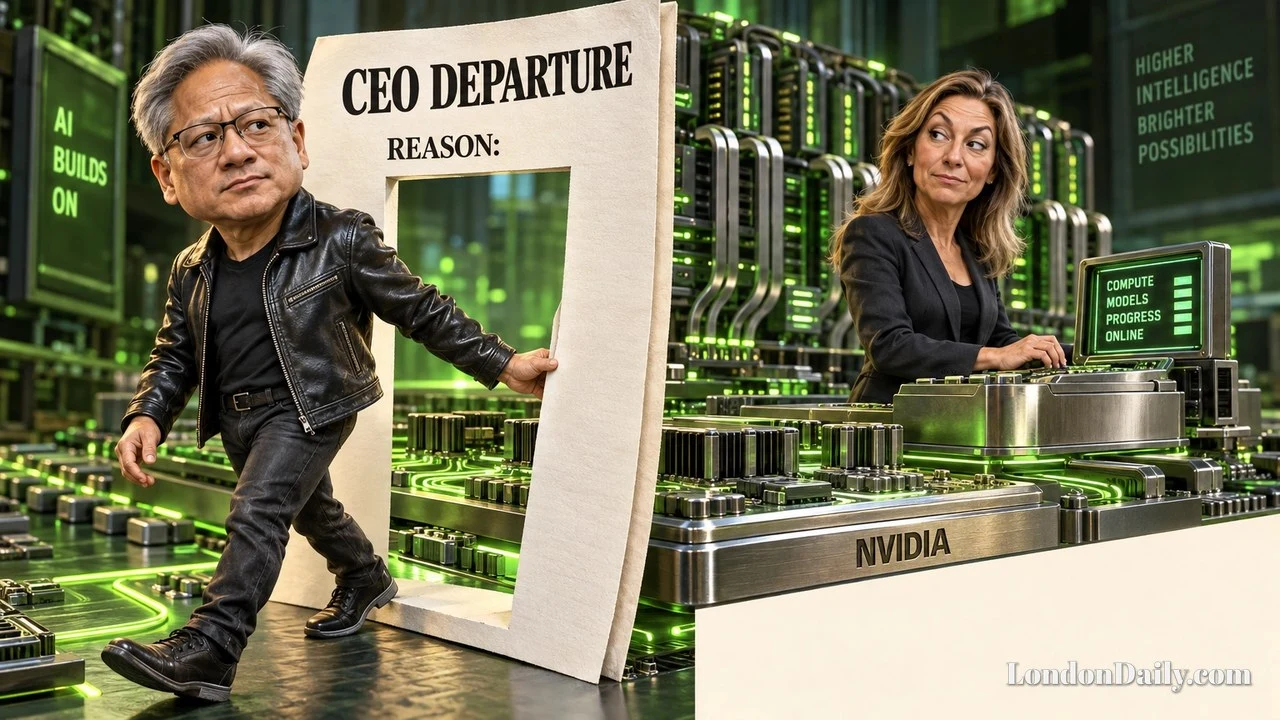
Jensen Huang has resigned with immediate effect after 33 years as Nvidia’s chief executive, following reports of two extramarital relationships that prompted scrutiny of national security risks and corporate governance. The company did not give a reason for his departure in its official announcement.
Chief financial officer Colette Kress has been appointed interim chief executive while Nvidia seeks a permanent successor. Shares fell by more than 13% in early trading before recovering some of their losses.
The leadership change, confirmed on 12 November, ends the tenure of the 63-year-old executive who co-founded Nvidia in April 1993. It comes despite public support for Huang from US President Donald Trump and reported backing from Elon Musk and billionaire investor Bill Ackman.
Two relationships under scrutiny
Huang, who has been married to his wife Lori since 1985, acknowledged an extramarital affair amid reports concerning Alice Huang, a Chinese businesswoman and former senior executive at Singapore-based cloud computing company Megaspeed.
US intelligence officials reportedly suspected Alice Huang of acting on Beijing’s behalf. Those suspicions arose amid investigations into advanced semiconductor shipments to China and possible attempts to circumvent US restrictions on artificial intelligence technology.
The espionage allegations remain unproven. Beijing rejected the accusations through state media, describing them as a baseless smear campaign. Singaporean authorities have investigated suspected irregularities in Megaspeed’s server shipments without establishing espionage offences.
Nvidia’s board investigation into the relationship examined potential threats to American national security and the possible disclosure of commercially sensitive information. Those concerns do not establish that any such disclosure occurred.
Separate reports alleged that Huang had a prolonged relationship with Kimberly Powell, 48, Nvidia’s vice-president of healthcare and biomedical sciences. Powell joined the company in 2008 and reports directly to him.
Five current and former employees reportedly described seeing the pair displaying affection at a San Jose hotel during Nvidia’s annual developers’ conference last March. It was also alleged that Huang’s personal security guard confronted someone attempting to photograph them and asked that person to sign a confidentiality agreement.
Asked by journalists about his relationship with Powell, Huang reportedly replied: "I don't think you should be talking to me directly." He then ended the telephone conversation.
Governance concerns and public support
The allegations involving Powell raise a different set of concerns from those surrounding Alice Huang: whether a relationship between a chief executive and a direct report created conflicts of interest or breached corporate governance and ethics policies.
Relationships involving senior executives have previously led to dismissals at other major companies, including those of former Intel chief executive Brian Krzanich and former McDonald’s chief executive Steve Easterbrook. Those precedents do not establish Nvidia’s reasons for Huang’s departure, which its announcement left unspecified.
Trump, who awarded Huang the National Medal of Science last month, spoke to him after the controversy emerged. The president said he believed Huang’s account that he had been unaware of Alice Huang’s alleged involvement in espionage.
Praising Huang’s achievements, particularly Nvidia’s Blackwell artificial intelligence chips, Trump publicly argued that he should remain in charge. Musk and Ackman also reportedly expressed support.
A transition with consequences beyond Nvidia
The immediate challenge for Kress is to manage a leadership transition at a company whose processors, computing platforms and software infrastructure underpin much of the modern AI industry.
Nvidia’s Blackwell processors remain dominant in the market for training advanced artificial intelligence models. The unresolved commercial question is whether the upheaval will accelerate major technology companies’ efforts to find alternatives, rather than simply cause short-term disruption.
Those alternatives include AMD’s Instinct MI300 and MI350 AI accelerators, custom semiconductor technology developed by Broadcom, and Google’s Tensor Processing Units, or TPUs. They offer large cloud computing providers ways to reduce their dependence on Nvidia and diversify operational and geopolitical risks. Competitors may see an opportunity, but the leadership change alone does not establish that Nvidia’s technological position has weakened.
Powell’s responsibilities also place her within an important area of Nvidia’s expansion. She has helped develop its healthcare and biomedical research business, including BioNeMo, a platform designed to accelerate biological research and drug discovery through artificial intelligence.
That growing market also includes Google’s DeepMind and AlphaFold technology, Amazon’s AWS HealthOmics services, and Microsoft’s healthcare cloud and AI offerings. Although these technologies serve different purposes, they compete for investment, research partnerships and influence over AI-powered medicine.
Financial impact remains uncertain
The reported loss in Nvidia’s market value since the controversy began is close to $600 billion, although that calculation depends on the dates and share prices used for comparison. The full financial consequences of Huang’s departure remain uncertain.
Huang remains a significant shareholder, giving him a degree of influence without control of the board. His experience, industry relationships and record of negotiating major technology deals could also leave him influential elsewhere in the sector.
Nvidia, meanwhile, retains a substantial share of the global AI accelerator market, particularly in training large language models. Its strengths in hardware, software and developer infrastructure are not expected to disappear overnight. The task for its next leader is to preserve those advantages through the company’s first change of chief executive since its foundation in 1993.








Join the conversation