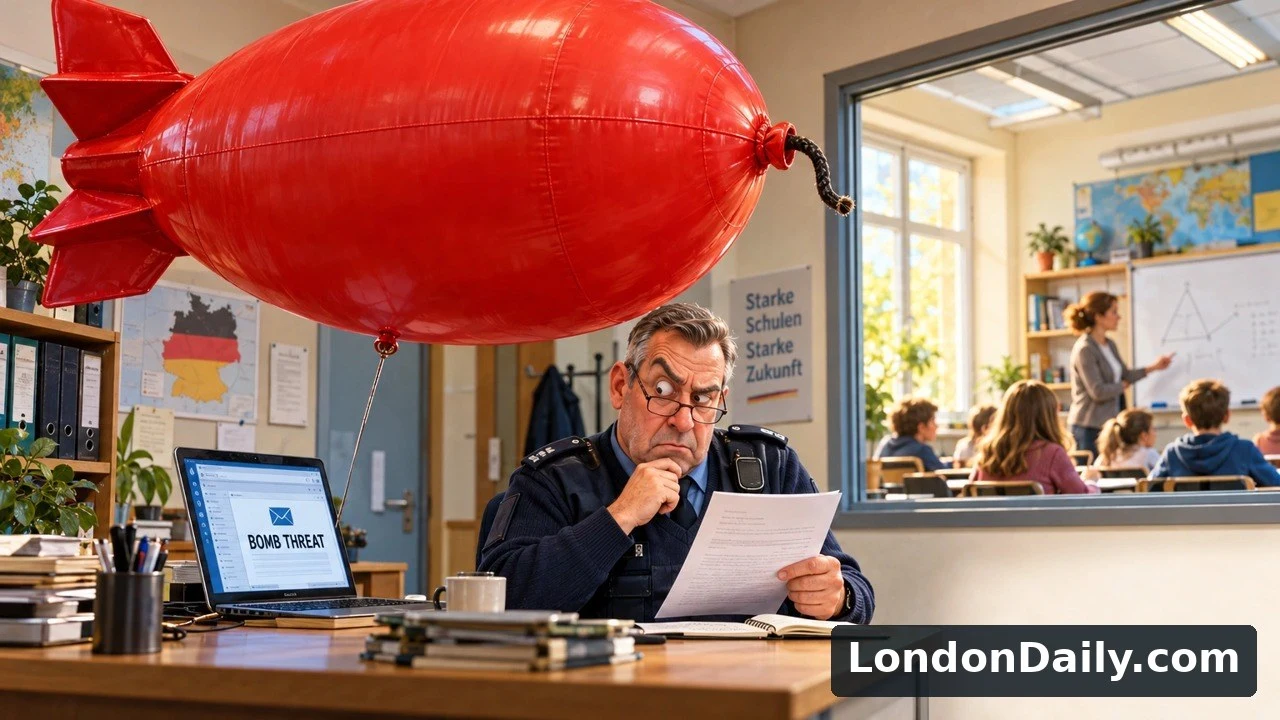
Hundreds of schools in Germany and Denmark received bomb threat emails on Monday that threatened to impose Sharia law, but German authorities judged the messages likely hoaxes and most schools were not evacuated.
At least 450 German schools received the emails that morning. Danish hospitals and prisons also reportedly received similar threats. No explosions or discoveries of suspicious objects were reported in either country.
The identical or similar messages threatened an explosion within an hour and claimed that another school had already been bombed, killing several people. There were no reports supporting that claim. They predicted the government’s resignation and the imposition of Islamic law, ending with a declaration that God is greatest.
The senders remain unidentified. The religious language does not establish Islamist responsibility; whether others were using it to sow division also remains unresolved.
Some German pupils were sent home, and police checked several schools. In Suhl, Thuringia, a special school was evacuated for about an hour before police gave the all-clear late that morning, having found no bomb. Saxony’s authorities said the emails came from two addresses described as originating in Denmark and India. That did not identify those responsible.
The restrained response follows repeated false alarms elsewhere. About a week and a half earlier, thousands of Italian schools received threats over two consecutive days, prompting widespread evacuations on the first. Schools in Scotland, Northern Ireland and Ireland avoided evacuation after assessing similar warnings as hoaxes. More than 10 Spanish schools were evacuated following threats last week.
Some Italian emails bore the name Mikhail Andropov, self-described leader of Wilayat Misogynistan, an apparently satirical alias combining Islamic terminology with misogyny. The purported sender had also claimed responsibility for threats against newsrooms in Ireland and Bulgaria earlier this month. This does not establish responsibility for Monday’s emails.
The threats coincide with concern about hybrid warfare: cyberattacks, intimidation and disruption intended to undermine security and daily life without necessarily using military force. Recent incidents have affected aircraft, railway stations, media organisations, supermarket refrigeration systems and blood banks.
Some European security officials suspect Russia of a broader disruption campaign against countries supporting Ukraine. No evidence of Russian involvement in the school threats has been reported. The Kremlin denies involvement in such operations and accuses the West of seeking to discredit Russia.
Separately, France this month accused Iran of attacking refrigeration systems at hundreds of supermarkets and summoned its ambassador; Tehran denied the accusation. Italian foreign minister Antonio Tajani blamed pro-Russian hackers after his personal information appeared on the dark web. Neither allegation establishes who sent the school threats.








Join the conversation