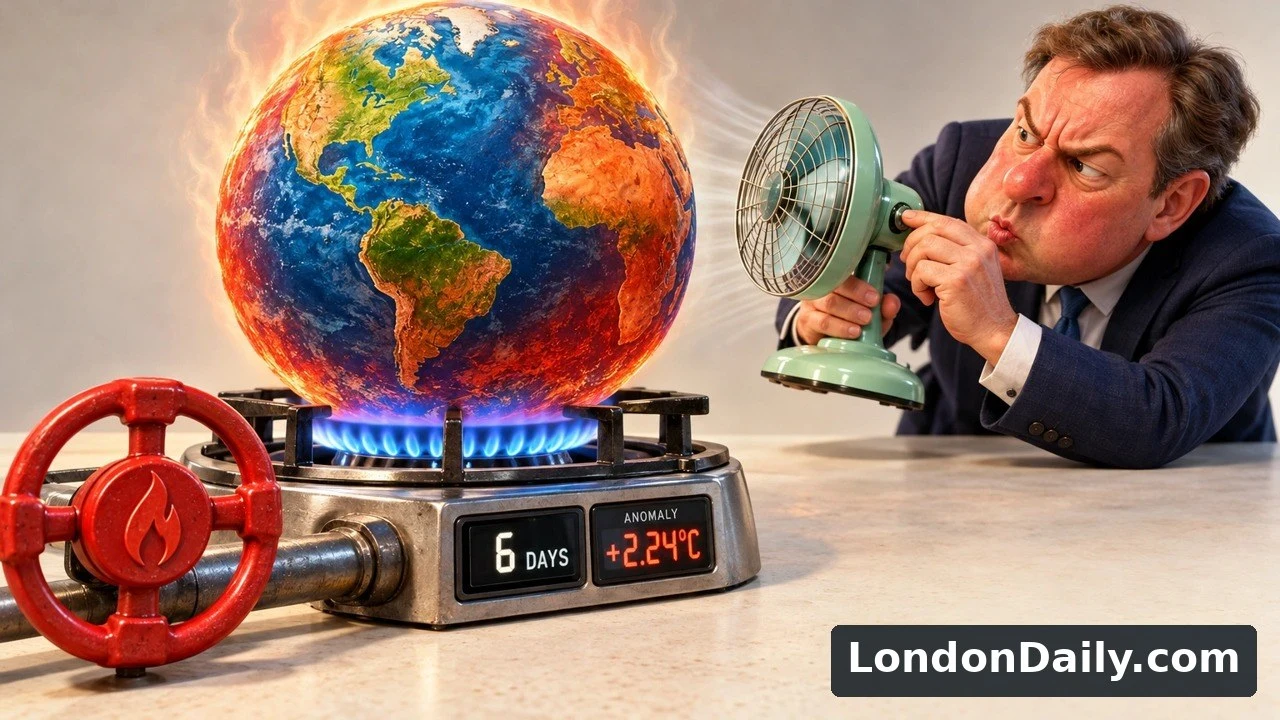
Global surface temperatures have remained at least 2C above pre-industrial levels for six consecutive days for the first time, reaching a record 2.24C above the baseline on Monday, the latest day with available data.
The spell is continuing, with similarly high readings forecast for several more days. It is too brief to constitute a breach of the Paris agreement’s long-term temperature limit, but scientists warn it offers an indication of conditions ahead unless fossil fuel emissions are rapidly eliminated. Whether global heating is accelerating remains a growing scientific concern, rather than a conclusion established by this spell alone.
“This is an exceptional global temperature anomaly,” said Samantha Burgess, strategic lead for climate at the Copernicus Climate Change Service. Daily temperatures previously exceeded 2C above pre-industrial levels in November 2023 and February 2024, but neither episode lasted as long or reached as high. Berkeley Earth researcher Zeke Hausfather said the previous record, 2.05C above the 1850–1900 baseline in 2023, had been “smashed”.
Human-caused warming from burning fossil fuels is combining with an unusually large El Niño. Scientists expect it to peak between now and January, with its full effect arriving months later. Burgess said the last El Niño of comparable scale, in the 1870s, caused famine that killed 50 million people.
Heat is also weakening natural carbon absorption. Droughts and fires are affecting Indonesia’s tropical rainforests and the Amazon; drought-stressed ecosystems grow less vigorously and remove less carbon from the atmosphere.
Richard Betts, head of climate impacts research at the Met Office Hadley Centre, predicts atmospheric carbon dioxide will rise by about 3.5 parts per million from this year to next. That is a third faster than in recent years and nearly twice the increase compatible with being on track to limit warming to 1.5C. This feedback amplifies the accumulation caused by fossil fuel burning.
Almost 200 countries signed the 2015 Paris agreement, pledging to pursue efforts to limit warming to 1.5C and keep it well below 2C. Following the failure of this month’s Cop31 talks in Antalya, Turkey, UN secretary general António Guterres warned of accelerating heating.
The human consequences are already severe: this year’s record summer heat killed more than 50,000 people in the EU and 5,000 in the UK. Burgess described melting roads, buckling railway lines, school closures and overwhelmed hospitals, arguing that governments must both adapt infrastructure and accelerate emissions cuts.
Betts warned that forest-fire smoke threatens health, damaged ecosystems face further pressure, and food and water supplies may be at risk. Preparing for heat cannot, in the scientists’ assessment, substitute for stopping the emissions that intensify it.








Join the conversation