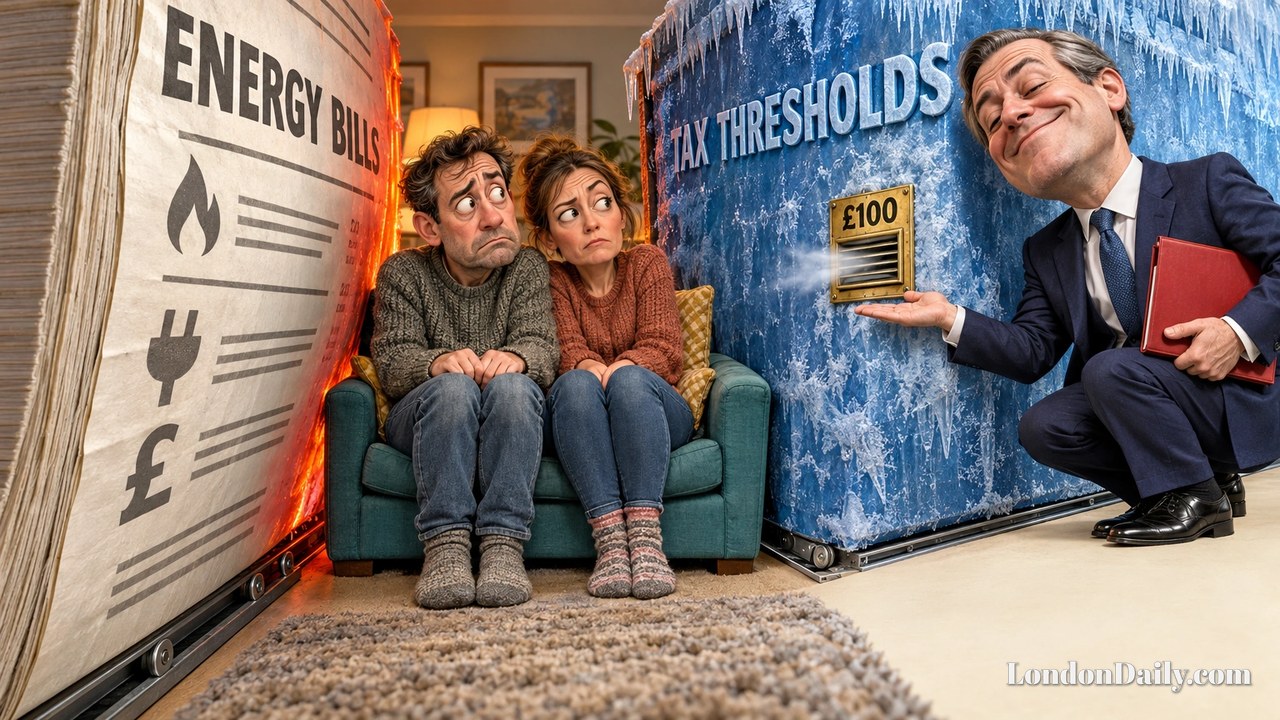
Typical working-age households face a £1,050 fall in disposable income by 2029, according to the Resolution Foundation, as higher energy costs and frozen tax thresholds threaten to outweigh the government’s Budget support.
The projected 3% decline comes as the Institute for Fiscal Studies (IFS) warns that this decade is on course to record the weakest household income growth on record. Chancellor John Healey says his measures offer “breathing space”, while acknowledging that government cannot entirely remove cost-of-living pressures.
Around 20 million households will receive a £100 payment, with eligibility determined by council tax band. The Resolution Foundation argues that support should have been concentrated more heavily on the poorest households. Its analysis suggests that, even after government help, households will face higher energy bills than during the 2022 energy crisis.
The foundation’s chief executive, Ruth Curtice, described a parliament of contrasting halves: rising living standards, solid growth and additional public-service funding initially, followed by a much harder period. She called the Budget “scattergun” and insufficient for the challenges ahead.
Across the parliament, the foundation expects non-pensioner household incomes, after taxes, benefits and housing costs, to rise by just £600, with those gains already behind them.
The Office for Budget Responsibility (OBR) attributes the difficult outlook to higher borrowing costs and inflation caused by the US-Iran war. It forecasts GDP growth slowing from 1.2% in 2026 to 1% in 2027, a sharp downgrade for next year from its March assessment. Its 2027 inflation forecast has risen from 2% to 3.4%. Frozen tax thresholds are also squeezing take-home pay.
These projections carry substantial uncertainty: the OBR says inflation could prove significantly higher or lower. Its living-standards measure also differs from the foundation’s, covering all households, including pensioners, and using a rolling ten-year average. It projects annual growth of less than 0.1% by the decade’s end.
IFS director Helen Miller called the outlook “depressing”, arguing that temporary support cannot substitute for a stronger economy. She also questioned whether extremely tight spending plans would be delivered, warning that they underpin the government’s borrowing-reduction plans. Her impression was that Healey hoped economic improvement would ease those decisions.
Healey said international “economic storms”, including the Iran war and Russia’s invasion of Ukraine, were affecting countries worldwide and that ministers were helping where possible.
Conservative shadow chancellor Andrew Griffith argued that reduced fiscal headroom had made the public finances “more fragile”. Liberal Democrat leader Ed Davey said many would regard the £100 payment as the Budget’s best measure, but that it was inadequate alongside what he called “stealth tax rises” reducing take-home pay.








Join the conversation