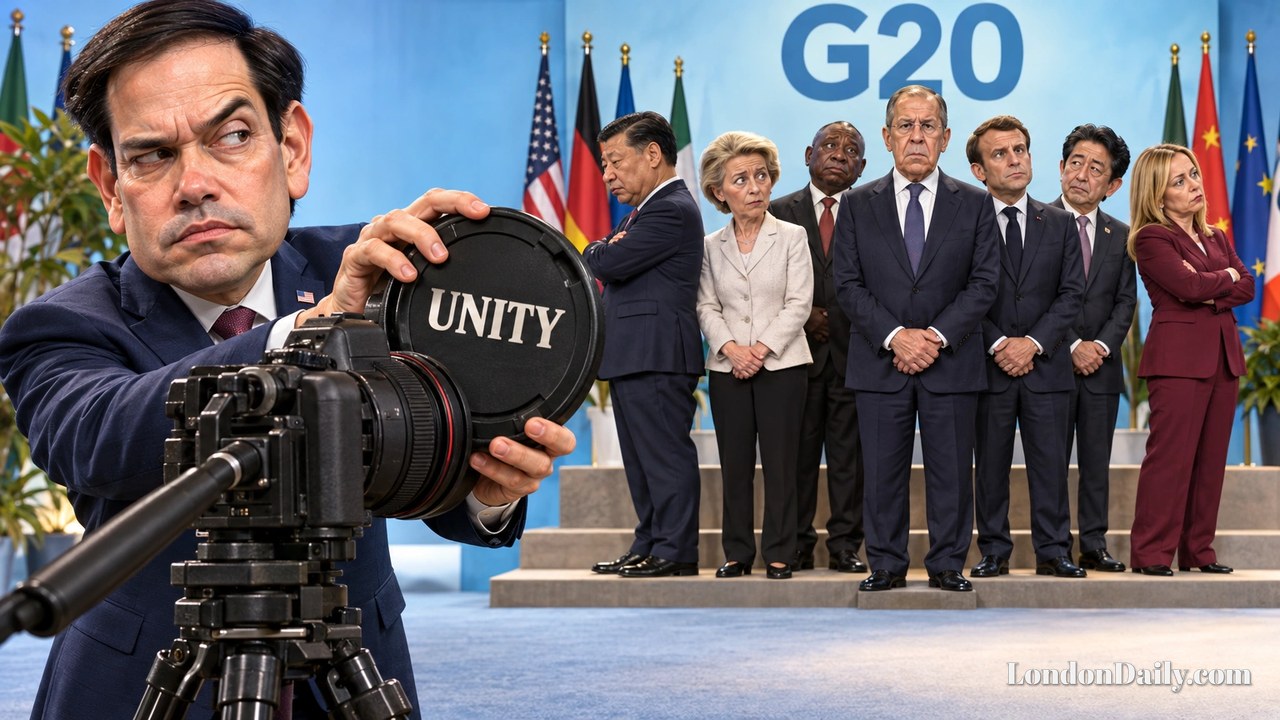
The United States cancelled the traditional group photograph at the G20 foreign ministers’ meeting in Atlanta after about a third of participating countries indicated they would not appear alongside Russian representatives, exposing divisions that participants said could also prevent a joint communiqué.
US secretary of state Marco Rubio abandoned the photograph after Australia, the UK and several European delegations threatened a boycott or walkout over Russian foreign minister Sergei Lavrov’s presence. He nevertheless opened the talks by urging unity over threats to international security and trade.
“We are in a critical moment,” Rubio said. “We are facing a series of interconnected economic and geopolitical crises.”
European Union countries had ruled out joining the photograph. Germany’s foreign minister, Johann Wadephul, said there could be no such appearance with Lavrov because “there is no normality with Russia”. Ed Miliband, identified as the UK foreign secretary, said Britain had not engaged with Russia in that way for years.
Australia’s foreign minister, Penny Wong, condemned Russia’s invasion of Ukraine during the opening session, with Lavrov present. She said the war was brutal and unjustified, had disrupted international markets and had worsened global food security. Her spokesperson backed the cancellation, saying Australia would not normalise the invasion while remaining focused on the G20’s economic work.
The dispute comes amid the Trump administration’s efforts to reintegrate Russia and President Vladimir Putin into international diplomacy despite the continuing war. Diplomats described the opening session as cordial but said Russia remained unyielding on Ukraine and opposed Poland joining the G20.
Participants said those disagreements, alongside objections to Washington’s exclusion of South Africa, would probably prevent a joint communiqué when the meetings ended on Saturday. Polish deputy prime minister and foreign minister Radosław Sikorski, attending his country’s first G20 meeting as a guest, said agreeing a common position was difficult with participants in wars around the table.
The invitation policy added another point of contention. US officials said Ukraine’s exclusion reflected a deliberate decision to invite only formal members, yet Poland attended as a non-member seeking membership with US support. South Africa, a founding member and the group’s only African country, was not invited.
South Africa has several bitter disputes with the Trump administration. Trump and Rubio shunned its meetings when it chaired the G20 last year. Ministerial spokesperson Phindile Kunene said its absence was not voluntary.
Despite these divisions, participants speaking anonymously because the talks were closed said all had agreed to try to make next month’s leaders’ summit, hosted by President Donald Trump in Florida, a success.








Join the conversation