London Daily

Focus on the big picture.
Wednesday, Jun 10, 2026

UK living standards squeeze will intensify as real pay plunges

UK living standards squeeze will intensify as real pay plunges

Analysis: Rising inflation likely to lead to more strikes and falling spending unless government acts

Forget talk of a return to the inflationary spirals of the 1970s. The real story of Britain’s labour market is of an intensifying squeeze on living standards as the gap between pay and the cost of living widens.

Real regular pay – wages adjusted for prices once bonus payments have been stripped out – were 2.8% lower in the three months to May than in the same period of 2021. Not only was that the sixth monthly decline in a row, it was the biggest drop since modern records began in 2001.

What’s more, there is worse to come as inflation heads higher over the coming months. Pay growth excluding bonuses picked up slightly from 4.2% to 4.3% according to the latest Office for National Statistics data but nowhere near fast enough to keep up with price increases. If the Bank of England is right and inflation peaks above 11% after energy bills rise again in the autumn, the pressure on household budgets will be enormous.
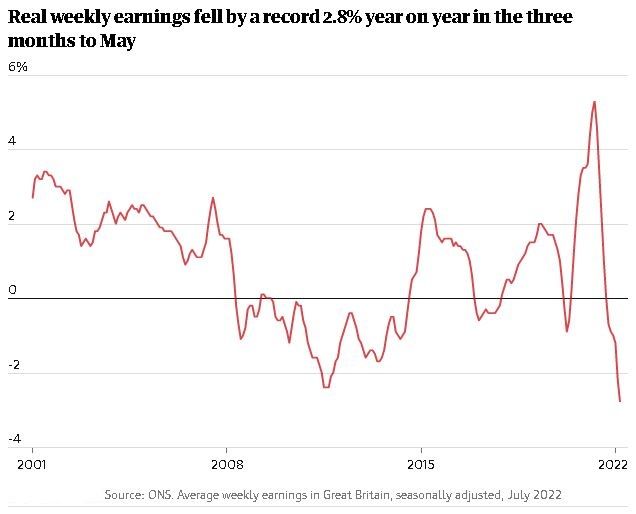

Including bonuses, the picture is a bit brighter. Here the fall in real pay is smaller – at 0.9% – but the benefits of bonuses have been skewed towards better-paid workers in the finance and business services sectors and construction. These groups enjoyed annual total pay growth of 8.2% and 8.1% respectively, enough to keep pace with price rises.

But not all workers can rely on bonuses to top up their pay packets. Real earnings are falling particularly rapidly in the public sector, where total pay was just 1.5% higher in the three months to May than it was a year earlier.

The ONS labour market figures show a decline in inactivity as people return to the workforce in search of jobs. This is not entirely surprising: job vacancies are at record levels and households need paid employment when they are struggling to pay the bills.

Two big conclusions can be drawn from the latest data. The first is that there will be trouble ahead unless the government responds to the falling living standards of teachers, nurses, civil servants and other groups of public sector workers. This will mean either people leaving the public sector or strikes, and probably both.

The second is that the economy is rapidly reaching crunch point. If average regular pay is rising by just over 4% and annual inflation is running well above 10%, something has to give. That something will be consumer spending, with the lowest-paid and most vulnerable workers suffering most.


Newsletter

Related Articles

0:00
0:00
Close
Farmers Warn of Crop Losses Following Months of Unseasonal Rainfall
Civil Aviation Authority Launches Review of Regional Airport Operations
Met Office Issues Heat-Health Alert Across Parts of England
National Grid Introduces New Measures to Protect Winter Energy Supply
Northern England Rail Upgrades Receive Additional Government Funding
Wales Advances Green Hydrogen Strategy to Decarbonize Heavy Industry
UK Expands Recruitment Incentives to Address Shortage of STEM Teachers
High Court Opens Door to Climate Liability Claims Against Major Industrial Emitters
Police Service of Northern Ireland Investigates Major Personnel Data Breach
Defense Ministry Overhauls Procurement System to Accelerate AUKUS Submarine Program
Net Migration Remains Above Government Expectations, New Data Shows
UK and Scottish Governments Agree Framework for Expanded North Sea Wind Development
UK Treasury Launches New Tax Incentives to Boost AI and Semiconductor Investment
Bank of England Signals Continued Caution on Interest Rate Cuts
UK Unveils £10 Billion NHS Digital Modernization Plan Centered on AI Integration
Nebius Opens Major Robotics and Physical AI Laboratory in London
Bank of England Data Shows Strong Rise in New Mortgage Approvals
Network Rail Completes Landmark Upgrade of Severn Tunnel Rail Infrastructure
East West Rail Passenger Services Between Oxford and Milton Keynes Set for December Launch
GlaxoSmithKline Reportedly Pursues £7 Billion Acquisition of US Cancer Drug Developer Nuvalent
Bank of England Signals Interest Rates Likely to Remain Unchanged Despite Energy Market Risks
NHS Trusts Launch Job-Cutting Programmes as Financial Pressures Intensify Across England
More Than 130 Labour MPs Urge Ban on Trade With Israeli Settlements
Keir Starmer Orders Technology Firms to Introduce Smartphone Nudity Controls for Under-18s
UK Unveils £400 Million National AI Supercomputer Fund and New Economics Institute
Japanese Technology Firm Fujitsu Launches Advanced Artificial Intelligence Tool for Corporate Disclosures
South Africa Officially Launches Nationwide Campaign for Highly Contested Local Government Elections
United Kingdom Commits Additional Funding for Unexploded Ordnance Clearance in Laos
Singapore Announces Stringent New Greenhouse Gas Regulations for Commercial Cooling Systems
Cambodia and Thailand Hold High-Level Border Security Talks at United Nations Headquarters
Myanmar Military Government and China Sign Major Agreement to Upgrade Media and Cultural Cooperation
Knife Attack at Swiss Train Station Leaves Three Injured in Suspected Act of Domestic Terrorism
Transnational Extortion Gang Threatens Canadian Police With Army of One Thousand Armed Operatives
Australia Imposes Forty-Two-Day Quarantine on Cruise Ship Passengers Following Deadly Hantavirus Outbreak
International Monetary Fund Unlocks Seven Hundred Million United States Dollars for Sri Lanka Following Economic Reforms
Australia Launches Record One Point Four Billion Dollar Lawsuit Against Chemical Giant 3M Over Contamination
China and Canada Foreign Ministers Meet in Ottawa in Effort to Stabilize Strained Diplomatic Ties
Indonesia Demands Urgent United Nations Security Council Reform Amid Escalating Global Conflicts
Extreme Weather Patterns Trigger Severe Drought in Madagascar and Destructive Flooding in East Africa
Indian State of Karnataka Faces Political Upheaval as Chief Minister Siddaramaiah Abruptly Resigns
Philippines and Japan Reaffirm Defense Ties as Crucial for Indo-Pacific Regional Stability
Norway Joins French Nuclear Deterrence Initiative in Major Shift for European Security Architecture
Global Critical Mineral Alliances Expand as Western Nations Move to Counter Chinese Supply Dominance
United States Imposes Fifty Percent Tariffs on Mexican Steel and Aluminum Ahead of Trade Pact Review
European Union and China Head Toward Major Trade Conflict Over Clean Technology Exports
United States Economic Growth Severely Downgraded to One Point Six Percent as Stagflation Fears Mount
World Health Organization Warns Central African Ebola Epidemic is Outpacing Containment Efforts
United States Treasury Department Conditions Sanctions Relief on Reopening of the Strait of Hormuz
Iranian Air Defenses Intercept and Destroy United States Military Drone Over Bushehr Province
Iranian Armed Forces Launch Ballistic Missiles Toward Unspecified Targets Prompting Regional Condemnation
×