

Spain eases Covid entry rules for UK travellers
The Spanish government confirmed that non-vaccinated travellers from outside the EU can enter the country from Saturday.
Fully vaccinated passengers will still need to show proof of vaccination.
The UK removed all its remaining international Covid travel restrictions for entry on 18 March.
This included passenger locator forms and tests for passengers who do not qualify as vaccinated.
Other European countries followed suit, with Austria, Greece, Switzerland, Bulgaria, Croatia, Lithuania, Sweden, Serbia, Slovenia and Slovakia no longer having any Covid travel restrictions for visitors.
Previously, heightened restrictions meant UK travellers were only allowed to enter Spain with vaccine certification or proof of recovery from the virus.
As the latest wave of that strain dissipated, countries across the world loosened their Covid travel restrictions to welcome visitors again.
And on Saturday, Spanish tourism minister Reyes Maroto said the "new phase of the pandemic" meant the country was able to relax the rules by equating non-EU travellers with those of the EU and Schengen-associated countries.
"This is excellent news, much awaited by the tourism sector," said Ms Maroto, adding: "Spain is becoming one of the most desired destinations in the world."
Analysis by Simon Browning, BBC business reporter
We love Spain.
Mallorca, Marbella and Madrid are some of our holiday favourites.
In 2019, 18 million visitors from the UK arrived at Spanish airports - and the Spanish want to see the same numbers hitting their beaches again this year.
Demand is high for holiday destinations across Europe, with airlines and tour operators reporting surges for summer sun bookings almost everywhere.
But Spain wants to retain its crown as Britain's favourite, and to do that it has to be open to everyone. That's why they've followed European holiday rivals and started allowing unvaccinated travellers - with a negative test - from today.
More holidaymakers means more euros arriving and that's good for the Spanish economy, where tourism is crucial.
From 21 May, all visitors entering Spain at air or sea borders, wherever they are travelling from, must provide one of the following three certificates:
* Vaccination certificate meeting the government's requirements
* A negative test certificate (PCR or similar)
* Certificate of recovery at least 11 days after testing positive
Spain accepts the UK's proof of Covid-19 vaccination record, either digitally, or as a printed download.
PCR tests must be carried out in the 72 hours prior to departure to Spain or an antigen test in the 24 hours prior to departure.
Proof of recovery certificates will be valid for 180 days from the date of the positive test.
Children under the age of 12 are exempt from submitting any type of certificate.
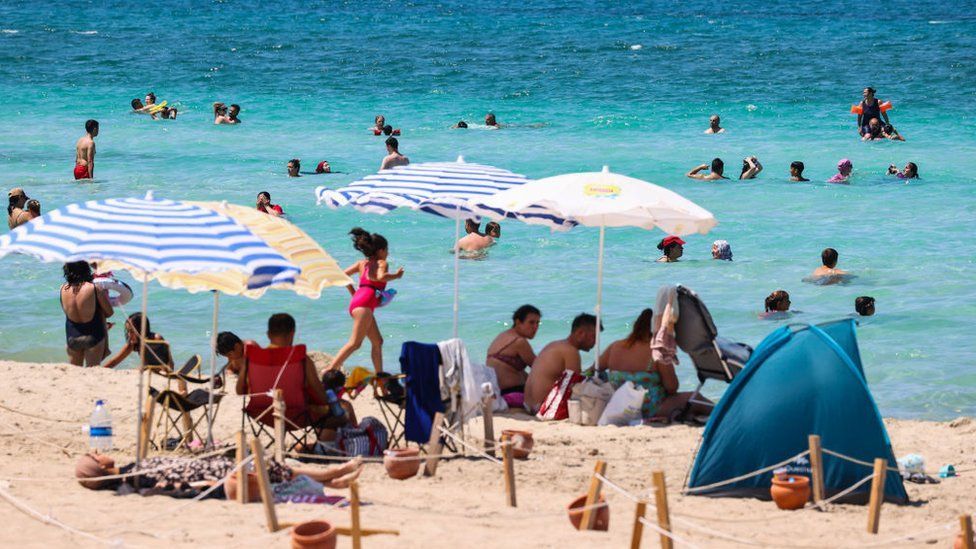 Abta says this summer is expected to be the busiest holiday season since the Covid pandemic began
Julia Lo Bue-Said from the Advantage Travel Partnership, an independent travel agent group, said: "This is very good news just ahead of the May half-term and peak season."
Describing it as "extremely positive" for holidaymakers and the travel industry, she added: "However, it is disappointing that Spain has not gone further and removed the need for pre-arrival tests for unvaccinated travellers given the minimal benefit these tests have for public health.
"Consumers want to travel with ease and if destinations prohibit this, then they will go elsewhere."
The Association of British Travel Agents (Abta) said the relaxation of the rules was great news as Spain is the most popular summer holiday destination for Britons.
The travel industry trade body said: "This summer is expected to be the busiest holiday season since the start of the pandemic, with 70% of families saying they have a holiday abroad booked this year."
Abta said that France, Italy, Greece and Portugal were also proving popular. While Greece has scrapped all Covid travel restrictions, the other three countries still require visitors to meet certain entry rules.
Travellers either need proof of vaccination or to have taken a negative test before leaving the UK, while Italy and Portugal will also accept a Covid recovery certificate.

