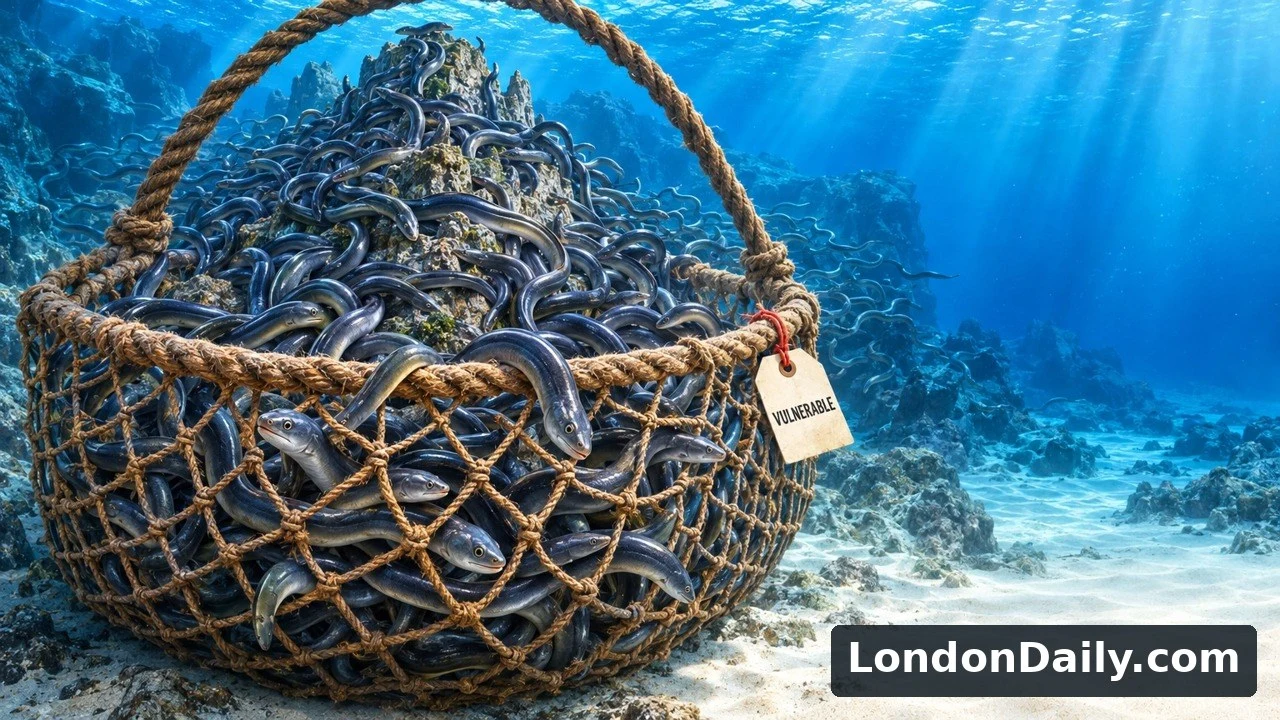
An estimated 2.8 million basketwork eels gather each year at an underwater mountain south of Tasmania, apparently to breed, a study has found. Together, they weigh nearly 3.5 million kilograms.
The dense concentration at Patience Seamount, within Huon Marine Park, occupies an area roughly two by three kilometres across, about 1,000 metres below the surface. Eels gather there for almost 10 months each year, with numbers peaking between March and May before dispersal in October.
Australia’s national science agency, CSIRO, surveyed the site between 2023 and 2025 using hydro-acoustic equipment, which sends sound waves into the water and measures their echoes. The study, published in Royal Society Open Science on 28 October 2026, provides the first count of the gathering. Its estimate far exceeds the tens of thousands suggested for April 2015; that difference does not, by itself, establish population growth.
The evidence for a breeding gathering comes partly from eels caught at the site. All those examined had empty stomachs, while most females were close to spawning, or laying eggs. This suggests the animals may stop eating as they prepare to congregate. Earlier catches also found males and females in peak spawning condition.
Known scientifically as Diastobranchus capensis, these scavenging eels occur along the southern coasts of Australia and Africa. Their repeated gatherings at the same ridge at Patience Seamount have been recorded since the 1980s.
Molly Fowkes, who researches eel behaviour at Lancaster University, suggested a possible parallel with European eels. Those fish are catadromous: they mature in continental waters before travelling thousands of kilometres across the Atlantic towards their presumed spawning grounds in the Sargasso Sea. Basketwork eels may similarly return to a particularly suitable breeding site, she said, although what attracts them and how they co-ordinate remains unresolved.
Such an immense gathering is not evidence that the species is secure. The International Union for Conservation of Nature’s Red List classifies basketwork eels as vulnerable, with accidental fishing catches causing significant population declines. Populations on New Zealand’s slopes have fallen by 85% over the past 40 years. Millions concentrated in one place can coexist with a species in decline.








Join the conversation