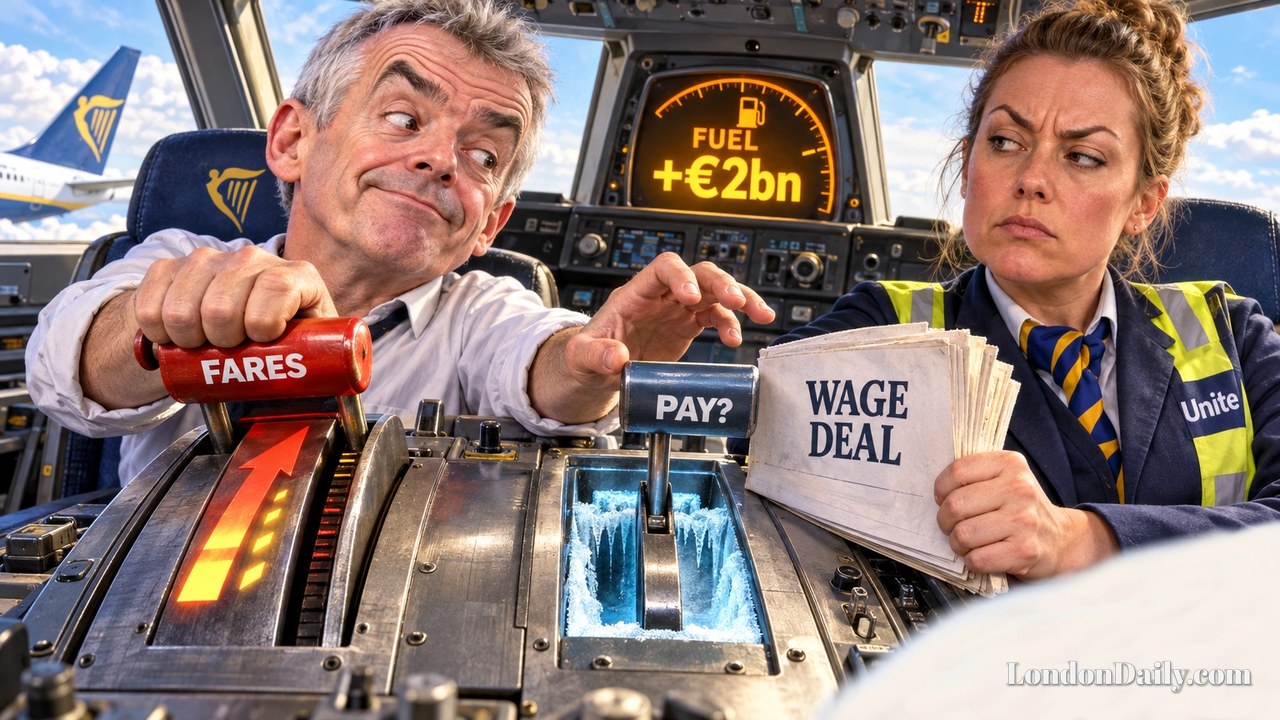
Ryanair is considering freezing staff pay alongside double-digit fare rises as it faces a forecast €2bn (£1.6bn) increase in its short-term fuel bill. Unite says its existing wage agreement covers next year and must be honoured, regardless of the airline’s performance.
The company said fares would be “materially higher” next summer following the sharp rise in aviation fuel costs caused by the US-Israel war with Iran. It expects fuel prices to remain elevated “well into 2027” unless the conflict reaches a swift resolution.
Chief executive Michael O’Leary reiterated his earlier estimate that Ryanair would need a 20% fare increase to cover jet fuel costs, while questioning whether that would be achievable.
“I'm not sure we'll get to 20%,” he said. “But we're certainly looking at double-digit fare increases across Europe from all airlines in 2027.”
That is O’Leary’s forecast for the industry, rather than an announced pricing decision by other carriers. Ryanair itself says higher fares are unlikely to absorb the full increase in costs, prompting consideration of a temporary wage freeze as multi-year union agreements expire. The policy could begin in April next year.
Unite’s national officer, Oliver Richardson, said the union had not been advised of any such proposals. He said its multi-year agreement covered next year, as did agreements held by several other unions across Europe.
“Our pay agreement was not attached to, nor dependent on company performance,” Richardson said, adding that the union expected it to be honoured. The immediate dispute therefore concerns not only who bears the higher costs, but which existing pay commitments remain in force.
Ryanair’s pre-tax profits fell 16% to €2.4bn in the six months to the end of September, largely because fuel costs rose 15%. Although 80% of its fuel bill was hedged, effectively bought in advance at fixed prices, the remainder remained expensive.
The war has sharply reduced supplies of refined products from the Gulf, increasing competition for supplies elsewhere. O’Leary said hiring would slow, while Ryanair plans greater use of artificial intelligence in back-office and support functions.
The airline has already reduced winter flights and said on Monday that further cuts would follow. It said reductions were occurring across the industry, particularly among short-haul carriers. O’Leary expects cuts to continue into summer 2027 and short-haul capacity to remain constrained into the early 2030s, potentially leaving passengers facing both higher fares and fewer available flights.








Join the conversation